
Skip to main content Accessibility help
×
  • Cited by 3
    • Show more authors
    • You may already have access via personal or institutional login
    • Select format
    • Publisher:
      Cambridge University Press
      Publication date:
      21 January 2021
      11 February 2021
      ISBN:
      9781108903318
      9781108842440
      Dimensions:
      (244 x 170 mm)
      Weight & Pages:
      0.9kg, 396 Pages
      Dimensions:
      Weight & Pages:
    You may already have access via personal or institutional login
  • Selected: Digital
    Add to cart View cart Buy from Cambridge.org

    Book description

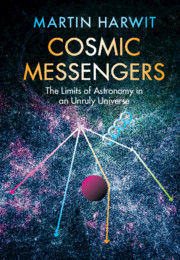
    Martin Harwit, author of the influential book Cosmic Discovery, asks key questions about the scope of observational astronomy. Humans have long sought to understand the world we inhabit. Recent realization of how our unruly Universe distorts information before it ever reaches us reveals distinct limits on how well we will ultimately understand the Cosmos. Even the best instruments we might conceive will inevitably be thwarted by ever more complex distortions and will never untangle the data completely. Observational astronomy, and the cost of pursuing it, will then have reached an inherent end. Only some totally different lines of approach, as yet unknown and potentially far more costly, might then need to emerge if we wish to learn more. This accessible book is written for all astronomers, astrophysicists, and those curious about how well we will ever understand the Universe and the potential costs of pushing those limits.

    Reviews

    ‘A fitting conclusion, and perhaps the most provocative of Martin Harwit’s trilogy, Cosmic Discovery, In Search of the True Universe, and now Cosmic Messengers, which discusses the limitations of what we can learn about the universe from observational astronomy, and the implications for the future of observational astronomy and society.’

    Lennard A. Fisk - Thomas M. Donahue Distinguished University Professor of Space Science, University of Michigan

    ‘This brilliant work by the distinguished astrophysicist - and philosophy-of-science theoretician - Martin Harwit brings forward a uniquely synthesized view of astronomy and astrophysics, and how we got to be where we are in understanding the Universe. This magnum opus is a fascinating book that should be read by all astrophysicists and held by all libraries.’

    Jay M. Pasachoff - Field Memorial Professor of Astronomy, Williams College, Massachusetts

    ‘… this is an interesting and challenging book.’

    Robert Connon Smith Source: The Observatory magazine

    'I am not aware of a better 36-page introduction to cosmology. … the book is interesting and informative.'

    William L. Vanderburgh Source: Metascience

    ‘Cosmic Messengers should be of interest to a wide audience of astronomers, other scientists, historians of science, government agency planners, and anyone who wants to see the fruits of curiosity- driven research. It will also be a valuable resource to students and others aiming to place their research into a much larger context.’

    James Moran Source: Physics Today

    Refine List

    Actions for selected content:

    Select all | Deselect all
    • View selected items
    • Export citations
    • Download PDF (zip)
    • Save to Kindle
    • Save to Dropbox
    • Save to Google Drive

    Save Search

    You can save your searches here and later view and run them again in "My saved searches".

    Please provide a title, maximum of 40 characters.
    ×

    Contents

    • 1 - Instruments, Messengers, Astrophysics, and Cosmochemistry
      pp 3-38

    Metrics

    Full text views

    Total number of HTML views: 0
    Total number of PDF views: 0 *
    Loading metrics...

    Book summary page views

    Total views: 0 *
    Loading metrics...

    * Views captured on Cambridge Core between #date#. This data will be updated every 24 hours.

    Usage data cannot currently be displayed.

    Accessibility standard: Unknown

    Why this information is here

    This section outlines the accessibility features of this content - including support for screen readers, full keyboard navigation and high-contrast display options. This may not be relevant for you.

    Accessibility Information

    Accessibility compliance for the PDF of this book is currently unknown and may be updated in the future.
