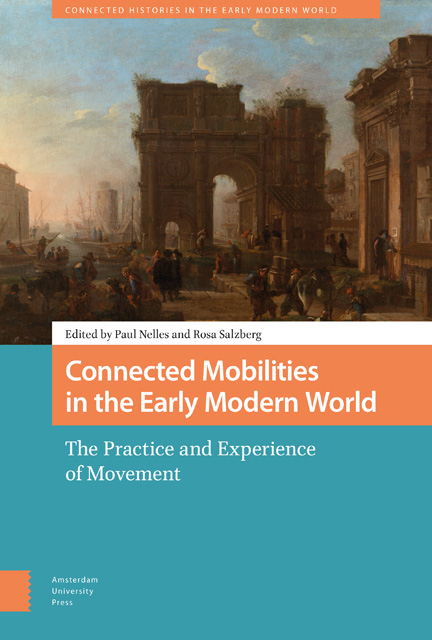
Connected Mobilities in the Early Modern World

-
The digital format of this book is no longer available to purchase from Cambridge Core. Other formats may be available.
-
Select format
-
- Publisher:
- Amsterdam University Press
- Publication date:
- Invalid date
- December 2022
- ISBN:
- 9789463729239
- Dimensions:
- Weight & Pages:
- Dimensions:
- Weight & Pages:
You may already have access via personal or institutional login
Show more authors 
You may already have access via personal or institutional login
Book description
This book offers a panorama of movement, mobility, and exchange in the early modern world. While the pre-modern centuries have long been portrayed as static and self-contained, it is now acknowledged that Europe from the Middle Ages onwards saw increasing flows of people and goods. Movement also connected the continent more closely to other parts of the world. The present work challenges dominant notions of the 'fixed,' immobile nature of pre-modern cultures through study of the inter-connected material, social, and cultural dimensions of mobility. The case studies presented here chart the technologies and practices that both facilitated and impeded movement in diverse spheres of social activity such as communication, transport, politics, religion, medicine, and architecture. The chapters underscore the importance of the movement of people and objects through space and across distance to the dynamic economic, political, and cultural life of the early modern period.
Contents
Contents
Metrics
Full text views
Full text views helpTotal number of HTML views: 0
Total number of PDF views: 0 *
 Loading metrics...
* Views captured on Cambridge Core between #date#. This data will be updated every 24 hours.
Usage data cannot currently be displayed.
Accessibility standard: Unknown
Why this information is here
This section outlines the accessibility features of this content - including support for screen readers, full keyboard navigation and high-contrast display options. This may not be relevant for you.
Accessibility Information
Accessibility compliance for the PDF of this book is currently unknown and may be updated in the future.