
Skip to main content Accessibility help
×
  • Cited by 2
    • The digital format of this book is no longer available to purchase from Cambridge Core. Other formats may be available.
    • Please contact Liverpool University Press for availability about this product

      https://www.liverpooluniversitypress.co.uk/

    • Show more authors
    • You may already have access via personal or institutional login
    • Select format
    • Publisher:
      Liverpool University Press
      Publication date:
      05 January 2012
      15 July 2009
      ISBN:
      9781846315220
      9781846311956
      Dimensions:
      Weight & Pages:
      00kg,
      Dimensions:
      Weight & Pages:
    You may already have access via personal or institutional login
    Selected: Digital
    Add to cart View cart Buy from Cambridge.org

    Book description

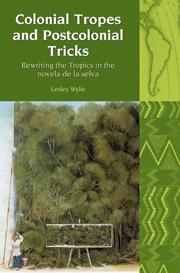
    The vision of the South American rainforest as a wilderness of rank decay, poisonous insects, and bloodthirsty ‘savages’ in the Spanish American novela de la selva has often been interpreted as a belated imitation of European travel literature. This book offers a new reading of the genre by arguing that, far from being derivative, the novela de la selva re-imagined the tropics from a Latin American perspective, redefining tropical landscape aesthetics and ethnography through parodic rewritings of European perceptions of Amazonia in fictional and factual travel writing. With particular reference to the four emblematic novels of the genre – W. H. Hudson’s Green Mansions [1904], José Eustasio Rivera’s La vorágine [1924], Rómulo Gallegos’s Canaima [1935], and Alejo Carpentier’s Los pasos perdidos [1953] – the book explores how writers throughout post-independence Latin America turned to the jungle as a locus for the contestation of both national and literary identity, harnessing the superabundant tropical vegetation and native myths and customs to forge a descriptive vocabulary which emphatically departed from the reductive categories of European travel writing. Despite being one of the most significant examples of postcolonial literature to emerge from Latin America in the twentieth century, the novela de la selva has, to date, received little critical attention: this book returns a seminal genre of Latin American literature to the centre of contemporary debates about postcolonial identity, travel writing, and imperial landscape aesthetics.

    Refine List

    Actions for selected content:

    Select all | Deselect all
    • View selected items
    • Export citations
    • Download PDF (zip)
    • Save to Kindle
    • Save to Dropbox
    • Save to Google Drive

    Save Search

    You can save your searches here and later view and run them again in "My saved searches".

    Please provide a title, maximum of 40 characters.
    ×

    Contents

    Metrics

    Full text views

    Total number of HTML views: 0
    Total number of PDF views: 0 *
    Loading metrics...

    Book summary page views

    Total views: 0 *
    Loading metrics...

    * Views captured on Cambridge Core between #date#. This data will be updated every 24 hours.

    Usage data cannot currently be displayed.

    Accessibility standard: Unknown

    Why this information is here

    This section outlines the accessibility features of this content - including support for screen readers, full keyboard navigation and high-contrast display options. This may not be relevant for you.

    Accessibility Information

    Accessibility compliance for the PDF of this book is currently unknown and may be updated in the future.
