
Skip to main content Accessibility help
×
  • Cited by 1356
    • Show more authors
    • You may already have access via personal or institutional login
    • Select format
    • Publisher:
      Cambridge University Press
      Publication date:
      June 2012
      January 2004
      ISBN:
      9780511803864
      9780521661140
      9780521667708
      Dimensions:
      (228 x 152 mm)
      Weight & Pages:
      0.716kg, 376 Pages
      Dimensions:
      (228 x 152 mm)
      Weight & Pages:
      0.622kg, 374 Pages
    You may already have access via personal or institutional login
  • Selected: Digital
    Add to cart View cart Buy from Cambridge.org

    Book description

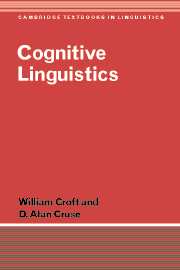
    Cognitive Linguistics argues that language is governed by general cognitive principles, rather than by a special-purpose language module. This introductory textbook surveys the field of cognitive linguistics as a distinct area of study, presenting its theoretical foundations and the arguments supporting it. Clearly organised and accessibly written, it provides a useful introduction to the relationship between language and cognitive processing in the human brain. It covers the main topics likely to be encountered in a course or seminar, and provides a synthesis of study and research in this fast-growing field of linguistics. The authors begin by explaining the conceptual structures and cognitive processes governing linguistic representation and behaviour, and go on to explore cognitive approaches to lexical semantics, as well as syntactic representation and analysis, focusing on the closely related frameworks of cognitive grammar and construction grammar. This much-needed introduction will be welcomed by students in linguistics and cognitive science.

    Refine List

    Actions for selected content:

    Select all | Deselect all
    • View selected items
    • Export citations
    • Download PDF (zip)
    • Save to Kindle
    • Save to Dropbox
    • Save to Google Drive

    Save Search

    You can save your searches here and later view and run them again in "My saved searches".

    Please provide a title, maximum of 40 characters.
    ×

    Contents

    References
    References
    Akmajian, Adrian. 1984. Sentence types and the form-function fit. Natural Language and Linguistic Theory 2:1–23
    Allan, Keith. 1986. Interpreting English comparatives. Journal of Semantics 5:1–50
    Andersen, Henning. 1980. Russian conjugation: acquisition and evolutive change. Papers from the 4th International Conference on Historical Linguistics, ed. Elizabeth Closs Traugott et al., 285–302. Amsterdam: John Benjamins
    Ariel, Mira. 1990. Accessing noun phrase antecedents. New York: Routledge
    Armstrong, Sharon Lee, Gleitman, Lila R. and Gleitman, Henry. 1983. What some concepts might not be. Cognition 13:263–308
    Aronoff, Mark. 1993. Morphology by itself: items and inflectional classes. Cambridge, Mass.: MIT Press
    Atran, Scott. 1990. Cognitive foundations of natural history: towards an anthropology of science. Cambridge: Cambridge University Press
    Barlow, Michael and Suzanne Kemmer (eds.). 2000. Usage-based models of language. Stanford: Center for the Study of Language and Information
    Barsalou, Lawrence W. 1983. Ad hoc categories. Memory and Cognition 11: 211–27
    Barsalou, Lawrence W 1987. The instability of graded structure: implications for the nature of concepts. Concepts and conceptual development: ecological and intellectual factors in categorization, ed. Ulric Neisser, 101–40. Cambridge: Cambridge University Press
    Barsalou, Lawrence W 1992a. Frames, concepts, and conceptual fields. Frames, fields and contrasts: new essays in semantic and lexical organization, ed. Adrienne Lehrer and Eva Feder Kittay, 21–74. Hillsdale, N. J.: Lawrence Erlbaum Associates
    Barsalou, Lawrence W 1992b. Cognitive psychology: an overview for cognitive scientists. Hillsdale, N. J.: Lawrence Erlbaum Associates
    Becker, Joseph. 1975. The phrasal lexicon. Bolt, Beranek and Newman Report No. 3081, Artificial Intelligence Report No. 28
    Berlin, Brent and Paul Kay. 1969. Basic color terms: their universality and evolution. Berkeley: University of California Press
    Berlin, Brent, Breedlove, Dennis E. and Raven, Peter H.. 1973. General principles of classification and nomenclature in folk biology. American Anthropologist 75:214–42
    Birner, Betty J. and Gregory Ward. 1998. Information status and noncanonical word order in English. (Studies in Language Companion Series, 40.) Amsterdam: John Benjamins
    Black, Max. 1993[1979]. More about metaphor. Metaphor and thought (2nd ed.), ed. Andrew Ortony, 19–41. Cambridge: Cambridge University Press
    Bolinger, Dwight. 1971. The phrasal verb in English. Cambridge, Mass.: Harvard University Press
    Bolinger, Dwight 1980. Language, the loaded weapon. London: Longmans
    Bolinger, Dwight 1992. About furniture and birds. Cognitive Linguistics 3:111–18
    Braine, Martin D. S. 1976. Children's first word combinations. (Monographs of the Society for Research in Child Development 41, no. 1.) Chicago: University of Chicago Press
    Bresnan, Joan (ed.). 1982. The mental representation of grammatical relations. Cambridge, Mass.: MIT Press
    Brown, Cecil H. 2002. Paradigmatic relations of inclusion and identity I: Hyponymy. Lexicology: an international handbook on the nature and structure of words and vocabularies (Handbooks of Linguistics and Communication Science, 21), ed. D. Alan Cruse, Franz Hundsnurscher, Michael Job and Peter Lutzeier, ch. 47. Berlin: Walter de Gruyter
    Brown, Roger. 1958. How shall a thing be called?Psychological Review 65:14–21
    Bybee, Joan L. 1985. Morphology: a study into the relation between meaning and form. Amsterdam: John Benjamins
    Bybee, Joan L. 1995. Regular morphology and the lexicon. Language and Cognitive Processes 10:425–55
    Bybee, Joan L. 2001. Phonology and language use. Cambridge: Cambridge University Press
    Bybee, Joan L. and Brewer, Mary Alexandra. 1980. Explanation in morphophonemics: changes in Provençal and Spanish preterite forms. Lingua 52:271–312
    Bybee, Joan and Paul Hopper. 2001. Frequency and the emergence of linguistic structure. (Typological Studies in Language, 45.) Amsterdam: John Benjamins
    Bybee, Joan L. and Moder, Carol Lynn. 1983. Morphological classes as natural categories. Language 59:251–70
    Bybee, Joan L. and Pardo, Elly. 1981. On lexical and morphological conditioning of alternations: a nonce-probe experiment with Spanish verbs. Linguistics 19:937–68
    Bybee, Joan L. and Scheibman, Joanne. 1999. The effect of usage on degrees of constituency: the reduction of don't in English. Linguistics 37:575–96
    Bybee, Joan L. and Slobin, Dan I.. 1982. Rules and schemas in the development and use of the English past tense. Language 58:265–89
    Bybee, Joan L. and Sandra A. Thompson. 1997. Three frequency effects in syntax. Proceedings of the 23rd Annual Meeting of the Berkeley Linguistics Society, ed. Matthew L. Juge and Jeri O. Moxley, 378–88. Berkeley: Berkeley Linguistics Society
    Chafe, Wallace. 1994. Discourse, consciousness and time: the flow and displacement of conscious experience in speaking and writing. Chicago: University of Chicago Press
    Chafe, Wallace (ed.). 1980. The pear stories. New York: Ablex
    Chomsky, Noam. 1981. Lectures on government and binding. Dordrecht: Foris
    Chomsky, Noam. 1993. A minimalist program for linguistic theory. The view from Building 20, ed. Kenneth Hale and Samuel Jay Keyser, 1–52. Cambridge, Mass.: MIT Press
    Chomsky, Noam. 1995. The minimalist program. Cambridge, Mass.: MIT Press
    Clahsen, Harald and Rothweiler, M.. 1992. Inflectional rules in children's grammar: evidence from the development of participles in German. Yearbook of Morphology 1992, 1–34
    Clark, Eve V. and Clark, Herbert H.. 1979. When nouns surface as verbs. Language 55:767–811
    Clark, Herbert H. 1996. Using language. Cambridge: Cambridge University Press
    Clark, Herbert H. and Susan Haviland. 1977. Comprehension and the given-new contract. Discourse production and comprehension, ed. R. Freedle, 1–40. Norwood, N. J.: Ablex
    Clausner, Timothy C. 1991. Sentence types and salience. University of Michigan working papers in linguistics, ed. William Croft, 1–11. Ann Arbor: Department of Linguistics, University of Michigan
    Clausner, Timothy C. and Croft, William. 1997. The productivity and schematicity of metaphor. Cognitive Science 21:247–82
    Clausner, Timothy C. and William, Croft. 1999. Domains and image-schemas. Cognitive Linguistics 10:1–31
    Coleman, Linda and Kay, Paul. 1981. Prototype semantics. Language 57:26–44
    Collins, Allan M. and Ross Quillian, M.. 1969. Retrieval time from semantic memory. Journal of Verbal Learning and Verbal Behaviour 8:240–47
    Cornwell, Patricia. 2000. Black notice. London: Warner Books
    Coseriu, Eugenio. 1975. Vers une typologie des champs lexicaux. Cahiers de Lexicologie 27:30–51
    Coulson, Seana. 2000. Semantic leaps: frame-shifting and conceptual blending in meaning construction. Cambridge: Cambridge University Press
    Croft, William. 1991. Syntactic categories and grammatical relations: the cognitive organization of information. Chicago: University of Chicago Press
    Croft, William. 1993 [2002]. The role of domains in the interpretation of metaphors and metonymies. Cognitive Linguistics 4:335–70. Revised version printed in Metaphor and metonymy in comparison and contrast, ed. René Dirven and Ralf Pörings, 161–205. Berlin: Mouton de Gruyter, 2002
    Croft, William. 1995. Autonomy and functionalist linguistics. Language 71:490–532
    Croft, William. 1998a. The structure of events and the structure of language. The new psychology of language: cognitive and functional approaches to language structure, ed. Michael Tomasello, 67–92. Mahwah, N. J.: Lawrence Erlbaum Associates
    Croft, William. 1998b. Event structure in argument linking. The projection of arguments: lexical and compositional factors, ed. Miriam Butt and Wilhelm Geuder, 1–43. Stanford: Center for the Study of Language and Information
    Croft, William. 1998c. Linguistic evidence and mental representations. Cognitive Linguistics 9:151–73
    Croft, William. 2000. Explaining language change: an evolutionary approach. London: Longman
    Croft, William. 2001. Radical construction grammar: syntactic theory in typological perspective. Oxford: Oxford University Press
    Croft, William. 2003a. Lexical rules vs. constructions: a false dichotomy. Motivation in language: studies in honour of Günter Radden, ed. Hubert Cuyckens, Thomas Berg, René Dirven and Klaus-Uwe Panther, 49–68. Amsterdam: John Benjamins
    Croft, William. 2003b. Typology and universals (2nd ed.). Cambridge: Cambridge University Press
    Croft, William. 2003b. In preparation. Verbs: aspect and argument structure. Oxford: Oxford University Press
    Croft, William and Esther J. Wood. 2000. Construal operations in linguistics and artificial intelligence. Meaning and cognition: a multidisciplinary approach, ed. Liliana Albertazzi, 51–78. Amsterdam: John Benjamins
    Cruse, D. Alan. 1977. The pragmatics of lexical specificity. Journal of Linguistics 13:153–64
    Cruse, D. Alan 1979. On the transitivity of the part-whole relation. Journal of Linguistics 15:29–38
    Cruse, D. Alan 1986. Lexical semantics. Cambridge: Cambridge University Press
    Cruse, D. Alan 1990. Prototype theory and lexical semantics. Meanings and prototypes: studies in linguistic categorization, ed. Savas L. Tzohatzidis, 382–402. London: Routledge
    Cruse, D. Alan 1992a. Antonymy revisited: some thoughts on the relation between words and concepts. Frames, fields and contrasts: new essays in semantic and lexical organization, ed. Adrienne Lehrer and Eva Feder Kittay, 289–306. Hillsdale, N. J.: Lawrence Erlbaum Associates
    Cruse, D. Alan 1992b. Cognitive linguistics and word meaning: Taylor on linguistic categorization. (Review article on John R. Taylor, Linguistic categorization: prototypes in linguistic theory.)Journal of Linguistics 28:165–83
    Cruse, D. Alan 1994. Prototype theory and lexical relations. Rivista di Linguistica 6:167–88
    Cruse, D. Alan 2000a. Lexical “facets”: between monosemy and polysemy. Sprachspiel und Bedeutung: Festschrift für Franz Hundsnurscher zum 60. Geburtstag, ed. S. Beckmann, P. P. König and T. Wolf, 25–36. Tübingen: Max Niemeyer Verlag
    Cruse, D. Alan 2000b. Aspects of the micro-structure of word meanings. Polysemy: theoretical and computational approaches, ed. Yael Ravin and Claudia Leacock, 30–51. Oxford: Oxford University Press
    Cruse, D. Alan 2002a. Microsenses, default specificity and the semantics-pragmatics boundary. Axiomathes 1:1–20
    Cruse, D. Alan 2002b. Hyponymy and its varieties. The semantics of relationships: an interdisciplinary perspective, ed. Rebecca Green, Carol A. Bean and Sung Hyon Myaeng, 3–21. Dordrecht: Kluwer
    Cruse, D. Alan., Franz Hundsnurscher, Michael Job and Peter Lutzeier (eds.). 2002. Lexicology: an international handbook on the nature and structure of words and vocabularies. (Handbooks of Linguistics and Communication Science, 21.1.) Berlin: Walter de Gruyter
    Cruse, D. Alan and Togia, Pagona. 1995. Towards a cognitive model of antonymy. Lexicology 1:113–41
    Daugherty, K. and Mark Seidenberg. 1992. Rules or connections? The past tense revisited. Proceedings of the 14th Annual Meeting of the Cognitive Science Society 259–64. Hillsdale, N. J.: Erlbaum
    Daugherty, K. and Mark Seidenberg. 1994. Beyond rules and exceptions: a connectionist modeling approach to inflectional morphology. The reality of linguistic rules, ed. Susan D. Lima, R. L. Corrigan and Gregory K. Iverson, 353–88. Amsterdam: John Benjamins
    Deane, Paul D. 1988. Polysemy and cognition. Lingua 75:325–61
    Deane, Paul D. 1991. Limits to attention: a cognitive theory of island phenomena. Cognitive Linguistics 2:1–63
    DeLancey, Scott. 1981. An interpretation of split ergativity and related patterns. Language 57:626–57
    Denison, David. 1993. English historical syntax. London: Longman
    Denison, David. 1998. Syntax. The Cambridge history of the English language, vol 4: 1776–1997, ed. Suzanne Romaine, 92–329. Cambridge: Cambridge University Press
    Dreyfus, Hubert L. 1991. Being-in-the-world: a commentary of Heidegger's Being and Time, Division I. Cambridge, Mass.: MIT Press
    Eco, Umberto. 1996. Metaphor. Philosophy of language: an international handbook of contemporary research (Handbooks of Linguistics and Communication Science, 7.2), ed. Marcelo Dascal, Dietfried Gerhardus, Kuno Lorenz and Georg Meggle, 1313–23. Berlin: Walter de Gruyter
    Elman, Jeffrey L., Elizabeth A. Bates, Mark H. Johnson, Annette Karmiloff-Smith, Domenico Parisi and Kim Plunkett. 1996. Rethinking innateness: a connectionist perspective on development. Cambridge, Mass.: MIT Press
    Elman, Jeffrey L. and James L. McClelland. 1984. Speech perception as a cognitive process: the interactive activation model. Speech and language, vol. 10, ed. Norman Lass, 337–74. New York: Academic Press
    Fauconnier, Gilles. 1985 [1994]. Mental Spaces (2nd ed.). Cambridge: Cambridge University Press
    Fauconnier, Gilles. 1986. Quantification, roles, and domains. Versus 44/45:61–80
    Fauconnier, Gilles. 1997. Mappings in thought and language. Cambridge: Cambridge University Press
    Fauconnier, Gilles and Eve Sweetser (ed.). 1996. Spaces, worlds and grammar. Chicago: University of Chicago Press
    Fauconnier, Gilles and Mark Turner. 1996. Blending as a central process in grammar. Conceptual structure, discourse and language, ed. Adele E. Goldberg, 113–30. Stanford, Calif.: CSLI Publications
    Fauconnier, Gilles and Mark Turner. 1994. Conceptual projection and middle spaces. San Diego: University of California, Department of Cognitive Science Technical Report 9401 (available at http://www.blending.stanford.edu)
    Fauconnier, Gilles and Mark Turner. 2002. The way we think. New York: Basic Books
    Feyaerts, Kurt. 2000. Refining the inheritance hypothesis: interaction between metaphoric and metonymic hierarchies. Metaphor and metonymy at the crossroads: a cognitive perspective, ed. Antonio Barcelona, 59–78. Berlin: Mouton de Gruyter
    Fillmore, Charles J. 1975. An alternative to checklist theories of meaning. Proceedings of the First Annual Meeting of the Berkeley Linguistics Society, ed. Cathy Cogen et al., 123–31. Berkeley: Berkeley Linguistics Society
    Fillmore, Charles J. 1977a. Scenes-and-frames semantics. Linguistic structures processing (Fundamental Studies in Computer Science, 5), ed. Antonio Zampolli, 55–81. Amsterdam: North-Holland
    Fillmore, Charles J. 1977b. The case for case reopened. Grammatical relations (Syntax and Semantics, 8), ed. Peter Cole and Jerrold M. Sadock, 59–82. New York: Academic Press
    Fillmore, Charles J. 1982a. Frame semantics. Linguistics in the morning calm, ed. The Linguistic Society of Korea, 111–37. Seoul: Hanshin
    Fillmore, Charles J. 1982b. Ideal readers and real readers. Analyzing discourse: text and talk, ed. Deborah Tannen, 248–70. Washington, D. C.: Georgetown University Press
    Fillmore, Charles J. 1985. Frames and the semantics of understanding. Quaderni di semantica 6:222–54
    Fillmore, Charles J. 1986a. «U»-semantics, second round. Quaderni di semantica 7:49–58
    Fillmore, Charles J. 1986b. Pragmatically-controlled zero anaphora. Proceedings of the Twelfth Annual Meeting of the Berkeley Linguistics Society, ed. Vassiliki Nikiforidou et al., 95–107. Berkeley: Berkeley Linguistics Society
    Fillmore, Charles J. 1999. Inversion and constructional inheritance. Lexical and constructional aspects of linguistic explanation, ed. Gert Webelhuth, Jean-Pierre Koenig and Andreas Kathol, 113–28. Stanford, Calif.: CSLI Publications
    Fillmore, Charles J. and Beryl T. Atkins. 1992. Toward a frame-based lexicon: the semantics of RISK and its neighbors. Frames, fields and contrasts: new essays in semantic and lexical organization, ed. Adrienne Lehrer and Eva Feder Kittay, 75–102. Hillsdale, N. J.: Lawrence Erlbaum Associates
    Fillmore, Charles J. and Paul Kay. 1993. Construction grammar coursebook, chapters 1 thru 11 (reading materials for Ling. X20). Berkeley: University of California
    Fillmore, Charles J., Kay, Paul and O'Connor, Mary Kay. 1988. Regularity and idiomaticity in grammatical constructions: the case of let alone. Language 64:501–38
    Fillmore, Charles J., Paul Kay, Laura A. Michaelis and Ivan A. Sag. In preparation. Construction Grammar. Stanford, Calif.: CSLI Publications
    Flickinger, Daniel, Carl Pollard and Thomas Wasow. 1985. Structure-sharing in lexical representation. Proceedings of the 23rd Annual Meeting of the Association for Computational Linguistics, 262–67. Chicago: Association for Computational Linguistics
    Gadamer, Hans-Georg. 1989. Truth and method, trans. William Glen-Doepel, ed. John Cumming and Garrett Barden, translation rev. Joel Weinsheimer and Donald G. Marshall. London: Sheed & Ward
    Gathercole, Virginia C.Mueller, Eugenia Sebastián and Soto, Pilar. 1999. The early acquisition of Spanish verbal morphology: across-the-board or piecemeal knowledge?International Journal of Bilingualism 3:133–82
    Gazdar, Gerald, Ewan Klein, Geoffrey Pullum and Ivan Sag. 1985. Generalized Phrase Structure Grammar. Oxford: Basil Blackwell
    Geckeler, Horst. 1971. Strukturelle Semantik und Wortfeldtheorie. Munich: Fink
    Geeraerts, Dirk. 1993. Vagueness's puzzles, polysemy's vagaries. Cognitive Linguistics 4:223–72
    Geertz, Clifford. 1973. The interpretation of cultures. New York: Basic Books
    Gentner, Dedre. 1983. Structure-mapping: a theoretical framework for analogy. Cognitive Science 7:155–70
    Gentner, Dedre. 1988. Metaphor as structure mapping: the relational shift. Child Development 59:47–59
    Gibbs, Raymond W. Jr. 1990. Psycholinguistic studies on the conceptual basis of idiomaticity. Cognitive Linguistics 1:417–51
    Gibbs, Raymond W., Jr. 1994. The poetics of mind: figurative thought, language and understanding. Cambridge: Cambridge University Press
    Gibbs, Raymond W. and Brien, J. O'. 1990. Idioms and mental imagery: the metaphorical motivation of idiomatic meaning. Cognition 36:35–68
    Glucksberg, Samuel. 2001. Understanding figurative language. Oxford: Oxford University Press
    Goldberg, Adele E. 1995. Constructions: a construction grammar approach to argument structure. Chicago: University of Chicago Press
    Goossens, Louis. 1990. Metaphtonymy: the interaction of metaphor and metonymy in expressions of linguistic action. Cognitive Linguistics 1:323–40
    Grady, Joseph E. 1997. Theories are buildings revisited. Cognitive Linguistics 8:267–90
    Grady, Joseph E. 1998. The “conduit metaphor” revisited: a reassessment of metaphors for communication. Bridging the gap: discourse and cognition, ed. Jean-Pierre Koenig, 205–18. Stanford, Calif.: Center for the Study of Language and Information
    Grady, Joseph E., Todd Oakley and Seanna Coulson. 1999. Blending and metaphor. Metaphor in cognitive linguistics, ed. Raymond W. Gibbs Jr. and Gerard J. Steen, 101–24. Amsterdam: John Benjamins
    Gundel, Jeannette K., Hedberg, Nancy and Zacharski, Ron. 1993. Cognitive status and the form of referring expressions in discourse. Language 69:274–307
    Haegeman, Liliane. 1994. Introduction to government and binding theory (2nd ed.). Oxford: Basil Blackwell
    Hahn, Ulrike and Nick Chater. 1997. Concepts and similarity. Knowledge, concepts and categories, ed. Koen Lamberts and David Shanks, 43–92. Hove: Psychology Press
    Haiman, John. 1980. Dictionaries and encyclopedias. Lingua 50:329–57
    Hampton, James. 1991. The combination of prototype concepts. The psychology of word meanings, ed. P. Schwanenflugel, 91–116. Hillsdale, N. J.: Lawrence Erlbaum Associates
    Hampton, James. 1997. Psychological representation of concepts. Cognitive models of memory, ed. Martin A. Conway, 81–107. Hove: Psychology Press
    Hare, Mary and Elman, Jeffrey L.. 1995. Learning and morphological change. Cognition 56:61–98
    Hare, Mary, Elman, Jeffrey L. and Daugherty, Kim G.. 1995. Default generalization in connectionist networks. Language and Cognitive Processes 10:601–30
    Haspelmath, Martin. 1989. Schemas in Hausa plural formation: product-orientation and motivation vs. source-orientation and generation. Buffalo Working Papers in Linguistics, 89–01, 32–74
    Haspelmath, Martin. 2003. The geometry of grammatical meaning: semantic maps and cross-linguistic comparison. The new psychology of language, vol. 2, ed. Michael Tomasello, 211–42. Mahwah, N. J.: Lawrence Erlbaum Associates
    Hawkinson, Annie and Hyman, Larry. 1974. Natural hierarchies of topic in Shona. Studies in African Linguistics 5:147–70
    Hayes, Victoria. 2001. A comparative analysis of antonymy and hybrid anto-complementarity in English and German within a cognitive framework. Ph. D. thesis, University of Manchester
    Heidegger, Martin. 1927 [1962]. Being and time, trans. John Macquarrie and Edward Robinson. New York: Harper and Row. (Sein und Zeit. Tübingen: Neomarius Verlag.)
    Heider, Eleanor. 1971. Focal color areas and the development of color names. Developmental Psychology 4:447–55
    Heider, Eleanor. 1972. Universals in color naming and memory. Journal of Experimental Psychology 93:10–20
    Herskovits, Annette. 1986. Language and spatial cognition. Cambridge: Cambridge University Press
    Hudson, Richard. 1984. Word grammar. Oxford: Basil Blackwell
    Hull, David L. 1988. Science as a process: an evolutionary account of the social and conceptual development of science. Chicago: University of Chicago Press
    Husserl, Edmund. 1948 [1973]. Experience and judgement, trans. James S. Churchill and Karl Ameriks. Evanston, Ill.: Northwestern University Press. (Erfahrung und Urteil, ed. Ludwig Landgrebe. Hamburg: Claassen & Goverts.)
    Israel, Michael. 1996. The way constructions grow. Conceptual structure, discourse and language, ed. Adele E. Goldberg, 217–30. Stanford: Center for the Study of Language and Information
    Jackendoff, Ray. 1983. Semantics and cognition. Cambridge, Mass.: MIT Press
    Jackendoff, Ray. 1990. Semantic structures. Cambridge, Mass.: MIT Press
    Jackendoff, Ray. 1997. Twistin' the night away. Language 73:534–59
    Jackendoff, Ray and Aaron, David. 1991. Review of George Lakoff and Mark Turner, More than cool reason: a field guide to poetic metaphor. Language 67:320–38
    Janda, Richard D. 1990. Frequency, markedness and morphological change: on predicting the spread of noun-plural -s in Modern High German and West Germanic. Proceedings of the Eastern States Conference on Linguistics (ESCOL '90), 136–53. Columbus: The Ohio State University
    Jespersen, Otto. 1942. A modern English grammar on historical principles, vol. 6. London: Allen & Unwin
    Johnson, David E. and Paul M. Postal. 1980. Arc pair grammar. Guildford, N. J.: Princeton University Press
    Johnson, Mark. 1987. The body in the mind. Chicago: University of Chicago Press
    Johnson, Mark. 1993. Moral imagination: implications of cognitive science for ethics. Chicago: University of Chicago Press
    Jolicoeur, Pierre S., Gluck, Martin A. and Kosslyn, Stephen M.. 1984. Pictures and names: making the connection. Cognitive Psychology 19:31–53
    Kant, Immanuel. 1790 [1952]. The critique of judgement, trans. J. C. Meredith. Oxford: Clarendon Press. (Kritik der Urteilskraft. Berlin: Bey Lagarde und Friederich.)
    Katz, Jerrold J. and Jerry A. Fodor. 1963. The structure of a semantic theory. Language 39:170–210. (Reprinted in The structure of language: readings in the philosophy of language, ed. Jerry A. Fodor and Jerrold J. Katz, 479–518. Englewood Cliffs, N. J.: Prentice-Hall, 1964.)
    Kay, Paul. 1997. Construction grammar feature structures (revised). Available at http://www.icsi.berkeley.edu/~kay/bcg/FSrev.html
    Kay, Paul. 2002. English subjectless tagged sentences. Language 78:453–81
    Kay, Paul and Fillmore, Charles J.. 1999. Grammatical constructions and linguistic generalizations: the What's X doing Y? construction. Language 75:1–33
    Kay, Paul, Charles J. Fillmore, Laura A. Michaelis and Ivan A. Sag. In preparation. Construction Grammar. Stanford: Center for the Study of Language and Information
    Kimenyi, Alexandre. 1980. A relational grammar of Kinyarwanda. (University of California Publications in Linguistics, 91.) Berkeley: University of California Press
    Kleiber, Georges. 1996. Cognition, sémantique et facettes: une “histoire” de livres et de … romans. Les formes du sens, ed. Georges Kleiber and Martin Riegel, 319–31. Louvain: Duculot
    Koffka, Kurt. 1935. Principles of Gestalt psychology. New York: Harcourt, Brace & World
    Köpcke, Klaus-Michael. 1988. Schemas in German plural formation. Lingua 74:303–35
    Köpcke, Klaus-Michael. 1998. The acquisition of plural marking in English and German revisited: schemata versus rules. Journal of Child Language 25:293–319
    Kövecses, Zoltán. 2002. Metaphor: a practical introduction. Oxford: Oxford University Press
    Kövecses, Zoltán and Radden, Günter. 1998. Metonymy: developing a cognitive linguistic view. Cognitive Linguistics 9:37–77
    Kuno, Susumu. 1987. Functional syntax: anaphora, discourse and empathy. Chicago: University of Chicago Press
    Kuno, Susumu and Etsuko, Kaburaki. 1977. Empathy and syntax. Linguistic Inquiry 8:627–72
    Labov, William. 1973. The boundaries of words and their meanings. New ways of analyzing variation in English, ed. Joshua Fishman, 340–73. Washington D. C.: Georgetown University Press
    Lakoff, George. 1973. Hedges: a study in meaning criteria and the logic of fuzzy concepts. Journal of Philosophical Logic 2:458–508
    Lakoff, George. 1987. Women, fire and dangerous things: what categories reveal about the mind. Chicago: University of Chicago Press
    Lakoff, George. 1990. The Invariance Hypothesis: Is abstract reason based on image-schemas?Cognitive Linguistics 1:39–74
    Lakoff, George. 1993. The contemporary theory of metaphor. Metaphor and thought, ed. Andrew Ortony, 202–51. Cambridge: Cambridge University Press
    Lakoff, George. 1996. Moral politics. Chicago: University of Chicago Press
    Lakoff, George and Mark Johnson. 1980. Metaphors we live by. Chicago: University of Chicago Press
    Lakoff, George and Mark Johnson. 1999. Philosophy in the flesh. New York: Basic Books
    Lakoff, George and Rafael Núñez. 2000. Where mathematics comes from. New York: Basic Books
    Lakoff, George and Eve Sweetser. 1994. Foreword to Gilles Fauconnier, Mental Spaces, ix–xlvi. Cambridge: Cambridge University Press
    Lakoff, George and Mark Turner. 1989. More than cool reason: a field guide to poetic metaphor. Chicago: University of Chicago Press
    Lambrecht, Knud. 1990. “What, me worry?” – ‘Mad Magazine’ sentences revisited. Proceedings of the Sixteenth Annual Meeting of the Berkeley Linguistics Society, ed. Kira Hall, Jean-Pierre Koenig, Michael Meacham, Sondra Reinman and Laurel A. Sutton, 215–28. Berkeley: Berkeley Linguistics Society
    Lambrecht, Knud. 1994. Information structure and sentence form: topic, focus and the mental representations of discourse referents. Cambridge: Cambridge University Press
    Langacker, Ronald W. 1976. Semantic representations and the linguistic relativity hypothesis. Foundations of Language 14:307–57
    Langacker, Ronald W. 1987. Foundations of cognitive grammar, vol. 1: theoretical prerequisites. Stanford, Calif.: Stanford University Press
    Langacker, Ronald W. 1988. An overview of cognitive grammar. Topics in cognitive linguistics, ed. Brygida Rudzka-Ostyn, 3–48. Amsterdam: John Benjamins
    Langacker, Ronald W. 1991a. Foundations of cognitive grammar, vol. 2: descriptive application. Stanford, Calif.: Stanford University Press
    Langacker, Ronald W. 1991b. Concept, image, and symbol: the cognitive basis of grammar. Berlin: Mouton de Gruyter
    Langacker, Ronald W. 1998. On subjectification and grammaticization. Bridging the gap: discourse and cognition, ed. Jean-Pierre Koenig, 71–89. Stanford, Calif.: Center for the Study of Language and Information
    Langacker, Ronald W. 1999. Grammar and conceptualization. Berlin: Mouton de Gruyter
    Langacker, Ronald W. 2002. Discourse and cognitive grammar. Cognitive Linguistics 12:143–88
    Larsen, Thomas W. and William M. Norman. 1979. Correlates of ergativity in Mayan grammar. Ergativity, ed. Frans Plank, 347–69. New York: Academic Press
    Levinson, Stephen C. 1983. Pragmatics. Cambridge: Cambridge University Press
    Lewis, David. 1969. Convention. Cambridge, Mass.: MIT Press
    Lieven, Elena V. M., Pine, Julian M. and Baldwin, Gillian. 1997. Lexically-based learning and early grammatical development. Journal of Child Language 24:187–219
    Lobben, M. 1991. Pluralization of Hausa nouns, viewed from psycholinguistic experiments and child language data. M. Phil. dissertation, University of Oslo, Norway
    Losiewicz, B. L. 1992. The effect of frequency on linguistic morphology. Ph.D. dissertation, University of Texas, Austin
    Lyons, John. 1963. Structural semantics. Cambridge: Cambridge University Press
    Lyons, John. 1968. Introduction to theoretical linguistics. Cambridge: Cambridge University Press
    Makkai, Adam. 1972. Idiom structure in English. The Hague: Mouton
    Marcus, G., Brinkmann, U., Clahsen, H., Wiese, R., Woest, A. and Pinker, S.. 1995. German inflection: the exception that proves the rule. Cognitive Psychology 29:189–256
    Markman, Arthur B. 1999. Knowledge representation. Mahwah, N. J.: Lawrence Erlbaum Associates
    Matthews, Peter H. 1981. Syntax. Cambridge: Cambridge University Press
    McCarthy, John and Prince, Alan. 1990. Foot and word in prosodic morphology: the Arabic broken plural. Natural Language and Linguistic Theory 8:209–83
    McCawley, James D. 1981 [1993]. Everything that linguists have always wanted to know about logic (but were ashamed to ask) (2nd ed.). Chicago: University of Chicago Press
    McGregor, William B. 1997. Semiotic grammar. Oxford: Clarendon
    Meyer-Lübke, W. 1923. Grammaire des langues romanes. New York: Stechert
    Michaelis, Laura A. and Lambrecht, Knud. 1996. Toward a construction-based theory of language functions: the case of nominal extraposition. Language 72:215–47
    Mondloch, James L. 1978. Basic Quiché grammar. (Institute for Mesoamerican Studies, Publication 2.) Albany: Institute for Mesoamerican Studies
    Moore, Terence and Christine Carling. 1982. Understanding language: towards a post-Chomskyan linguistics. London: Macmillan
    Mossé, Fernand. 1952. A handbook of Middle English, transl. James Albert Walker. Baltimore: The Johns Hopkins University Press
    Murphy, Gregory L. and Mary E. Lassaline. 1997. Hierarchical structure in concepts and the basic level of categorization. Knowledge, concepts and categories, ed. Koen Lamberts and David Shanks, 93–132. Hove: Psychology Press
    Murphy, Gregory L. and Medin, Douglas L.. 1985. The role of theories in conceptual coherence. Psychological Review 92:289–316
    Neisser, Joseph Ulric. 2001. Review of George Lakoff and Mark Johnson, Philosophy in the flesh. Language 77:166–68
    Norman, William M. 1978. Advancement rules and syntactic change: the loss of instrumental voice in Mayan. Proceedings of the Fourth Annual Meeting of the Berkeley Linguistics Society, ed. Jeri J. Jaeger, Anthony C. Woodbury, Farrell Ackerman, Christine Chiarello, Orin D. Gensler, John Kingston, Eve. E. Sweetser, Henry Thompson and Kenneth W. Whistler, 458–76. Berkeley: Berkeley Linguistics Society
    Nunberg, Geoffrey. 1995. Transfers of meaning. Journal of Semantics 12:109–32
    Nunberg, Geoffrey, Sag, Ivan A. and Wasow, Thomas. 1994. Idioms. Language 70:491–538
    Omar, M. 1973. The acquisition of Egyptian Arabic as a native language. The Hague: Mouton
    Perlmutter, David M. (ed.). 1983. Studies in relational grammar 1. Chicago: University of Chicago Press
    Pine, Julian and Elena, V. M. Lieven. 1997. Slot and frame patterns and the development of the determiner category. Journal of Child Language 18:123–38
    Pine, Julian, Lieven, Elena V. M. and Rowland, Caroline F.. 1998. Comparing different models of the development of the English verb category. Linguistics 36:4–40
    Pinker, Stephen and Alan Prince. 1994. Regular and irregular morphology and the psychological status of rules of grammar. The reality of linguistic rules, ed. Susan D. Lima, R. L. Corrigan and Gregory K. Iverson, 353–88. Amsterdam: John Benjamins
    Pollard, Carl and Ivan A. Sag. 1993. Head-driven Phrase Structure Grammar. Chicago: University of Chicago Press and Stanford: the Center for the Study of Language and Information
    Poplack, Shana. 1992. The inherent variability of the French subjunctive. Theoretical analyses in Romance linguistics, ed. Christiane Laeufer and Terrell A. Morgan, 235–63. Amsterdam: John Benjamins
    Poplack, Shana. 1996. The sociolinguistic dynamics of apparent convergence. Towards a social science of language: papers in honor of William Labov, vol. 1: variation and change in language and society, ed. Gregory Guy, John Baugh and Deborah Schiffrin, 295–309. Amsterdam: John Benjamins
    Prasada, Sandeep and Pinker, Steven. 1993. Generalization of regular and irregular morphological patterns. Language and Cognitive Processes 8:1–56
    Prince, Ellen F. 1978. A comparison of WH-clefts and it-clefts in discourse. Language 54:883–906
    Prince, Ellen F. 1981a. Toward a taxonomy of given-new information. Radical pragmatics, ed. Peter Cole, 223–56. New York: Academic Press
    Prince, Ellen F. 1981b. Topicalization, Focus-movement and Yiddish-movement: a pragmatic differentiation. Proceedings of the Seventh Annual Meeting of the Berkeley Linguistics Society, ed. Danny K. Alford et al., 249–64. Berkeley: Berkeley Linguistics Society
    Pulman, Steven G. 1983. Word meaning and belief. London: Croom Helm
    Pustejovsky, James. 1995. The generative lexicon. Cambridge, Mass.: MIT Press
    Quine, Willard van Orman. 1951 [1961]. Two dogmas of empiricism. From a logical point of view (2nd ed.), 20–46. New York: Harper. (Originally published in Philosophical Review 60:20–43, 1951.)
    Radden, Günter. 2000. How metonymic are metaphors? Metaphor and metonymy at the crossroads: a cognitive perspective, ed. Antonio Barcelona, 93–108. Berlin: Mouton de Gruyter
    Reddy, Michael J. 1979 [1993]. The conduit metaphor – a case of frame conflict in our language about language. Metaphor and thought (2nd ed.), ed. Andrew Ortony, 164–201. Cambridge: Cambridge University Press
    Reinhart, Tanya. 1984. Principles of gestalt perception in the temporal organization of narrative texts. Linguistics 22:779–809
    Richards, I. A. 1936. The philosophy of rhetoric. London: Oxford University Press
    Ricoeur, Paul. 1978. The metaphorical process as cognition, imagination and feeling. On metaphor, ed. Sheldon Sacks, 141–57. Chicago: University of Chicago Press
    Riemer, Nick. 2001. Remetonymizing metaphor: hypercategories in semantic extension. Cognitive Linguistics 12:379–401
    Rosch, Eleanor H. 1973. Natural categories. Cognitive Psychology 4:328–50
    Rosch, Eleanor H. 1978. Principles of categorization. Cognition and categorization, ed. Eleanor Rosch and Barbara Lloyd, 27–48. Hillsdale, N. J.: Lawrence Erlbaum Associates
    Rosch, Eleanor H. and Mervis, Carolyn B.. 1975. Family resemblances: studies in the internal structure of categories. Cognitive Psychology 7:573–605
    Rosch, Eleanor H., Mervis, Carolyn B., Gray, Wayne, David, Johnson and Boyes-Braem, Penny. 1976. Basic objects in natural categories. Cognitive Psychology 8:382–439
    Ross, John R. 1967. Constraints on variables in syntax. Ph.D. dissertation, Massachusetts Institute of Technology
    Rubino, Rejane B. and Pine, Julian M.. 1998. Subject-verb agreement in Brazilian Portuguese: what low error rates hide. Journal of Child Language 25:35–59
    Rudes, Blair A. 1980. On the nature of verbal suppletion. Linguistics 18:655–76
    Sadock, Jerrold M. and Arnold Zwicky. 1985. Speech act distinctions in syntax. Language typology and syntactic description, vol. 1: clause structure, ed. Timothy Shopen, 155–96. Cambridge: Cambridge University Press
    Schank, Roger C. and Robert P. Abelson. 1977. Scripts, plans, goals and understanding. Hillsdale, N. J.: Lawrence Erlbaum Associates
    Searle, John. 1979. Literal meaning. Expression and meaning, ed. John Searle, 117–36. Cambridge: Cambridge University Press
    Seidenberg, Mark S., Tanenhaus, Michael K., Leman, James M. and Bienkowski, Marie. 1982. Automatic access of meanings of ambiguous words in context: some limitations of knowledge-based processing. Cognitive Psychology 14:489–532
    Slobin, Dan I. 1991. Learning to think for speaking: native language, cognition, and rhetorical style. Pragmatics 1:7–26
    Smith, Edward E., Shoben, Edward J. and Rips, Lance J.. 1974. Structure and process in semantic memory: a featural model for semantic decisions. Psychological Review 81:214–41
    Smith, Linda B. and Larissa K. Samuelson. 1997. Perceiving and remembering: category stability, variability and development. Knowledge, concepts and categories, ed. Koen Lamberts and David Shanks, 161–95. Hove: Psychology Press
    Sperber, Dan and Deirdre Wilson. 1986. Relevance: communication and cognition. Oxford: Basil Blackwell
    Stassen, Leon. 1997. Intransitive predication. Oxford: Oxford University Press
    Stemberger, Joseph P. and Brian MacWhinney. 1988. Are inflected forms stored in the lexicon? Theoretical morphology, ed. Michael Hammond and Michael Noonan, 101–16. San Diego, Calif.: Academic Press
    Stern, Joseph. 2000. Metaphor in context. Cambridge, Mass.: MIT Press
    Sweetser, Eve. 1990. From etymology to pragmatics: metaphorical and cultural aspects of semantic structure. Cambridge: Cambridge University Press
    Swinney, David A. 1979. Lexical access during sentence comprehension: (re)consideration of context effects. Journal of Verbal Learning and Verbal Behavior 18:645–69
    Swinney, David A. 1982. The structure and time-course of information interaction during speech comprehension: lexical segmentation, access and interpretation. Perspectives on mental representation: experimental and theoretical studies of cognitive processes and capacities, ed. Jacques Mehler, Edward C. T. Walker and Merrill Garrett, 151–67. Hillsdale, N. J.: Lawrence Erlbaum Associates
    Sylestine, Cora, Heather K. Hardy and Timothy Montler. 1993. Dictionary of the Alabama language. Austin: University of Texas Press
    Talmy, Leonard. 1972. Semantic structures in English and Atsugewi. Ph.D. dissertation, Department of Linguistics, University of California, Berkeley
    Talmy, Leonard. 1976. Semantic causative types. The grammar of causative constructions (Syntax and Semantics, 6), ed. Masayoshi Shibatani, 43–116. New York: Academic Press
    Talmy, Leonard. 1977. Rubber sheet cognition in language. Papers from the Thirteenth Regional Meeting, Chicago Linguistic Society, ed. Woodford A. Beach et al., 612–28. Chicago: Chicago Linguistic Society
    Talmy, Leonard. 1978. The relation of grammar to cognition: a synopsis. Proceedings of TINLAP-2: theoretical issues in natural language processing, ed. David Waltz, 14–24. Urbana: University of Illinois Coordinated Science Laboratory
    Talmy, Leonard. 1983. How language structures space. Spatial orientation: theory, research and application, ed. Herbert L. Pick, Jr. and Linda P. Acredolo, 225–82. New York: Plenum Press
    Talmy, Leonard. 1988a. The relation of grammar to cognition. Topics in cognitive linguistics, ed. Brygida Rudzka-Ostyn, 165–205. Amsterdam: John Benjamins
    Talmy, Leonard. 1988b. Force dynamics in language and cognition. Cognitive Science 12. 49–100
    Talmy, Leonard. 2000. Toward a cognitive semantics, vol. 1: concept structuring systems. Cambridge, Mass.: MIT Press
    Taylor, John R. 1989 [1997]. Linguistic categorization: prototypes in linguistic theory (2nd ed.). Oxford: Oxford University Press
    Taylor, John R. 2002. Cognitive grammar. Oxford: Oxford University Press
    Togia, Pagona. 1996. Antonyms in English and Modern Greek: a cognitive approach. Unpublished Ph. D. thesis, University of Manchester
    Tomasello, Michael. 1992. First verbs: a case study of early grammatical development. Cambridge: Cambridge University Press
    Tomasello, Michael. 2000. Do young children have adult syntactic competence?Cognition 74:209–53
    Tomasello, Michael. 2003. Constructing a language: a usage-based theory of language acquisition. Cambridge, Mass.: Harvard University Press
    Tomasello, Michael, Akhtar, Nameera, Dodson, Kelly and Rekau, Laura. 1997. Differential productivity in young children's use of nouns and verbs. Journal of Child Language 24:373–87
    Tsukiashi, Ayumi. 1997. A usage-based analysis of the Japanese passive construction. M.A. dissertation, University of Manchester
    Tuggy, David. 1993. Ambiguity, polysemy and vagueness. Cognitive Linguistics 4:273–90
    Turner, Mark. 1987. Death is the mother of beauty: mind, metaphor, criticism. Chicago: University of Chicago Press
    Turner, Mark. 1990. Aspects of the invariance hypothesis. Cognitive Linguistics 1:247–55
    Turner, Mark. 2001. Cognitive dimensions of social science. Oxford: Oxford University Press
    Ungerer, Friederich and Hans-Jürgen Schmid. 1996. An introduction to cognitive linguistics. London: Longman
    Vallduví, Enric. 1992. The informational component. New York: Garland
    Wertheimer, Max. 1923 [1950]. Laws of organization in perceptual forms (abridged and translated by Willis D. Ellis). A source book of Gestalt psychology, ed. Willis D. Ellis, 71–88. New York: Humanities Press. (Untersuchungen zur Lehre von der Gestalt. Psychologische Forschung 4:301–50.)
    Whittlesea, Bruce W. A. 1997. The representation of general and particular knowledge. Knowledge, concepts and categories, ed. Koen Lamberts and David Shanks, 335–70. Hove: Psychology Press
    Wierzbicka, Anna. 1980. Lingua mentalis: the semantics of natural language. New York: Academic Press
    Wierzbicka, Anna. 1985. Oats and wheat: the fallacy of arbitrariness. Iconicity in syntax, ed. John Haiman, 311–42. Amsterdam: John Benjamins
    Wierzbicka, Anna. 1987. Boys will be boys. Language 63:95–114
    Wierzbicka, Anna. 1988. The semantics of grammar. Amsterdam: John Benjamins
    Wierzbicka, Anna. 1996. Semantics: primes and universals. Oxford: Oxford University Press
    Wilson, Deirdre. 1975. Presuppositions and non-truth-conditional semantics. New York: Academic Press
    Wittgenstein, Ludwig. 1953. Philosophical investigations. New York: Macmillan
    Wittgenstein, Ludwig. 1980. Culture and value, trans. P. Winch. Chicago: University of Chicago Press
    Wood, Mary McGee. 1993. Categorial grammars. London: Routledge
    Zager, David. 1980. A real-time process model of morphological change. Ph.D. dissertation, State University of New York at Buffalo, New York

    Metrics

    Altmetric attention score

    Full text views

    Total number of HTML views: 0
    Total number of PDF views: 0 *
    Loading metrics...

    Book summary page views

    Total views: 0 *
    Loading metrics...

    * Views captured on Cambridge Core between #date#. This data will be updated every 24 hours.

    Usage data cannot currently be displayed.

    Accessibility standard: Unknown

    Why this information is here

    This section outlines the accessibility features of this content - including support for screen readers, full keyboard navigation and high-contrast display options. This may not be relevant for you.

    Accessibility Information

    Accessibility compliance for the PDF of this book is currently unknown and may be updated in the future.
