Metrics
Full text views
Full text views help
Loading metrics...
* Views captured on Cambridge Core between #date#. This data will be updated every 24 hours.
Usage data cannot currently be displayed.
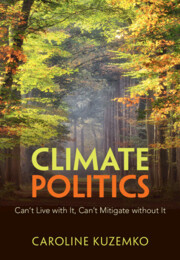
By exploring the dynamic relationships between politics, policymaking, and policy over time, this book aims to explain why climate change mitigation is so political, and why politics is also indispensable in enacting real change. It argues that politics is poorly understood and often sidelined in research and policy circles, which is an omission that must be rectified, because the policies that we rely on to drive down greenhouse gas emissions are deeply inter-connected with political and social contexts. Incorporating insights from political economy, socio-technical transitions, and public policy, this book provides a framework for understanding the role of specific ideas, interests, and institutions in shaping and driving sustainable change. The chapters present examples at global, national, and local scales, spanning from the 1990s to 2020s. This volume will prove valuable for graduate students, researchers, and policymakers interested in the politics and policy of climate change. This title is also available as Open Access on Cambridge Core.
‘Accessibly and engagingly written, this book expertly guides the reader through the complex world of climate politics, combining interdisciplinary theoretical insights and astute empirical observations to show how and why we have to place politics centrally in understanding societal responses to the threat of climate change.’
Peter Newell - University of Sussex, author of Power Shift and States of Transition
‘Caroline Kuzemko marvelously draws on international political economy, sociotechnical transitions and public policy to show why mitigation politics have remained poorly understood in the past, and why politicisation is key for designing effective policies going forward. This book is an indispensable read for scholars of climate politics and anyone who takes an interest in fighting dangerous climate change.’
Andreas Goldthau - University of Erfurt
Loading metrics...
* Views captured on Cambridge Core between #date#. This data will be updated every 24 hours.
Usage data cannot currently be displayed.
This section outlines the accessibility features of this content - including support for screen readers, full keyboard navigation and high-contrast display options. This may not be relevant for you.
Accessibility compliance for the PDF of this book is currently unknown and may be updated in the future.
