
Skip to main content Accessibility help
×
  • Cited by 10
    • Show more authors
    • You may already have access via personal or institutional login
    • Select format
    • Publisher:
      Cambridge University Press
      Publication date:
      27 September 2019
      03 October 2019
      ISBN:
      9781108677783
      9781108427616
      9781108446433
      Dimensions:
      (228 x 152 mm)
      Weight & Pages:
      0.39kg, 190 Pages
      Dimensions:
      (229 x 152 mm)
      Weight & Pages:
      0.268kg, 194 Pages
    You may already have access via personal or institutional login
  • Selected: Digital
    Add to cart View cart Buy from Cambridge.org

    Book description

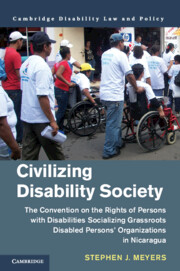
    The United Nations Convention on the Rights of Persons with Disabilities (CRPD) is increasingly used to civilize grassroots disabled persons' organizations (DPOs) around the world. The international disability rights movement actively promotes the CRPD's key norm that disabled persons mobilize in support of their rights under the Convention. The unintended consequence of these activities, however, is that local groups focused on social support and service provision, rather than disability-rights advocacy, are targeted for change. While the resources provided by international actors to grassroots organizations provide new opportunities, they also create barriers to local groups' ability to promote full civic participation of their members in the local community. Through a detailed account of grassroots DPOs in Nicaragua, Civilizing Disability Society demonstrates how local organizations navigate pressures from abroad as they attempt to concretely address the health, education and economic needs of their members at home.

    Reviews

    'Through an in-depth exploration of the context and narratives of the Nicaraguan disability community, the author provides a unique, interesting and heads on reality check for CRPD implementation and disability rights advocacy in the Global South.'

    Maya Sabatello - Columbia University, New York

    'This fascinating study shines a spotlight on the realities and experiences of Nicaraguan disabled people’s organisations, which are shaped by both the rights-based perspective embedded in the UNCRPD and Nicaragua’s civic participation model of solidaridad. Meyers’ insightful analysis brings to the surface uncomfortable tensions that often exist between Western understandings of human rights and local interpretations, particularly in Southern contexts. This excellent book is highly engaging and surprisingly revealing - a wake-up call for the international disability rights movement and an essential read for anyone who is interested in how best to meet the challenge of implementing disability rights around the globe without alienating disabled people themselves.'

    David Cobley - University of Birmingham

    Refine List

    Actions for selected content:

    Select all | Deselect all
    • View selected items
    • Export citations
    • Download PDF (zip)
    • Save to Kindle
    • Save to Dropbox
    • Save to Google Drive

    Save Search

    You can save your searches here and later view and run them again in "My saved searches".

    Please provide a title, maximum of 40 characters.
    ×

    Contents

    Metrics

    Altmetric attention score

    Full text views

    Total number of HTML views: 0
    Total number of PDF views: 0 *
    Loading metrics...

    Book summary page views

    Total views: 0 *
    Loading metrics...

    * Views captured on Cambridge Core between #date#. This data will be updated every 24 hours.

    Usage data cannot currently be displayed.

    Accessibility standard: Unknown

    Why this information is here

    This section outlines the accessibility features of this content - including support for screen readers, full keyboard navigation and high-contrast display options. This may not be relevant for you.

    Accessibility Information

    Accessibility compliance for the PDF of this book is currently unknown and may be updated in the future.
