Chernobyl Children

-
Select format
-
- Publisher:
- Cambridge University Press
- Publication date:
- 26 June 2025
- 14 August 2025
- ISBN:
- 9781009457750
- 9781009457767
- Dimensions:
- (229 x 152 mm)
- Weight & Pages:
- 0.66kg, 368 Pages
- Dimensions:
- Weight & Pages:
You may already have access via personal or institutional login
Show more authors 
You may already have access via personal or institutional login
Book description
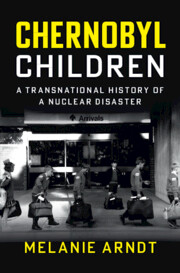
In the wake of the Chernobyl nuclear disaster, more than a million Belarusian, Ukrainian, and Russian children were sent abroad. Aided by the unprecedented efforts of transnational NGOs and private individuals, these children were meant to escape and recover from radiation exposure, but also from the increasing hardships of everyday life in post-Soviet society. Through this opening of the Soviet Union, hundreds of thousands of people in over forty countries witnessed the ecological, medical, social and political consequences of the disaster for the human beings involved. This awareness transformed the accident into a global catastrophe which could happen anywhere and have widespread impact. In this brilliantly insightful work, Melanie Arndt demonstrates that the Chernobyl children were both witness to and representative of a vanishing bipolar world order and the future of life in the Anthropocene, an age in which the human impact on the planet is increasingly borderless.
Reviews
‘Melanie Arndt places children at the centre of the Chernobyl catastrophe to reveal the ways Soviets built a civil society and faced the Anthropocene head-on. Brilliant research, a stunning work.'
Kate Brown - author of Manual for Survival: A Chernobyl Guide to the Future
‘Hundreds of thousands of children suffered from the Chernobyl disaster, even after evacuation, in irradiated landscapes, as their state failed them. Melanie Arndt gives voice to these forgotten Chernobyl children, the most vulnerable members of society, and to transnational charities that struggled to help them after the collapse of the USSR.'
Paul Josephson - author of Hero Projects
‘In a nuanced study rife with paradox, Melanie Arndt shows how the explosion of Chernobyl's unit number 4 on 26 April 1986 shuttered cities, shattered lives, and accelerated the collapse of the Soviet Union. But at the same time, it kicked off an unprecedented transnational medical response, nowhere more poignant than in the story of the “Chernobyl children”, young people who emerged from under the radioactive cloud to become the focus of international aid and recuperation efforts, and who grew up grateful for and often transformed by the experience of travel in foreign lands, all while refusing the victimhood so often thrust upon them. The catastrophe of Chernobyl transcends generations; in this transcendent history of this ‘long disaster' we not only begin to grasp not only its dark complexity and dreadful meaning but, astonishingly, glimmers of hope.'
Louis S. Warren - author of God's Red Son: The Ghost Dance Religion and the Making of Modern America
Contents
Contents
Metrics
Altmetric attention score
Full text views
Full text views helpTotal number of HTML views: 0
Total number of PDF views: 0 *
 Loading metrics...
* Views captured on Cambridge Core between #date#. This data will be updated every 24 hours.
Usage data cannot currently be displayed.
Accessibility standard: WCAG 2.1 AA
Why this information is here
This section outlines the accessibility features of this content - including support for screen readers, full keyboard navigation and high-contrast display options. This may not be relevant for you.
Accessibility Information
The PDF of this book complies with version 2.1 of the Web Content Accessibility Guidelines (WCAG), covering newer accessibility requirements and improved user experiences and achieves the intermediate (AA) level of WCAG compliance, covering a wider range of accessibility requirements.
Content Navigation
Table of contents navigation
Allows you to navigate directly to chapters, sections, or non‐text items through a linked table of contents, reducing the need for extensive scrolling.
Index navigation
Provides an interactive index, letting you go straight to where a term or subject appears in the text without manual searching.
Reading Order and Textual Equivalents
Single logical reading order
You will encounter all content (including footnotes, captions, etc.) in a clear, sequential flow, making it easier to follow with assistive tools like screen readers.
Short alternative textual descriptions
You get concise descriptions (for images, charts, or media clips), ensuring you do not miss crucial information when visual or audio elements are not accessible.
Visual Accessibility
Use of colour is not sole means of conveying information
You will still understand key ideas or prompts without relying solely on colour, which is especially helpful if you have colour vision deficiencies.
Structural and Technical Features
ARIA roles provided
You gain clarity from ARIA (Accessible Rich Internet Applications) roles and attributes, as they help assistive technologies interpret how each part of the content functions.