
Skip to main content Accessibility help
×
  • Cited by 7
    • Show more authors
    • Open Access
      You have digital access to this book
    • Select format
    • Publisher:
      Cambridge University Press
      Publication date:
      April 2022
      April 2022
      ISBN:
      9781108919210
      9781108843584
      Creative Commons:
      Creative Common License - CC Creative Common License - BY Creative Common License - NC Creative Common License - ND
      This content is Open Access and distributed under the terms of the Creative Commons Attribution licence CC-BY-NC-ND 4.0.
      https://creativecommons.org/creativelicenses
      Dimensions:
      (229 x 152 mm)
      Weight & Pages:
      0.79kg, 448 Pages
      Dimensions:
      Weight & Pages:
    Open Access
    You have digital access to this book
    Selected: Digital
    View content
    Add to cart View cart Buy from Cambridge.org

    Book description

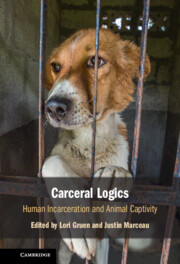
    Carceral logics permeate our thinking about humans and nonhumans. We imagine that greater punishment will reduce crime and make society safer. We hope that more convictions and policing for animal crimes will keep animals safe and elevate their social status. The dominant approach to human-animal relations is governed by an unjust imbalance of power that subordinates or ignores the interest nonhumans have in freedom. In this volume Lori Gruen and Justin Marceau invite experts to provide insights into the complicated intersection of issues that arise in thinking about animal law, violence, mass incarceration, and social change. Advocates for enhancing the legal status of animals could learn a great deal from the history and successes (and failures) of other social movements. Likewise, social change lawyers, as well as animal advocates, might learn lessons from each other about the interconnections of oppression as they work to achieve liberation for all. This title is also available as Open Access on Cambridge Core.

    Reviews

    ‘Carceral logics permeate our thinking about humans and nonhumans. We imagine that greater punishment will reduce crime and make society safer. We hope more convictions and policing for animal crimes will keep animals safe and elevate their social status. The dominant approach to human-animal relations is governed by an unjust imbalance of power that subordinates or ignores the interest nonhumans have in freedom. In this volume, Gruen and Marceau invited experts to provide insights into the complicated intersection of issues that arise in thinking about animal law, violence, mass incarceration, and social change. Carceral Logics is remarkable in how far it expands and deepens our understanding of the animal protection movement’s carceral tendencies, the impulses that motivate them, and the alternatives before us. This book will undoubtedly not only shape research and debate, but help to inform the continued development of a more just and inclusive animal protection movement.'

    Source: Mercy For Animals

    ‘Many of the most well-funded nonprofits in the animal protection movement have colluded with police, prosecutors, and for-profit animal torturing corporations to pursue mass human caging that has no discernable benefit to the animals they ostensibly seek to protect. With this brilliant, rigorous new volume, leading scholars and activists expose the intellectual dishonesty, ideological inconsistency, corruption, and lack of connection to other liberatory movements that have plagued the animal protection movement for too long. It is an essential call to change for all those who care about the value of human and nonhuman life.’

    Alec Karakatsanis - founder of Civil Rights Corps, and author of Usual Cruelty

    'What do we do when laws prohibiting animal cruelty fail to stop the vast majority of violence inflicted upon animals? Essential reading for anyone working to enact laws to protect animals, Carceral Logics insists that we measure our success and assess our failures by the real-world impacts such laws have on humans and nonhumans.’

    Lauren Gazzola - SHAC 7 defendant

    ‘Carceral Logics invites readers into the messiness of the ways we treat each other and nonhuman animals. The essays resist simple equations of the experiences of human incarceration with nonhuman animal abuse and confinement, while challenging the assumptions that undergird each. What is revealed? That carceral logics belong to us, and dismantling these logics requires more than reform - we need systemic reimagining.’

    Reginald Dwayne Betts - founder of Freedom Reads, and author of Felon

    Refine List

    Actions for selected content:

    Select all | Deselect all
    • View selected items
    • Export citations
    • Download PDF (zip)
    • Save to Kindle
    • Save to Dropbox
    • Save to Google Drive

    Save Search

    You can save your searches here and later view and run them again in "My saved searches".

    Please provide a title, maximum of 40 characters.
    ×

    Contents

    Full book PDF

    Page 1 of 2


    • Carceral Logics
      pp i-ii
    • Carceral Logics - Title page
      pp iii-iii
    • Human Incarceration and Animal Captivity
    • Copyright page
      pp iv-iv
    • Contents
      pp v-viii
    • Notes on Contributors
      pp ix-xii
    • Acknowledgments
      pp xiii-xiv
    • Introduction
      pp 1-10
    • 1 - Saved
      pp 15-36
    • The Historical Roots of Humane Carceral Logics in the United States
    • 2 - Criminal Animal Abuse, Interconnectedness, and Human Morality
      pp 37-52
    • 3 - Giving a Voice to the Voiceless
      pp 53-69
    • A Prosecutor’s Efforts to Combat Animal Cruelty
    • 4 - Examining Anticruelty Enhancements
      pp 70-86
    • Historical Context and Policy Advances
    • 5 - Carceral Progressivism and Animal Victims
      pp 87-100
    • 6 - Spectacular Immigration Enforcement in Hidden Spaces
      pp 105-127
    • 8 - Criminalization as a Solution to Abuse
      pp 144-157
    • A Cautionary Tale
    • 9 - Humanizing Animals, Dehumanizing Humans
      pp 158-186
    • 11 - Carceral Logics beyond Incarceration
      pp 204-224
    • 12 - Incarcerating Animals and Egregious Losses of Freedoms
      pp 229-237
    • 14 - Bovine Lives and the Making of a Nineteenth-Century American Carceral Archipelago
      pp 261-275
    • Part IV - Challenging Captivity and Changing Carceral Thinking
      pp 315-416
    • Introduction
    • 18 - Litigating Animal Captivity
      pp 343-365
    • Habeas Corpus in the Carceral State
    • 19 - “True” Imprisonment
      pp 366-383

    Page 1 of 2


    Metrics

    Altmetric attention score

    Full text views

    Total number of HTML views: 0
    Total number of PDF views: 0 *
    Loading metrics...

    Book summary page views

    Total views: 0 *
    Loading metrics...

    * Views captured on Cambridge Core between #date#. This data will be updated every 24 hours.

    Usage data cannot currently be displayed.

    Accessibility standard: Unknown

    Why this information is here

    This section outlines the accessibility features of this content - including support for screen readers, full keyboard navigation and high-contrast display options. This may not be relevant for you.

    Accessibility Information

    Accessibility compliance for the PDF of this book is currently unknown and may be updated in the future.
