
Skip to main content Accessibility help
×
  • Cited by 7
    • Show more authors
    • You may already have access via personal or institutional login
    • Select format
    • Publisher:
      Cambridge University Press
      Publication date:
      September 2017
      November 2017
      ISBN:
      9781107300859
      9781107041813
      Dimensions:
      (228 x 152 mm)
      Weight & Pages:
      1.37kg, 798 Pages
      Dimensions:
      Weight & Pages:
    You may already have access via personal or institutional login
  • Selected: Digital
    Add to cart View cart Buy from Cambridge.org

    Book description

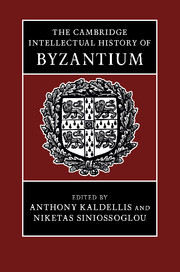
    This volume brings into being the field of Byzantine intellectual history. Shifting focus from the cultural, social, and economic study of Byzantium to the life and evolution of ideas in their context, it provides an authoritative history of intellectual endeavors from Late Antiquity to the fifteenth century. At its heart lie the transmission, transformation, and shifts of Hellenic, Christian, and Byzantine ideas and concepts as exemplified in diverse aspects of intellectual life, from philosophy, theology, and rhetoric to astrology, astronomy, and politics. Case studies introduce the major players in Byzantine intellectual life, and particular emphasis is placed on the reception of ancient thought and its significance for secular as well as religious modes of thinking and acting. New insights are offered regarding controversial, understudied, or promising topics of research, such as philosophy and medical thought in Byzantium, and intellectual exchanges with the Arab world.

    Awards

    Winner, 2018 PROSE Award for Single Volume Reference/Humanities and Social Sciences

    Reviews

    'It brings a great deal of clarity to a murky field, especially for an outsider, and should indeed serve as an excellent platform from which the growing field of Byzantine intellectual history might expand. The volume as a whole feels well thought out and well rounded in its execution. It is a most welcome addition to the corpus of modern Byzantine studies and should remain both a useful reference and an excellent teaching tool for years to come.'

    Nathan Leidholm Source: H-Ideas

    Refine List

    Actions for selected content:

    Select all | Deselect all
    • View selected items
    • Export citations
    • Download PDF (zip)
    • Save to Kindle
    • Save to Dropbox
    • Save to Google Drive

    Save Search

    You can save your searches here and later view and run them again in "My saved searches".

    Please provide a title, maximum of 40 characters.
    ×

    Contents


    Page 1 of 2


    • Introduction
      pp 1-24
    • Chapter 1 - Institutional Settings: The Court, Schools, Church, and Monasteries
      pp 27-36

    Page 1 of 2


    Metrics

    Altmetric attention score

    Full text views

    Total number of HTML views: 0
    Total number of PDF views: 0 *
    Loading metrics...

    Book summary page views

    Total views: 0 *
    Loading metrics...

    * Views captured on Cambridge Core between #date#. This data will be updated every 24 hours.

    Usage data cannot currently be displayed.

    Accessibility standard: Unknown

    Why this information is here

    This section outlines the accessibility features of this content - including support for screen readers, full keyboard navigation and high-contrast display options. This may not be relevant for you.

    Accessibility Information

    Accessibility compliance for the PDF of this book is currently unknown and may be updated in the future.
