Metrics
Full text views
Full text views help
Loading metrics...
* Views captured on Cambridge Core between #date#. This data will be updated every 24 hours.
Usage data cannot currently be displayed.
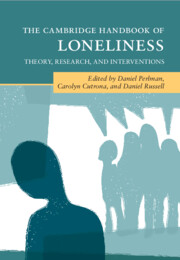
Everyone has experienced loneliness – perhaps briefly – perhaps for many years. This handbook explores why people of all ages can become lonely, and features steps that can be taken by individuals, communities, and entire societies to prevent and alleviate loneliness. Chapters present rigorous scientific research drawn from psychology, relationship science, neuroscience, physiology, sociology, public health, and gerontology to demystify the phenomenon of loneliness and its consequences. The volume investigates the significant risks that loneliness poses to health and the harmful physiological processes it can set in motion. It also details numerous therapeutic approaches to help people overcome loneliness from multiple perspectives, including traditional and cognitive psychotherapy, efforts to connect individuals to their communities, and designing communities and public policies to create a greater sense of social connection. Using accessible terminology understandable to a non-medical audience, it is an important work for social science scholars, students, policymakers, and practitioners.
‘Written by a global roster of experts, this timely collection is bursting with deep insights and practical guidance about today’s epidemic of loneliness. It’s a must-have resource for scholars, policymakers, and applied practitioners who want to know what loneliness is, where it comes from, what its effects are, and what to do about it.’
Harry T. Reis - Dean’s Professor in Arts and Sciences and Professor of Psychology, University of Rochester, UK
‘Loneliness is a perennial problem in modern societies, as economic, technological, and societal forces weaken traditional social ties, leaving individuals untethered and insecure. This book, edited by long-time experts on loneliness research, brings together diverse perspectives on the nature, causes, and consequences of loneliness. It is a must-read for anyone concerned with this hugely important topic.’
Phillip R. Shaver - Distinguished Professor Emeritus, University of California, Davis, USA and co-author of Attachment Theory Applied
Loading metrics...
* Views captured on Cambridge Core between #date#. This data will be updated every 24 hours.
Usage data cannot currently be displayed.
This section outlines the accessibility features of this content - including support for screen readers, full keyboard navigation and high-contrast display options. This may not be relevant for you.
Accessibility compliance for the PDF of this book is currently unknown and may be updated in the future.
