
Skip to main content Accessibility help
×
  • Cited by 34
    • You may already have access via personal or institutional login
    • Select format
    • Publisher:
      Cambridge University Press
      Publication date:
      February 2015
      September 2002
      ISBN:
      9780511802973
      9780521815321
      9780521893534
      Dimensions:
      (228 x 152 mm)
      Weight & Pages:
      0.48kg, 208 Pages
      Dimensions:
      (228 x 152 mm)
      Weight & Pages:
      0.29kg, 208 Pages
    You may already have access via personal or institutional login
  • Selected: Digital
    Add to cart View cart Buy from Cambridge.org

    Book description

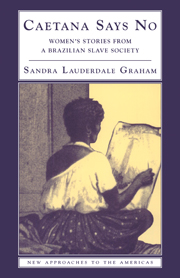
    This 2002 book presents the true and dramatic accounts of two nineteenth-century Brazilian women - one young and born a slave, the other old and from an illustrious planter family - and how each sought to retain control of their lives: the slave woman struggling to avoid an unwanted husband; the woman of privilege assuming a patriarch's role to endow a family of her former slaves with the means for a free life. But these women's stories cannot be told without also recalling how their decisions drew them ever more firmly into the orbits of the worldly and influential men who exercised power in their lives. These are stories with a twist: in this society of radically skewed power, Lauderdale Graham reveals that more choices existed for all sides than we first imagine. Through these small histories she casts new light on larger meanings of slave and free, female and male.

    Reviews

    "Two women, different roles, both shaking the structures of established male authority through the intransigence of their personal moral decisions. In this marvelous book Lauderdale Graham retrieves two sinuous stories from ecclesiastical and legal archives, and through their close analysis lays bare the stresses, ambivalences and the surprising elasticity of the slave system as practiced in a river valley in southeastern Brazil during the middle decades of the nineteenth-century. 'Brazilian Slavery' will never look the same again." Inga Clendinnen, Reader in History Emeritus at La Trobe University

    "Caetana is a finely crafted book on women's lives under patriarchal planters. Readers will appreciate the author's vivid descriptions and analysis of typical Brazilian social customs and gender roles of the nineteenth century. The short length of the book combined with photographs will make this especially attractive for classroom use." The Americas

    "This is a fascinating study of gender, slavery and patriarchy, written from the perspective of two remarkable, and at the same time so different, women. It combines imaginative research, engaging narrative, and solid thinking, opening a resonant new perspective on the historiography of nineteenth-century Brazil." Joao Jose Reis, Universidade Federal da Bahia

    "Two women, different roles, both shaking the structures of established male authority through the intransigence of their personal moral decisions. In this marvelous book Lauderdale Graham retrieves two sinuous stories from ecclesiastical and legal archives, and through their close analysis lays bare the stresses, ambivalences and the surprising elasticity of the slave system as practiced in a river valley in southeastern Brazil during the middle decades of the nineteenth-century. 'Brazilian Slavery' will never look the same again." Inga Clendinnen, Reader in History Emeritus at La Trobe University

    "Sandra Lauderdale Graham's lucidly written and meticulously researched study of women in a slave society calls to mind novelist L.P. Hartley's observation that "the past is a foreign country:they do things differently there." A fascinating read set in the expanding coffee economy of nineteenth-century Brazil, this book links the lives of two women, Caetana and Inacia, who chose to act in ways that subtly challenged the men who held power in their lives. By piecing together their lives and choices, Lauderdale Graham vividly and memorably depicts the complex and competing intersections of gender, race, family, and property that characterized Brazilian slavery." Alida C. Metcalf, Trinity University

    "This is a fascinating study of gender, slavery and patriarchy, written from the perspective of two remarkable, and at the same time so different, women. It combines imaginative research, engaging narrative, and solid thinking, opening a resonant new perspective on the historiography of nineteenth-century Brazil." Joao Jose Reis, Universidade Federal da Bahia

    "By exploring two mysteries that can't be fully solved, by puzzling over small kindnesses and betrayals in two plantation households, we learn the grammar of rules and exceptions that made up Brazil's nineteenth-century system. These women's predicaments show us the flexible harshness of whimsical, 'cordial' domination in agrarian Brazil." Dain Borges, University of Chicago

    "Sandra Lauderdale Graham's lucidly written and meticulously researched study of women in a slave society calls to mind novelist L.P. Hartley's observation that "the past is a foreign country:they do things differently there." A fascinating read set in the expanding coffee economy of nineteenth-century Brazil, this book links the lives of two women, Caetana and Inacia, who chose to act in ways that subtly challenged the men who held power in their lives. By piecing together their lives and choices, Lauderdale Graham vividly and memorably depicts the complex and competing intersections of gender, race, family, and property that characterized Brazilian slavery." Alida C. Metcalf, Trinity University

    "Graham has given us a wonderfully insightful glimpse into the history of women in postcolonial Brazil.... This is one of the most lucid and welcome additions to the literature on the subject published in recent years. Highly recommended." Choice

    "Lauderdale Graham should be commended for bringing to the attention of English-speaking readers such rich and thought-provoking details of nineteenth-century Brazilian slave society and culture." American Historical Review

    Refine List

    Actions for selected content:

    Select all | Deselect all
    • View selected items
    • Export citations
    • Download PDF (zip)
    • Save to Kindle
    • Save to Dropbox
    • Save to Google Drive

    Save Search

    You can save your searches here and later view and run them again in "My saved searches".

    Please provide a title, maximum of 40 characters.
    ×

    Contents

    Bibliography
    Bibliography
    ARCHIVES
    Arquivo da Cúria Metropolitana, Salvador
    Arquivo da Santa Casa da Misericórdia, Salvador
    Arquivo do Estado de São Paulo, São Paulo
    Arquivo do Forum de Paraibuna, Paraibuna
    Arquivo do Instituto Histórico e Geográfico Brasileiro, Rio de Janeiro
    Arquivo Nacional, Rio de Janeiro
    Seção de Arquivos Particulares, Werneck Family Papers
    Seção do Poder Executivo
    Seção do Poder Judiciário
    Arquivo Público do Estado da Bahia, Salvador
    Seção Judiciária
    Biblioteca Nacional, Rio de Janeiro, Seção de Manuscritos
    Centro de Documentação Histórica, Universidade Severino Sombra, Vassouras
    OTHER SOURCES
    Alencastro, Luiz Felipe de, ed. Império: A corte e a modernidade nacional. Vol. 2 of História da vida privada no Brasil. Ed. Fernando A. Novais. São Paulo: Companhia das Letras, 1997
    Almanak administrativo, mercantil e industrial da corte e provincia do Rio de Janeiro. Rio de Janeiro, 1849–1852, 1856–1868, 1871
    Almeida, Candido Mendes de, comp. and ed. Codigo Philippino; ou Ordenações e leis do reino de Portugal, recopilados por mandado d'el-rey D. Philippe I. 14 ed. segundo a primeira de 1603 e a nona de Coimbra de 1824. Addicionada com diversas notas … Rio de Janeiro: Typ. do Instituto Philomathico, 1870
    Antonil, André João. Cultura e opulência do Brasil. 1711. Reprint, São Paulo: Melhoramentos, 1976
    Anu á rio Genealógico Brazileiro 1 (1939), 4 (1941)
    Barickman, B. J. A Bahian Counterpoint: Sugar, Tobacco, Cassava, and Slavery in the Recôncavo, 1780–1860. Stanford: Stanford University Press, 1998
    Barickman, B. J.‘A Bit of Land, which They Call Roça’: Slave Provision Grounds in the Bahian Recôncovo, 1780–1860.” Hispanic American Historical Review 74, no. 4 (November 1994): 649–687
    Barman, Roderick J. Brazil: The Forging of a Nation, 1798–1852. Stanford: Stanford University Press, 1988
    Bethell, Leslie. The Abolition of the Brazilian Slave Trade: Britain, Brazil and the Slave Trade Question, 1807–1869. Cambridge: Cambridge University Press, 1970
    Blake, Augusto Victorino Alves Sacramento. Diccionario bibliographico brazileiro. 7 vols. 1900. Reprint, Rio de Janeiro: Conselho Federal de Cultura, 1970
    Bliss, Kathryn. Colonial Habits: Convents and the Spiritual Economy of Cuzco, Peru. Durham: Duke University Press, 1999
    Braga, Greenleigh H. Faria, De Vassouras: História, fatos, e gente. Rio de Janeiro: Ultra-Set, 1978
    Braga, Greenleigh H. Faria, comp. and ed. Vassouras de ontem. Vassouras: Irmandade da Santa Casa de Misericórdia da cidade de Vassouras, 1975
    Brazil. Congresso. Câmara dos Deputados. Anais
    Brazil. Laws, statutes, etc. Coleção das Leis do Brasil
    Brazil pittoresco: album de vistas, panoramas, paisagens, monumentos, costumes, etc., com os retratos de Sua Magestade Imperador Don [sic] Pedro II et [sic] da Familia Imperial, photographiados por Victor Frond, lithographiados pelos primeiros artistas de Paris … e acompanhados de tres volumes … sobre a historia, as instituições, as cidades, as fazendas, a cultura, a colonização, etc., do Brazil, por Charles Ribeyrolles. Paris: Lemercier, 1861
    Burnard, Trevor. “‘Do Thou in Gentle Phibia Smile’: Scenes from an Interracial Marriage, Jamaica, 1754–1786.” Paper presented at the Race and Slavery Seminar, Department of History, University of Texas at Austin, Spring 1997
    Castro, Hebe Maria Mattos de. Ao sul da história: Lavradores pobres na crise do trabalho escravo. São Paulo: Brasiliense, 1987
    Castro, Hebe Maria Mattos de. Das cores do silêncio: Os significados da liberdade do sudeste escravista, Brasil século XIX. Rio de Janeiro: Arquivo Nacional, 1995
    Castro, Hebe Maria Mattos de. “Laços de família e direitos no final da escravidão.” In História da vida privada no Brasil, ed. Fernando A. Novais. vol. 2, Império: A corte e a modernidade nacional, ed. Luiz Felipe de Alencastro. São Paulo: Companhia das Letras, 1997
    Castro, Jeanne Berrance de. A milícia cidadã: A Guarda Nacional de 1831 a 1850. São Paulo: Companhia Editora Nacional, 1977
    Catharino, Ernesto José Coelho Rodrigues. Eufrásia Teixeira Leite: Fragmentos de uma existência, 1850–1930. Rio de Janeiro: Edição do Autor, 1992
    Chalhoub, Sidney. Visões da liberdade: Uma história das últimas décadas da escravidão na corte. São Paulo: Companhia das Letras, 1990
    Childs, Matt D., “‘A Peculiar Sight, and Very Fit for a Photograph’: Master-Slave Rituals of Power at a Gold Mine in Nineteenth-Century Brazil.” History Workshop Journal 53 (Spring 2002), forthcoming
    Codigo commercial do Imperio do Brazil. Annotated by Salustiano Orlando de Araujo Costa. 4th ed. Rio de Janeiro: Laemmert, 1886
    Conrad, Robert. The Destruction of Brazilian Slavery, 1850–1888. Berkeley: University of California Press, 1972
    Costa, Emília Viotti da. “Brazil: The Age of Reform, 1870–1889.” In The Cambridge History of Latin America. vol. 5: C. 1870 to 1930, ed. Leslie Bethell. Cambridge: Cambridge University Press, 1986
    Costa, Emília Viotti da. The Brazilian Empire: Myths and Histories. Chicago: University of Chicago Press, 1985
    d'Araujo, Manoel do Monte Rodrigues. Elementos de direito ecclesiastico em relação á disciplina geral da igreja e com applicação aos usos da igreja do Brasil. 3 vols. Rio de Janeiro: Livraria de Antonio Gonçalves Guimarães, 1857–1859
    Davis, David Brion. The Problem of Slavery in Western Culture. Ithaca: Cornell University Press, 1966
    Dean, Warren. Rio Claro: A Brazilian Plantation System, 1820–1920. Stanford: Stanford University Press, 1976
    Diccionario da lingua portugueza. Comp. Antonio de Moraes Silva. 2 vols. 8th ed. Rio de Janeiro: Editoria-Empreza Litteraria Fluminense, 1889–1891
    Duncan, Julian Smith. Public and Private Operation of the Railways in Brazil. New York: Columbia University Press, 1932
    Faria, Sheila de Castro. A colônia em movimento: Fortuna e família no cotidiano colonial. Rio de Janeiro: Nova Fronteira, 1998
    Fernandes, Florestan. The Negro in Brazilian Society. Trans. Jacqueline D. Skiles, A. Brunel, and Arthur Rothwell. New York: Columbia University Press, 1969
    Ferrez, Gilberto, ed. The Brazil of Eduard Hildebrandt. Rio de Janeiro: Distribuidora Record, 1991
    Ferrez, Gilberto. Photography in Brazil, 1840–1900. Trans. Stella de Sá Rego. Albuquerque: University of New Mexico Press, 1984
    Ferrez, Gilberto, and Weston J. Naef. Pioneer Photographers of Brazil, 1840–1920. New York: Center for Inter-American Relations, 1976
    Florentino, Manolo, and José Roberto Góes. A paz das senzalas: Famílias escravas e tráfico, Rio de Janeiro, c.1790–c.1850. Rio de Janeiro: Civilização Brasileira, 1997
    Flory, Thomas. Judge and Jury in Imperial Brazil, 1808–1871: Social Control and Political Stability in the New State. Austin: University of Texas Press, 1981
    Franco, Maria Sylvia de Carvalho. Homens livres na ordem escravocrata. São Paulo: Ática, 1976
    Gomes, Flávio dos Santos. Histórias de quilombolas: Mocambos e comunidade de senzalas no Rio de Janeiro, século XIX. Rio de Janeiro: Arquivo Nacional, 1995
    Graham, Richard. Britain and the Onset of Modernization in Brazil, 1850–1914. Cambridge: Cambridge University Press, 1968
    Graham, Richard. Patronage and Politics in Nineteenth-Century Brazil. Stanford: Stanford University Press, 1990
    Graham, Richard. “Slave Families on a Rural Estate in Colonial Brazil.” Journal of Social History 9:3 (Spring 1976): 382–402
    Gudeman, Stephen, and Stuart B. Schwartz. “Cleansing Original Sin: Godparenthood and the Baptism of Slaves in Eighteenth-Century Bahia.” In Kinship Ideology and Practice in Latin American, ed. Raymond T. Smith. Chapel Hill: University of North Carolina Press, 1984
    Higgins, Kathleen J. “Licentious Liberty” in a Brazilian Gold-Mining Region: Slavery, Gender, and Social Control in Eighteenth-Century Sabará, Minas Gerais. University Park: Pennsylvania State University Press, 1999
    Hünefeldt, Christine. Paying the Price of Freedom: Family and Labor among Lima's Slaves, 1800–1854. Berkeley: University of California Press, 1994
    Instrucções para a Commissão Permanente nomeada pelos fazendeiros do municipio de Vassouras. Rio de Janeiro: Typ. Episcopal de Guimarães e Cia., 1854
    Insurreição negra e justiça, Paty do Alferes, 1838. Transcribed by João Luiz Pinaud, Carlos Otavio de Andrade, Salete Neme, Maria Cândida Gomes de Souza, and Jeannette Garcia. Rio de Janeiro: Ed. Expressão e Cultura-Exped Ltda. e Ordem dos Advogados do Brasil, 1987
    Johnson, Elizabeth. “Slavery and the Benedictine Order in Late Colonial São Paulo.” Master's thesis, University of Texas at Austin, 1996
    Karasch, Mary C. Slave Life in Rio de Janeiro, 1808–1850. Princeton: Princeton University Press, 1987
    Koster, Henry. Travels in Brazil. 2 vols. Philadelphia: M. Carey and Son, 1817
    Laërne, C. F. van Delden. Brazil and Java: Report on the Coffee-Culture in America, Asia, and Africa. London: W. H. Allen, 1885
    Lara, Silvia Hunold. Campos da violência: Escravos e senhores na Capitania do Rio de Janeiro, 1750–1808. Rio de Janeiro: Paz e Terra, 1988
    Lauderdale Graham, Sandra. “A cultura do patriarcado rural às vésperas do império.” Paper presented at the Colóquio Internacional, “De Cabral a Pedro I,” Fundação Calouste Gulbenkian, Lisbon, Portugal, 29–31 March 2000
    Lauderdale Graham, Sandra. House and Street: The Domestic World of Servants and Masters in Nineteenth-Century Rio de Janeiro. Cambridge: Cambridge University Press, 1988
    Lauderdale Graham, Sandra. “Slavery's Impasse: Slave Prostitutes, Small-Time Mistresses, and the Brazilian Law of 1871.” Comparative Studies in Society and History 33, no. 4 (October 1991): 369–394
    Lee, Monika Kittiya. “The Ungrateful Art of Correspondence: A Love Affair.” Honors thesis, University of Texas at Austin, 1995
    Lewin, Linda. “Natural and Spurious Children in Brazilian Inheritance Law from Colony to Empire: A Methodological Essay.” The Americas 48, no. 3 (January 1992): 351–396
    Machado, Maria Helena. Crime e escravidão: Trabalho, luta e resistência nas lavouras paulistas, 1830–1888. São Paulo: Brasiliense, 1987
    Machado, Maria Helena. O plano e o pânico: Os movimentos sociais na década da abolição. Rio de Janeiro: Editora Universidade Federal do Rio de Janeiro; São Paulo: Editora da Universidade de São Paulo, 1994
    Malheiro, Agostinho Marques Perdigão. A escravidão no Brasil: Ensaio históricojurídico-social. 3 parts in 1 vol. Rio de Janeiro: Typ. Nacional, 1866–1867
    Malheiro, Agostinho Marques Perdigão. A escravidão no Brasil: Ensaio histórico-jurídico-social. 3 parts in 2 vols. 1866–1867. Reprint. Petrópolis: Vozes, 1976
    Maloiy, G. M. O., et al. “Energetic Cost of Carrying Loads: Have African Women Discovered an Economic Way?Nature 319 (February 1986): 668–669
    Marcílio, Maria Luiza. A cidade de São Paulo: Povoamento e população, 1750–1850. São Paulo: Pioneira, 1974
    Mattoso, Katia M. de Queirós. Bahia: A cidade do Salvador e seu mercado no século XIX. São Paulo: Hucitec, 1978
    Mattoso, Katia M. de Queirós. Bahia, século XIX: Uma província no império. Rio de Janeiro: Nova Fronteira, 1992
    McCann, Bryan. “Slavery Negotiated: Mediators on the Middle Ground, the Paraíba Valley, Brazil, 1835–1888.” Master's thesis, University of New Mexico at Albuquerque, 1994
    Merwick, Donna. Death of a Notary: Conquest and Change in Colonial New York. Ithaca: Cornell University Press, 1999
    Mesquita, Eni. “O papel do agregado na região de Itú – 1780–1830.” Coleção Museu Paulista 6 (1977): 13–121
    Metcalf, Alida C. Family and Frontier in Colonial Brazil: Santana de Parnaíba, 1580–1822. Berkeley: University of California Press, 1992
    Muldrew, Craig. The Economy of Obligation: The Culture of Credit and Social Relations in Early Modern England. New York: St. Martin's Press, 1998
    Müller, Daniel Pedro. Ensaio d'um quadro estatístico da província de São Paulo: Ordenado pelas leis provincias de 11 de abril de 1836 e 10 de março de 1837. 1838. Reprint, São Paulo: Governo do Estado de São Paulo, 1978
    Nabuco, Joaquim. Cartas a amigos. Ed. Carolina Nabuco. São Paulo: Instituto Progresso Editorial, 1949
    Nader, Helen. Liberty in Absolutist Spain: The Habsburg Sale of Towns, 1516–1700. Baltimore: Johns Hopkins University Press, 1990
    Naro, Nancy Priscilla Smith. “Customary Rightholders and Legal Claimants to Land in Rio de Janeiro, Brazil, 1870–1890.” The Americas 48, no. 4 (April 1992): 485–517
    Nazzari, Muriel. “Transition toward Slavery: Changing Practices regarding Indians in Seventeenth-Century São Paulo.” The Americas 49, no. 2 (October 1991): 131–155
    Nishida, Mieko. “Manumission and Ethnicity in Urban Slavery: Salvador, Brazil, 1808–1888.” Hispanic American Historical Review 73, no. 3 (August 1993): 361–391
    Pereira, José Saturnino da Costa. Diccionario topographico do Imperio do Brasil. Rio de Janeiro: Typ. P. Gueffier, 1834
    Phillips, Roderick. Putting Asunder: A History of Divorce in Western Society. Cambridge: Cambridge University Press, 1988
    Pondé, Francisco de Paula e Azevedo. “A fazenda do barão de Pati do Alferes.” Revista do Instituto Histórico e Geográfico Brasileiro 327 (April–June 1980): 83–155
    Porto, M. J. de Campos. Repertorio de legislação ecclesiastica desde 1500 até 1874. Rio de Janeiro: Garnier, 1875
    A Provincia de São Paulo. São Paulo, 1888
    Ramos, Belisário Vieira. Livro da família Werneck. Rio de Janeiro: Cia. Carioca de Artes Gráficas, 1941
    Reis, João José. A morte é uma festa: Ritos fúnebres e revolta popular no Brasil do século XIX. São Paulo: Companhia das Letras, 1991
    Reis, João José. “Escravos e coiteiros no quilombo do Oitizeiro, Bahia, 1806.” In Liberdade por um fio: História dos quilombos no Brasil. Ed. João José Reis and Flávio dos Santos Gomes. São Paulo: Companhia das Letras, 1996
    Reis, João José. Slave Rebellion in Brazil: The Muslim Uprising of 1835 in Bahia. Trans. Arthur Brakel. Baltimore: Johns Hopkins University Press, 1993
    Reis, João José Reis, and Flávio dos Santos Gomes, eds. Liberdade por um fio: História dos quilombos no Brasil. São Paulo: Companhia das Letras, 1996
    Russell-Wood, A. J. R. The Black Man in Slavery and Freedom in Colonial Brazil. London: Macmillan Press and St. Antony's College, Oxford, 1982
    Russell-Wood, A. J. R. Fidalgos and Philanthropists: The Santa Casa da Misericórdia of Bahia, 1550–1755. Berkeley: University of California Press, 1968
    Salles, José Roberto da Cunha. Fôro penal: Theoria e pratica do processo criminal brazileiro. Rio de Janeiro: Garnier, 1882
    Santos, Noronha. “Anotações a Introdução das ‘Memórias.”’ In Luiz Gonçalves dos Santos (Padre Perereca). Memórias para servir à história do Reino do Brasil. 2 vols. 1825. Reprint. Belo Horizonte: Editora Itatiaia, 1981
    São Paulo (state). Arquivo do Estado de São Paulo. Repertório das sesmarias concedidas pelos Capitães Generais da Capitania de São Paulo desde 1721 até 1821. São Paulo: Tip. do Globo, 1944. Reprint, São Paulo: Secretaria de Estado da Cultura, 1994
    Schwartz, Stuart B.The Manumission of Slaves in Colonial Brazil: Bahia, 1684–1745.” Hispanic American Historical Review 54, no. 4 (November 1974): 603–635
    Schwartz, Stuart B. Slaves, Peasants, Rebels: Reconsidering Brazilian Slavery. Urbana: University of Illinois Press, 1992
    Schwartz, Stuart B. Sugar Plantations in the Formation of Brazilian Society: Bahia, 1550–1835. Cambridge: Cambridge University Press, 1985
    Las siete partidas. Trans. Samuel Parsons Scott. Chicago: Commerce Clearing House, 1931
    Silva, Eduardo. Barões e escravidão: Três gerações de fazendeiros e a crise da estrutura escravista. Rio de Janeiro: Nova Fronteira, 1984
    Silva, Joaquim Norberto de Souza. “Memória histórica e documentada das aldêas de indios da província do Rio de Janeiro.” Revista do Instituto Histórico e Geográfico Brasileiro. “Parte documentada.” 17 (1854): 498–499
    Siqueira, Alexandre Joaquim de. “Memória histórica do município de Vassouras, 1852.” In Greenleigh H. Faria Braga, comp., Vassouras de ontem. Rio de Janeiro: Cia. Brasileira de Artes Gráficas, 1975
    Slenes, Robert W. “Black Homes, White Homilies: Perceptions of the Slave Family and of Slave Women in Nineteenth-Century Brazil.” In More Than Chattel: Black Women and Slavery in the Americas, ed. David Barry Gaspar and Darlene Clark Hine. Bloomington: Indiana University Press, 1996
    Slenes, Robert W. “The Demography and Economics of Brazilian Slavery: 1850–1888.” Ph.D. diss., Stanford University, 1976
    Slenes, Robert W.Escravidão e família: Padrões de casamento e estabilidade familiar numa comunidade escrava (Campinas, século XIX).” Estudos Econômicos 17, no. 2 (May–August 1987): 217–227
    Slenes, Robert W. Na senzala, uma flor: Esperanças e recordações na formação da família escrava, Brasil sudeste, século XIX. Rio de Janeiro: Nova Fronteira, 1999
    Slenes, Robert W. “Senhores e subalternos no oeste paulista.” In História da vida privada no Brasil, ed. Fernando A. Novais, vol. 2: Império: A corte e a modernidade nacional, ed. Luiz Felipe de Alencastro. São Paulo: Companhia das Letras, 1997
    Slenes, Robert W., Carlos Vogt, and Peter Fry. “Histórias do Cafundó.” In Carlos Vogt and Peter Fry, with the collaboration of Robert W. Slenes. Cafundó: A África no Brasil – Linguagem e sociedade. Campinas: Editora da Unicamp; São Paulo: Companhia das Letras, 1996
    Soares, Sebastião Ferreira. Notas estatísticas sobre a produção agrícola e carestia dos gêneros alimentícios no Império do Brasil. 1860. Reprint, Rio de Janeiro: IPEA/INPES, 1977
    Soeiro, Susan. “The Social and Economic Role of the Convent: Women and Nuns in Colonial Bahia, 1677–1800.” Hispanic American Historical Review 54, no. 2 (May 1974): 209–232
    Souza, José Antônio Soares. “O efêmero quilombo do Pati do Alferes em 1838.” Revista do Instituto Histórico e Geográfico Brasileiro 295 (April–June 1972): 33–69
    Souza, José Antônio Soares. “Vassouras e suas residências urbanas.” Revista do Instituto Histórico e Geográfico Brasileiro 290 (January/March 1971): 22–65
    Stein, Stanley J. Vassouras: A Brazilian Coffee County, 1850–1900. Cambridge: Harvard University Press, 1957
    Stulzer, Aurélio. Notas para a história da vila de Pati do Alferes. Rio de Janeiro: Lito-Tipo Guanabara, 1944
    Sweigart, Joseph E. Coffee Factorage and the Emergence of a Brazilian Capital Market, 1850–1888. New York: Garland Publishing, 1987
    Taunay, Affonso d'Escragnolle. Pequena história do café no Brasil (1727–1937). Rio de Janeiro: Departamento Nacional do Café, 1945
    Taunay, C. A. Manual do agricultor brazileiro, obra indispensavel a todo o senhor de engenho, fazendeiro e lavrador. 2nd ed. Rio de Janeiro, 1839
    Tollenare, L[ouis] F[rançois] de. Notas dominicais, tomadas durante uma viagem em Portugal e no Brasil em 1816, 1817 e 1818. Salvador, Bahia: Editora Progresso, 1956
    Vernek, Francisco Peixoto de Lacerda. Memoria sobre a fundação de huma fazenda na provincia do Rio de Janeiro, sua administração e épocas em que se devem fazer as plantações, suas colheitas, etc., etc. Rio de Janeiro: Laemmert, 1847
    Vide, Sebastião Monteiro da. Constituições primeiras do Arcebispado da Bahia. Feitas e ordenadas pelo … 5° Arcebispo do dito Arcebispado do Conselho de Sua Magestade: Propostas e aceitas em o synodo diocesano que o dito Senhor celebrou em 12 de junho do anno de 1707. Impressas em Lisboa no anno de 1719 e em Coimbra em 1720. … São Paulo: Typ. “2 de Dezembro,” 1853
    Vogt, Carlos, and Peter Fry, with the collaboration of Robert W. Slenes. Cafundó: A África no Brasil – Linguagem e sociedade. Campinas: Editora da Unicamp; São Paulo: Companhia das Letras, 1996
    Werneck, Francisco Klörs. História e genealogia fluminense. Rio de Janeiro: Edição do Autor, 1947
    Werneck, Luiz Peixoto de Lacerda. “Breves considerações sobre a posição atual da lavoura de café,” Almanak administrativo, mercantil e industrial da corte e provincia do Rio de Janeiro, Rio de Janeiro, 1855
    Werneck, Luiz Peixoto de Lacerda. Idéias sobre colonização, precedidas de uma sucinta exposição dos princípios que regem a população. Rio de Janeiro: Laemmert, 1855
    Wood, Michael. The Magician's Doubts: Nabokov and the Risks of Fiction. London: Chatto and Windus, 1994
    Zaluar, Augusto Emílio. Peregrinação pela província de São Paulo, 1860–1861. Belo Horizonte: Itatiaia, 1975

    Metrics

    Altmetric attention score

    Full text views

    Total number of HTML views: 0
    Total number of PDF views: 0 *
    Loading metrics...

    Book summary page views

    Total views: 0 *
    Loading metrics...

    * Views captured on Cambridge Core between #date#. This data will be updated every 24 hours.

    Usage data cannot currently be displayed.

    Accessibility standard: Unknown

    Why this information is here

    This section outlines the accessibility features of this content - including support for screen readers, full keyboard navigation and high-contrast display options. This may not be relevant for you.

    Accessibility Information

    Accessibility compliance for the PDF of this book is currently unknown and may be updated in the future.
