The Burning Saints

-
The digital format of this book is no longer available to purchase from Cambridge Core. Other formats may be available.
-
Select format
-
- Publisher:
- Acumen Publishing
- Publication date:
- 05 April 2014
- 31 October 2012
- ISBN:
- 9781844657704
- 9781845539764
- Dimensions:
- Weight & Pages:
- 00kg,
- Dimensions:
- Weight & Pages:
- Series:
- Religion, Cognition and Culture
- Subjects:
- Religion, Religion: General Interest
You may already have access via personal or institutional login- Series:
- Religion, Cognition and Culture
- Subjects:
- Religion, Religion: General Interest
Show more authors 
You may already have access via personal or institutional login
Book description
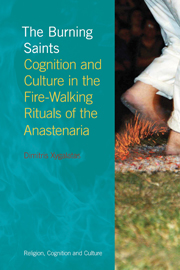
The Anastenaria are Orthodox Christians in Northern Greece who observe a unique annual ritual cycle focused on two festivals, dedicated to Saint Constantine and Saint Helen. The festivals involve processions, music, dancing, animal sacrifices, and culminate in an electrifying fire-walking ritual. Carrying the sacred icons of the saints, participants dance over hot coals as the saint moves them. The Burning Saints presents an analysis of these rituals and the psychology behind them. Based on long-term fieldwork, The Burning Saints traces the historical development and sociocultural context of the Greek fire-walking rituals. As a cognitive ethnography, the book aims to identify the social, psychological and neurobiological factors which may be involved and to explore the role of emotional and physiological arousal in the performance of such ritual. A study of participation, experience and meaning, The Burning Saints presents a highly original analysis of how mental processes can shape social and religious behaviour.
Reviews
"The first part of the book surely will satisfy the anthropologists, since (Xygalatas) thoroughly reconstructs the ethnographic settings of the fire-walkers in Agia Eleni. His writing style is enthralling and becomes almost literary when he describes the fire-walkers' festivals and rituals. The second part might startle the readers who are not familiar with the cognitive theories of ritual and religion... However, the way he puts his ethnography to use in testing certain cognitive theories proves that the cognitive study of religion does not treat humans as solely biological organisms whose cognitive capacities create the perceivable world... On the contrary, it treats humans as biological, psychological, social and cultural beings situated in a specific world with which they incessantly interact.'"
Source: Religion & Theology
Contents
Contents
Metrics
Full text views
Full text views helpTotal number of HTML views: 0
Total number of PDF views: 0 *
 Loading metrics...
* Views captured on Cambridge Core between #date#. This data will be updated every 24 hours.
Usage data cannot currently be displayed.
Accessibility standard: Unknown
Why this information is here
This section outlines the accessibility features of this content - including support for screen readers, full keyboard navigation and high-contrast display options. This may not be relevant for you.
Accessibility Information
Accessibility compliance for the PDF of this book is currently unknown and may be updated in the future.