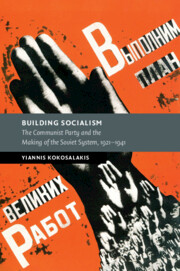

By placing the party grassroots at the centre of its focus, Building Socialism presents an original account of the formative first two decades of the Soviet system. Assembled in a large network of primary party organisations (PPO), the Bolshevik rank-and-file was an army of activists made up of ordinary people. While far removed from the levers of power, they were nevertheless charged with promoting the Party's programme of revolutionary social transformation in their workplaces, neighbourhoods, and households. Their regular meetings, conferences and campaigns have generated a voluminous source base. This rich material provides a unique view of the practical manifestation of the Party's revolutionary mission and forms the basis of this insightful new narrative of how the Soviet republic functioned in the period from the end of the Russian Civil War in 1921 to its invasion by Nazi Germany in 1941.
‘A seminal work that significantly contributes to our understanding of the Soviet Union. It offers a fresh perspective on the Communist Party’s role in Soviet society, emphasising the importance of grassroots activism and challenging conventional narratives about the nature of Soviet governance. Kokosalakis’ thorough research, insightful analysis and compelling narrative make this book an invaluable resource for scholars and students of Soviet history and socialism …’
Giannis Lainas Source: Europe-Asia Studies
‘… the thesis is novel and well argued.’
Jonathan Daly Source: SEER
Loading metrics...
* Views captured on Cambridge Core between #date#. This data will be updated every 24 hours.
Usage data cannot currently be displayed.
This section outlines the accessibility features of this content - including support for screen readers, full keyboard navigation and high-contrast display options. This may not be relevant for you.
Accessibility compliance for the PDF of this book is currently unknown and may be updated in the future.
