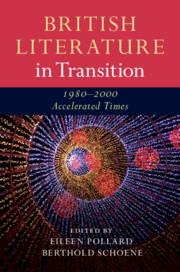
British Literature in Transition, 1980–2000

-
Select format
-
- Publisher:
- Cambridge University Press
- Publication date:
- December 2018
- December 2018
- ISBN:
- 9781316344071
- 9781107121423
- Dimensions:
- (228 x 152 mm)
- Weight & Pages:
- 0.71kg, 390 Pages
- Dimensions:
- Weight & Pages:
You may already have access via personal or institutional login
Show more authors 
You may already have access via personal or institutional login
Book description
The literature of twentieth-century Britain's final twenty years represents a crash course in transitional history. In the aftermath of the 1970s, the nation's hopes of becoming more efficient were high, leading to the fundamental domestic shake-up that was Margaret Thatcher's neoliberal revolution (1979–90). Following the end of the Cold War, Europe was undergoing radical rejuvenation, while the world as a whole began to thrive on new levels of connectivity and proximity brought through rapid advances in communication technology. Later, in the 1990s, Britons were asked to countenance not only internal devolution, but also the crystallisation of a brand-new European and global order. This volume shows how British literature recorded contemporaneous historical change. It traces the emergence and evolution of literary trends as well as enduring transitional shifts in genre, tone, style and thematic preoccupation.
Contents
Contents
Metrics
Altmetric attention score
Full text views
Full text views helpTotal number of HTML views: 0
Total number of PDF views: 0 *
 Loading metrics...
* Views captured on Cambridge Core between #date#. This data will be updated every 24 hours.
Usage data cannot currently be displayed.
Accessibility standard: Unknown
Why this information is here
This section outlines the accessibility features of this content - including support for screen readers, full keyboard navigation and high-contrast display options. This may not be relevant for you.
Accessibility Information
Accessibility compliance for the PDF of this book is currently unknown and may be updated in the future.