
Skip to main content Accessibility help
×
  • Cited by 2
    • Volume 23
      Show more authors
    • You may already have access via personal or institutional login
    • Select format
    • Publisher:
      Intersentia
      Publication date:
      September 2018
      March 2017
      ISBN:
      9781780684970
      9781780684406
      Dimensions:
      Weight & Pages:
      Dimensions:
      Weight & Pages:
    You may already have access via personal or institutional login
  • Selected: Digital
    Add to cart View cart Buy from Cambridge.org

    Book description

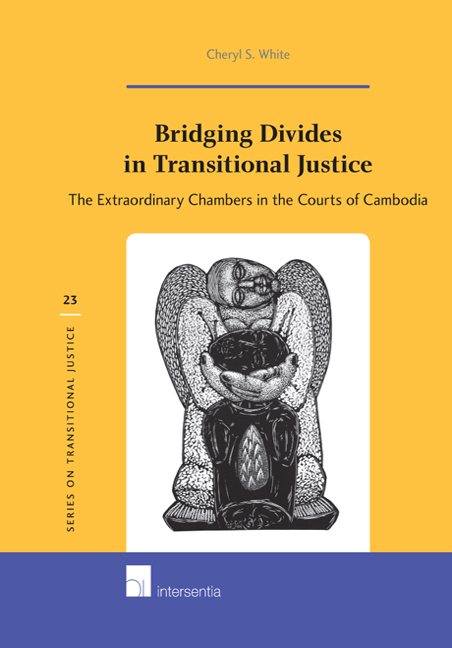
    The backdrop to Bridging Divides in Transitional Justice is Cambodia's history of radical Communist revolution (1975-1979) under the brutal Khmer Rouge regime, and the culture of impunity and silence imposed on the society by successive national governments for close to three decades. Dialogue on the suppressed past began in 2006 as key figures of the regime were brought before the in situ internationalised criminal court, the Extraordinary Chambers in the Courts of Cambodia (ECCC). The ECCC forms part of the panoply of international criminal courts of the post-Cold War era. The book engages with the dissonance between the expressivism of idealised international criminal trials and their communicative or discursive value within the societies most affected by their operation. An alternative view of the transitional trial is posited as the author elucidates the limits of expressivism and explores the communicative dynamics of ECCC trial procedure which have precipitated unprecedented local debate and reflection on the Khmer Rouge era.The book provides a timely and nuanced analysis of the ECCC's politically contentious and frequently criticised proceedings by examination of the trial dialogue in the Court's first two cases. From transcripts of the proceedings, exchanges between trial participants including witnesses, civil parties and the accused, are examined to show how, at times, the retributive proceedings assumed the character of restorative justice and encompassed significant dialogue on current social issues, such as the victim/perpetrator equation and the nature of ongoing post-traumatic stress disorder flowing from the events that took place under this violent regime The Court's capacity for representative and discursive proceedings is attributed to the substantive inclusion of the voice of the victim in proceedings, a modified inquisitorial procedure, narrative testimony and role-sharing between national and international court actors.

    Refine List

    Actions for selected content:

    Select all | Deselect all
    • View selected items
    • Export citations
    • Download PDF (zip)
    • Save to Kindle
    • Save to Dropbox
    • Save to Google Drive

    Save Search

    You can save your searches here and later view and run them again in "My saved searches".

    Please provide a title, maximum of 40 characters.
    ×

    Contents

    Metrics

    Full text views

    Total number of HTML views: 0
    Total number of PDF views: 0 *
    Loading metrics...

    Book summary page views

    Total views: 0 *
    Loading metrics...

    * Views captured on Cambridge Core between #date#. This data will be updated every 24 hours.

    Usage data cannot currently be displayed.

    Accessibility standard: Unknown

    Why this information is here

    This section outlines the accessibility features of this content - including support for screen readers, full keyboard navigation and high-contrast display options. This may not be relevant for you.

    Accessibility Information

    Accessibility compliance for the PDF of this book is currently unknown and may be updated in the future.
