
Skip to main content Accessibility help
×
  • Cited by 6
    • Show more authors
    • You may already have access via personal or institutional login
    • Select format
    • Publisher:
      Cambridge University Press
      Publication date:
      17 October 2019
      17 October 2019
      ISBN:
      9781108164511
      9781107196056
      9781316647172
      Dimensions:
      (228 x 152 mm)
      Weight & Pages:
      0.66kg, 332 Pages
      Dimensions:
      (229 x 152 mm)
      Weight & Pages:
      0.49kg, 336 Pages
    You may already have access via personal or institutional login
  • Selected: Digital
    Add to cart View cart Buy from Cambridge.org

    Book description

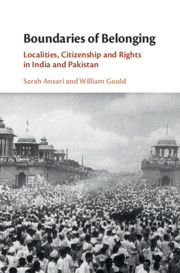
    The 1947 Partition had a major impact on issues of citizenship and rights in India and Pakistan in the decades that followed. Boundaries of Belonging shows how citizenship evolves at a time of political transition and what this meant for ordinary people, by directing attention away from South Asia's Partition 'hotspots' - Bengal and Punjab - to Partition's 'hinterlands' of Uttar Pradesh and Sindh. The analysis, based on rich archival research and fieldwork, brings out commonalities, differences, and the mutual co-construction of the 'citizen' in both places. It also reveals the way in which developments across the border, such as communal violence, could directly impact on minority rights in its neighbour. Questioning stereotypes of an increasingly 'authoritarian' Pakistan and 'democratic' India, Sarah Ansari and William Gould make a major contribution to recent scholarship that suggests the differences between India and Pakistan are overstated.

    Reviews

    ‘Boundaries of Belonging is an engaging and authoritative study which deserves a wide readership. It addresses everyday meanings of citizenship in the UP and Sindh 'hinterlands' of India's 1947 Partition. The book provides important insights into the common challenges facing India and Pakistan with respect to claims of entitlement to citizenship.’

    Ian Talbot - University of Southampton

    ‘This book is a major new addition to the growing literature on the idea of citizenship in the postcolonial world. Ansari and Gould have woven a narrative that brings to life political processes and lived social experiences of transitions from colonial subjecthood to republican modes of citizenship, describing in this process what it meant for people to identify as citizens and notions of belonging to the nation-state.’

    Ali Usman Qasmi - Lahore University of Management Sciences

    'The thematically organized chapters innovatively highlight both nations’ marginalized groups, including women, landless agricultural laborers, and their respective religious minorities.'

    M. H. Fisher Source: Choice

    Refine List

    Actions for selected content:

    Select all | Deselect all
    • View selected items
    • Export citations
    • Download PDF (zip)
    • Save to Kindle
    • Save to Dropbox
    • Save to Google Drive

    Save Search

    You can save your searches here and later view and run them again in "My saved searches".

    Please provide a title, maximum of 40 characters.
    ×

    Contents

    • Introduction
      pp 1-22
    • 1 - ‘Performing the State’ in Post-1947 India and Pakistan
      pp 23-66

    Metrics

    Altmetric attention score

    Full text views

    Total number of HTML views: 0
    Total number of PDF views: 0 *
    Loading metrics...

    Book summary page views

    Total views: 0 *
    Loading metrics...

    * Views captured on Cambridge Core between #date#. This data will be updated every 24 hours.

    Usage data cannot currently be displayed.

    Accessibility standard: Unknown

    Why this information is here

    This section outlines the accessibility features of this content - including support for screen readers, full keyboard navigation and high-contrast display options. This may not be relevant for you.

    Accessibility Information

    Accessibility compliance for the PDF of this book is currently unknown and may be updated in the future.
