
Skip to main content Accessibility help
×
  • Cited by 26
    • The digital format of this book is currently unavailable for purchase. Other formats may be available.
    • An alternative record for this book is available here.
    • Show more authors
    • You may already have access via personal or institutional login
    • Select format
    • Publisher:
      Liverpool University Press
      Publication date:
      05 December 2011
      08 February 2011
      ISBN:
      9781846316517
      9781846314971
      Dimensions:
      Weight & Pages:
      00kg,
      Dimensions:
      Weight & Pages:
    You may already have access via personal or institutional login
    Selected: Digital
    Add to cart View cart Buy from Cambridge.org

    Book description

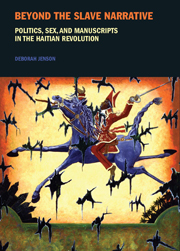
    The Haitian Revolution has generated responses from commentators in fields ranging from philosophy to historiography to twentieth-century literary and artistic studies. But what about the written work produced at the time, by Haitians? This book is the first to present an account of a specifically Haitian literary tradition in the Revolutionary era. Beyond the Slave Narrative shows the emergence of two strands of textual innovation, both evolving from the new revolutionary consciousness: the remarkable political texts produced by Haitian revolutionary leaders Toussaint Louverture and Jean-Jacques Dessalines, and popular Creole poetry from anonymous courtesans in Saint-Domingue's libertine culture. These textual forms, though they differ from each other, both demonstrate the increasing cultural autonomy and literary voice of non-white populations in the colony at the time of revolution. Unschooled generals and courtesans, long presented as voiceless, are at last revealed to be legitimate speakers and authors. These Haitian French and Creole texts have been neglected as a foundation of Afro-diasporic literature by former slaves in the Atlantic world for two reasons: because they do not fit the generic criteria of the slave narrative (which is rooted in the autobiographical experience of enslavement); and because they are mediated texts, relayed to the print-cultural Atlantic domain not by the speakers themselves, but by secretaries or refugee colonists. These texts challenge how we think about authorial voice, writing, print culture, and cultural autonomy in the context of the formerly enslaved, and demand that we reassess our historical understanding of the Haitian Independence and its relationship to an international world of contemporary readers.

    Reviews

    Colonial and postcolonial studies will gain significant new breadth and depth with the publication of Deborah Jenson’s Beyond the Slave Narrative: Sex, Politics, and Manuscripts in the Haitian Revolution. This pathbreaking book brings to light the rich but largely neglected Francophone record of black literacy from the late eighteenth and early-nineteenth centuries. Rectifying the anglocentric view that slave narratives were the only or most authentic form of black voices from the past, Jenson provides probing analyses of Creole poetry, political discourse, and other materials. Deeply committed to improving present-day conditions in Haiti, Jenson finds in the cultural heritage of the past the basis for a fuller understanding of current problems and for hope in the future.

    Doris Kadish Source: University of Georgia

    Refine List

    Actions for selected content:

    Select all | Deselect all
    • View selected items
    • Export citations
    • Download PDF (zip)
    • Save to Kindle
    • Save to Dropbox
    • Save to Google Drive

    Save Search

    You can save your searches here and later view and run them again in "My saved searches".

    Please provide a title, maximum of 40 characters.
    ×

    Contents

    Metrics

    Full text views

    Total number of HTML views: 0
    Total number of PDF views: 0 *
    Loading metrics...

    Book summary page views

    Total views: 0 *
    Loading metrics...

    * Views captured on Cambridge Core between #date#. This data will be updated every 24 hours.

    Usage data cannot currently be displayed.

    Accessibility standard: Unknown

    Why this information is here

    This section outlines the accessibility features of this content - including support for screen readers, full keyboard navigation and high-contrast display options. This may not be relevant for you.

    Accessibility Information

    Accessibility compliance for the PDF of this book is currently unknown and may be updated in the future.
