
Skip to main content Accessibility help
×
  • Cited by 11
    • Show more authors
    • You may already have access via personal or institutional login
    • Select format
    • Publisher:
      Cambridge University Press
      Publication date:
      09 March 2017
      16 February 2017
      ISBN:
      9781316686966
      9781107164161
      9781316615751
      Dimensions:
      (228 x 152 mm)
      Weight & Pages:
      0.48kg, 220 Pages
      Dimensions:
      (229 x 152 mm)
      Weight & Pages:
      0.4kg, 220 Pages
    You may already have access via personal or institutional login
  • Selected: Digital
    Add to cart View cart Buy from Cambridge.org

    Book description

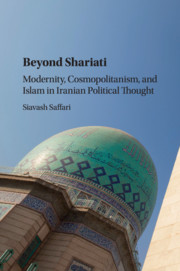
    Ali Shariati (1933–77) has been called by many the 'ideologue of the Iranian Revolution'. An inspiration to many of the revolutionary generation, Shariati's combination of Islamic political thought and Left-leaning ideology continues to influence both in Iran and across the wider Muslim world. In this book, Siavash Saffari examines Shariati's long-standing legacy, and how new readings of his works by contemporary 'neo-Shariatis' have contributed to a deconstruction of the false binaries of Islam/modernity, Islam/West, and East/West. Saffari argues that through their critique of Eurocentric metanarratives on the one hand, and the essentialist conceptions of Islam on the other, Shariati and neo-Shariatis have carved out a new space in Islamic thought beyond the traps of Orientalism and Occidentalism. This unique perspective will hold great appeal to researchers of the politics and intellectual thought of post-revolutionary Iran and the greater Middle East.

    Awards

    Co-winner, 2018 First Book Award, Foundations of Political Theory, American Political Science Association

    Reviews

    ‘Beyond Shariati signals the opening horizons of a fertile critical thinking to come.'

    Hamid Dabashi - Columbia University, New York

    ‘By focusing on the Iranian thinker, Dr Ali Shariati and his influence on modernist thinkers in Iran and beyond in the Muslim world, Siavash Saffari has challenged prevailing theses that privilege Eurocentric analysis of the history of modernization in the global context … No student of modern Islam or Iran can afford to ignore this valuable contribution.'

    Abdulaziz Sachedina - George Mason University, Virginia

    ‘In recent times, the relation between Western modernity and Islam has been a prominent topic of social-theoretical discussions … By focusing attention on the Iranian intellectual Ali Shariati and his later followers (the ‘neo-Shariatis'), Saffari shows that customary binaries - such as ‘Western universalism' vs ‘Islamic parochialism' - are hasty abstractions and also neglect a crucial geopolitical binary: that between center and periphery, between colonizers and colonized.'

    Fred Dallmayr - University of Notre Dame, Indiana

    Refine List

    Actions for selected content:

    Select all | Deselect all
    • View selected items
    • Export citations
    • Download PDF (zip)
    • Save to Kindle
    • Save to Dropbox
    • Save to Google Drive

    Save Search

    You can save your searches here and later view and run them again in "My saved searches".

    Please provide a title, maximum of 40 characters.
    ×

    Contents

    Metrics

    Altmetric attention score

    Full text views

    Total number of HTML views: 0
    Total number of PDF views: 0 *
    Loading metrics...

    Book summary page views

    Total views: 0 *
    Loading metrics...

    * Views captured on Cambridge Core between #date#. This data will be updated every 24 hours.

    Usage data cannot currently be displayed.

    Accessibility standard: Unknown

    Why this information is here

    This section outlines the accessibility features of this content - including support for screen readers, full keyboard navigation and high-contrast display options. This may not be relevant for you.

    Accessibility Information

    Accessibility compliance for the PDF of this book is currently unknown and may be updated in the future.
