
Skip to main content Accessibility help
×
  • Cited by 15
    • Show more authors
    • You may already have access via personal or institutional login
    • Select format
    • Publisher:
      Cambridge University Press
      Publication date:
      28 September 2019
      17 October 2019
      ISBN:
      9781108367592
      9781108421225
      9781108431613
      Dimensions:
      (228 x 152 mm)
      Weight & Pages:
      0.59kg, 338 Pages
      Dimensions:
      (228 x 152 mm)
      Weight & Pages:
      0.48kg, 339 Pages
    You may already have access via personal or institutional login
  • Selected: Digital
    Add to cart View cart Buy from Cambridge.org

    Book description

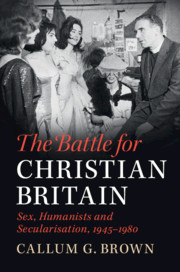
    Post-war British culture was initially dominated by religious-led sexual austerity and, from the sixties, by secular liberalism. Using five case studies of local licensing and a sixth on the BBC, conservative Christians are exposed here as the nation's censors, fighting effectively for purity on stage, screen and in public places. The Anglican-led Public Morality Council was astonishingly successful in restraining sex in London's media in the fifties, but a brazen sexualised culture thrived amongst the millions of tourists to Blackpool, whilst Glasgow and the Isle of Lewis were gripped by conservatism. But come the late 1960s, tourists took Blackpool's sexual liberalism home, whilst progressive Humanism burrowed into Parliament and the BBC to secularise moral reform and the national narrative. Using extensive archival research, Callum G. Brown adopts a secular gaze to show how conservative Christians lost the battle for the nation's moral culture.

    Reviews

    'Grounded in meticulous archival research, Callum G. Brown’s insightful historical explication is a vital contribution to understanding the how and why of contemporary non-religion. Brown expertly demonstrates why it is important for all of us interested in non-religion to pay careful attention to the historical forces that shape the present.'

    Lori G. Beaman - University of Ottawa

    'A fascinating examination of how the resurgent religious culture of 1950s Britain was undermined by the intellectual, political and social shifts of the 1960s and 1970s. Deeply researched, and written with the author's customary verve, Brown’s regional approach offers an important challenge to London-centric narratives of permissiveness.'

    Adrian Bingham - University of Sheffield

    'This work admirably illuminates both the miasmatic conservative Christian moral vigilantism that pervasively afflicted the ‘long 1950s’, and its collapse. It makes a powerful case for looking beyond narratives that centre London and ‘the establishment’ to explore regional differences and localised initiatives in social change.'

    Lesley Hall - author of Sex, Gender and Social Change in Britain since 1880

    'This rollicking survey of the defeat of a formidable Christian social, cultural and moral hegemony by sex, drugs, rock and roll and TV satire fundamentally reappraises religious change in Sixties Britain. A daring and devastating sortie on the scholarly consensus.'

    Alana Harris - King’s College London

    'For twenty years Brown has set the international agenda for histories of secularisation. He now breaks new ground by highlighting the rising influence of Humanists in the 1960s and 70s, through campaigning and especially through television. Well-researched, forcefully argued and highly readable, the book will stimulate a lively debate.'

    Hugh McLeod - University of Birmingham

    ‘Brown’s work is a meticulously researched meditation on the entanglements between sex and religion … this book will provoke lively debate among historians of modern Britain.’

    David Geiringer Source: Journal of British Studies

    ‘… The battle for Christian Britain makes a valuable contribution to questioning and rethinking the ways in which historians research and write about the religious and sexual transformations of the period. Its most significant contribution is likely to be in provoking further discussion and debate on these issues.’

    Laura Ramsay Source: Journal of Ecclesiastical History

    Refine List

    Actions for selected content:

    Select all | Deselect all
    • View selected items
    • Export citations
    • Download PDF (zip)
    • Save to Kindle
    • Save to Dropbox
    • Save to Google Drive

    Save Search

    You can save your searches here and later view and run them again in "My saved searches".

    Please provide a title, maximum of 40 characters.
    ×

    Contents

    Metrics

    Altmetric attention score

    Full text views

    Total number of HTML views: 0
    Total number of PDF views: 0 *
    Loading metrics...

    Book summary page views

    Total views: 0 *
    Loading metrics...

    * Views captured on Cambridge Core between #date#. This data will be updated every 24 hours.

    Usage data cannot currently be displayed.

    Accessibility standard: Unknown

    Why this information is here

    This section outlines the accessibility features of this content - including support for screen readers, full keyboard navigation and high-contrast display options. This may not be relevant for you.

    Accessibility Information

    Accessibility compliance for the PDF of this book is currently unknown and may be updated in the future.
