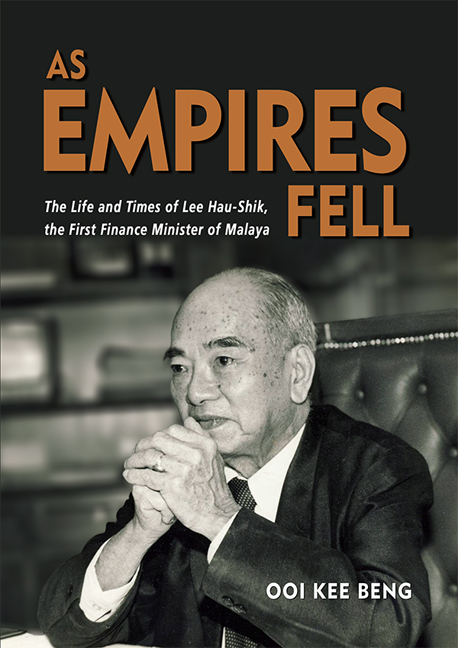
As Empires Fell

-
Select format
-
- Publisher:
- ISEAS–Yusof Ishak Institute
- Publication date:
- 24 November 2020
- 22 June 2020
- ISBN:
- 9789814881456
- 9789814881449
- Dimensions:
- Weight & Pages:
- Dimensions:
- Weight & Pages:
- Series:
- Local History and Memoirs
Show more authors 
You may already have access via personal or institutional login
Book description
To understand how independence was gained for a politically complex country such as Malaysia, and how its structure took form requires familiarity with the key players involved. More importantly, only by locating these actors within the changing socio-political context in which they specifically lived does their influence both before and after the birth of the country become clear. Having written potent biographies about Malaysian and Singapore leaders such as Ismail Abdul Rahman, the Deputy Prime Minister of Malaysia who died in 1973, Goh Keng Swee, the economic architect and one of the founding fathers of the Republic of Singapore, and Lim Kit Siang, the unwavering opposition leader of Malaysia, Ooi Kee Beng now tells the story of Lee Hau-Shik, based on the latter's extensive private papers housed at ISEAS Library, Singapore. Born in Hong Kong to a highly prominent family at a time when the Qing Dynasty was falling, Hau-Shik received degrees in Law and Economics in Cambridge and became a successful tin miner in British Malaya and an influential member of Kuala Lumpur's colonial society. After the Second World War, his influence in elite circles in China, Britain and Malaya allowed him to play a key role in the gaining of independence for Malaysia. He was one of the founders of the Malayan Chinese Association, and served as the country's first Minister of Finance."Ooi Kee Beng's new book on H.S. Lee provides a remarkable picture of an "unlikely politician" who made major contributions to the formation of the early Malayan state. It adds another dimension of study to the formidable task of nation building in a multi-communal society and is an excellent follow-up to his widely praised study of Tun Ismail as the 'reluctant politician'." -- Wang Gungwu, National University of Singapore"Set against the global turbulence that marks the birth of modern Malaysia, Ooi Kee Beng has given us a compelling account of Sir Henry Lee Hau Shik's personal life and political career, his role in the move to independence and the indelible imprint he left on the country's history. In highlighting and contextualizing H.S. Lee's own papers, As Empires Fell should be read by all those interested in how Malaysia came to be." -- Barbara Watson Andaya, University of Hawaii
Contents
Contents
Metrics
Full text views
Full text views helpTotal number of HTML views: 0
Total number of PDF views: 0 *
 Loading metrics...
* Views captured on Cambridge Core between #date#. This data will be updated every 24 hours.
Usage data cannot currently be displayed.
Accessibility standard: Unknown
Why this information is here
This section outlines the accessibility features of this content - including support for screen readers, full keyboard navigation and high-contrast display options. This may not be relevant for you.
Accessibility Information
Accessibility compliance for the PDF of this book is currently unknown and may be updated in the future.