
Skip to main content Accessibility help
×
  • Cited by 8
    • Show more authors
    • You may already have access via personal or institutional login
    • Select format
    • Publisher:
      Cambridge University Press
      Publication date:
      04 August 2018
      16 August 2018
      ISBN:
      9781108560061
      9781108472364
      Dimensions:
      (247 x 174 mm)
      Weight & Pages:
      1.19kg, 476 Pages
      Dimensions:
      Weight & Pages:
    You may already have access via personal or institutional login
  • Selected: Digital
    Add to cart View cart Buy from Cambridge.org

    Book description

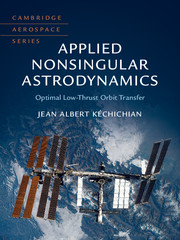
    This essential book describes the mathematical formulations and subsequent computer simulations required to accurately project the trajectory of spacecraft and rockets in space, using the formalism of optimal control for minimum-time transfer in general elliptic orbit. The material will aid research students in aerospace engineering, as well as practitioners in the field of spaceflight dynamics, in developing simulation software to carry out trade studies useful in vehicle and mission design. It will teach readers to develop flight software for operational applications in autonomous mode, so to actually transfer space vehicles from one orbit to another. The practical, real-life applications discussed will give readers a clear understanding of the mathematics of orbit transfer, allow them to develop their own operational software to fly missions, and to use the contents as a research tool to carry out even more complex analyses.

    Reviews

    'This book represents a lifetime of valuable contributions to optimal low-thrust orbit transfer.'

    John E. Prussing - University of Illinois

    ‘This is a book for specialists in orbital dynamics, authored by one of the leading current practitioners in the field. Its subtitle, ‘Optimal Low-thrust Orbit Transfer’ reflects one of the principal technical drivers behind the book, namely that an increasing number of satellites in Earth orbit are now using more fuel-efficient ion thrusters which have far lower thrust-levels than their chemically-propelled predecessors. As a consequence, there is an increasing need to optimise the longer trajectories - both in terms of time and distance travelled - that result from the use of this technology.’

    Stuart Eves Source: The Aeronautical Journal

    Refine List

    Actions for selected content:

    Select all | Deselect all
    • View selected items
    • Export citations
    • Download PDF (zip)
    • Save to Kindle
    • Save to Dropbox
    • Save to Google Drive

    Save Search

    You can save your searches here and later view and run them again in "My saved searches".

    Please provide a title, maximum of 40 characters.
    ×

    Contents

    • 4 - Optimal Low-Thrust Transfer Using Variable Bounded Thrust
      pp 135-153

    Metrics

    Altmetric attention score

    Full text views

    Total number of HTML views: 0
    Total number of PDF views: 0 *
    Loading metrics...

    Book summary page views

    Total views: 0 *
    Loading metrics...

    * Views captured on Cambridge Core between #date#. This data will be updated every 24 hours.

    Usage data cannot currently be displayed.

    Accessibility standard: Unknown

    Why this information is here

    This section outlines the accessibility features of this content - including support for screen readers, full keyboard navigation and high-contrast display options. This may not be relevant for you.

    Accessibility Information

    Accessibility compliance for the PDF of this book is currently unknown and may be updated in the future.
