
Skip to main content Accessibility help
×
  • Cited by 18
    • Show more authors
    • You may already have access via personal or institutional login
    • Select format
    • Publisher:
      Cambridge University Press
      Publication date:
      23 March 2020
      02 April 2020
      ISBN:
      9781316217320
      9781107103603
      9781107503205
      Dimensions:
      (228 x 152 mm)
      Weight & Pages:
      0.78kg, 352 Pages
      Dimensions:
      (229 x 152 mm)
      Weight & Pages:
      0.71kg, 472 Pages
    You may already have access via personal or institutional login
  • Selected: Digital
    Add to cart View cart Buy from Cambridge.org

    Book description

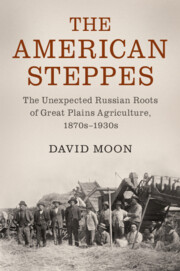
    Beginning in the 1870s, migrant groups from Russia's steppes settled in the similar environment of the Great Plains. Many were Mennonites. They brought plants, in particular grain and fodder crops, trees and shrubs, as well as weeds. Following their example, and drawing on the expertise of émigré Russian-Jewish scientists, the US Department of Agriculture introduced more plants, agricultural sciences, especially soil science; and methods of planting trees to shelter the land from the wind. By the 1930s, many of the grain varieties in the Great Plains had been imported from the steppes. The fertile soil was classified using the Russian term 'chernozem'. The US Forest Service was planting shelterbelts using techniques pioneered in the steppes. And, tumbling across the plains was an invasive weed from the steppes: tumbleweed. Based on archival research in the United States, Russia, Ukraine, and Kazakhstan, this book explores the unexpected Russian roots of Great Plains agriculture.

    Reviews

    'A fresh and significant new perspective on the perception and understanding of the Great Plains of North America in the light of scientific research carried out far away, on the other side of the planet, the Russian steppe country, which turns out to have had many surprising linkages with its North American counterpart.'

    Donald Worster - Distinguished Foreign Expert, Renmin University of China

    'The American Steppes is a heartening exemplar of transnational history done rightly and responsibly. David Moon has the reach to comprehend the complicated and cumulative processes by which Russian experience contributed to wheat culture, soil science, and shelterbelt establishment on the plains, and he does it with depth, through archival research that exhibits rich layers, like chernozem soils.'

    Tom Isern - Professor of History and University Distinguished Professor, North Dakota State University

    'David Moon’s terrific book demonstrates how deeply prior pioneering experience and scientific study in the Russian steppes influenced farming on the North American Great Plains (or, as Moon so appropriately dubs them, ‘the American Steppes’). This welcome corrective to generations of Great Plains scholarship permanently alters our telling of an iconic American environmental history.'

    Geoff Cunfer - University of Saskatchewan

    ‘This remarkable, incredibly well-researched book reminds readers that national differences are outweighed not just by similarities but by direct connections as well … Highly recommended.’

    T. P. Bowman Source: Choice

    ‘ …Moon’s study is eminently convincing. He makes careful, evidence based connections, though after reading it is tempting to search for Russian influences elsewhere in the social realism of the Newton sculpture for instance. One admirable feature of Moon’s text is his clear delineation of the book’s aims. a coherent read. … The American Steppes is an important entry into the growing body of literature that positions the American West within global histories. Aside from the obvious audiences of environmental and agricultural historians, The American Steppes will be of interest to anyone looking for a transnational study that does not devolve into mere comparisons. Finally, Moon’s book will appeal to Plains people who are interested in a more nuanced story of their Russian roots.’

    Michaela Rife Source: Agricultural History Review

    ‘… with this rich, stimulating study, Moon had done much to push historians of Russia and the United States to think more comparatively and to question entrenched notions of Russian and American uniqueness.’

    Sarah Cameron Source: The Russian Review

    ‘the work is a masterpiece.’

    Royden Loewen Source: Journal of Mennonite Studies

    Refine List

    Actions for selected content:

    Select all | Deselect all
    • View selected items
    • Export citations
    • Download PDF (zip)
    • Save to Kindle
    • Save to Dropbox
    • Save to Google Drive

    Save Search

    You can save your searches here and later view and run them again in "My saved searches".

    Please provide a title, maximum of 40 characters.
    ×

    Contents

    • Chapter 1 - Settlement
      pp 39-53
    • Chapter 2 - Barriers
      pp 54-84

    Metrics

    Altmetric attention score

    Full text views

    Total number of HTML views: 0
    Total number of PDF views: 0 *
    Loading metrics...

    Book summary page views

    Total views: 0 *
    Loading metrics...

    * Views captured on Cambridge Core between #date#. This data will be updated every 24 hours.

    Usage data cannot currently be displayed.

    Accessibility standard: Unknown

    Why this information is here

    This section outlines the accessibility features of this content - including support for screen readers, full keyboard navigation and high-contrast display options. This may not be relevant for you.

    Accessibility Information

    Accessibility compliance for the PDF of this book is currently unknown and may be updated in the future.
