Aftermath

-
Select format
-
- Publisher:
- Jagiellonian University Press
- Publication date:
- 06 November 2021
- 21 August 2022
- ISBN:
- 9788323370024
- 9788323347187
- Dimensions:
- Weight & Pages:
- Dimensions:
- Weight & Pages:
You may already have access via personal or institutional login
Show more authors 
You may already have access via personal or institutional login
Book description
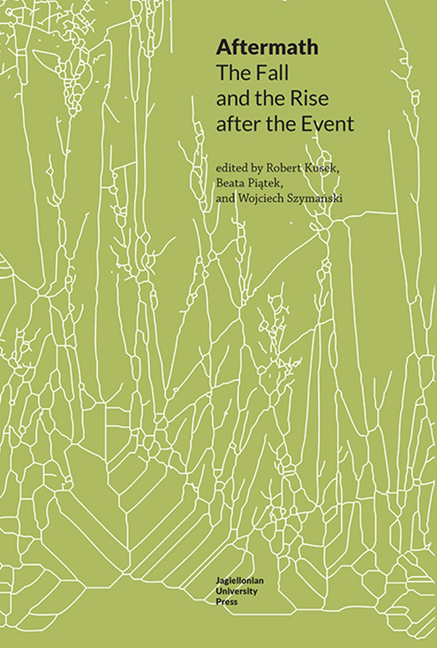
What happens in the wake of the event? Is the event's aftermath always characterised by the experience of disorder, fragmentation, and impermanence? Or, alternatively, can aftermath be seen as a new growth, a second crop of grass that can be sown and reaped and which gives rise to a new integrity, a new unity? The volume's twenty-three essays by scholars from Australia, France, Germany, India, Ireland, Luxembourg, New Zealand, Poland, Spain, and the United States re-visit the notion and representation of aftermath, understood here widely as a consequence/result/after-effect of a seminal event (to an individual, a community, society, regions or nations), and explore its transformative and life-changing characteristics. While acknowledging disastrous or catastrophic consequences of the event, Aftermath argues in favour of recognising some rejuvenating potential of its after-effects.
Contents
Contents
Metrics
Full text views
Full text views helpTotal number of HTML views: 0
Total number of PDF views: 0 *
 Loading metrics...
* Views captured on Cambridge Core between #date#. This data will be updated every 24 hours.
Usage data cannot currently be displayed.
Accessibility standard: Unknown
Why this information is here
This section outlines the accessibility features of this content - including support for screen readers, full keyboard navigation and high-contrast display options. This may not be relevant for you.
Accessibility Information
Accessibility compliance for the PDF of this book is currently unknown and may be updated in the future.