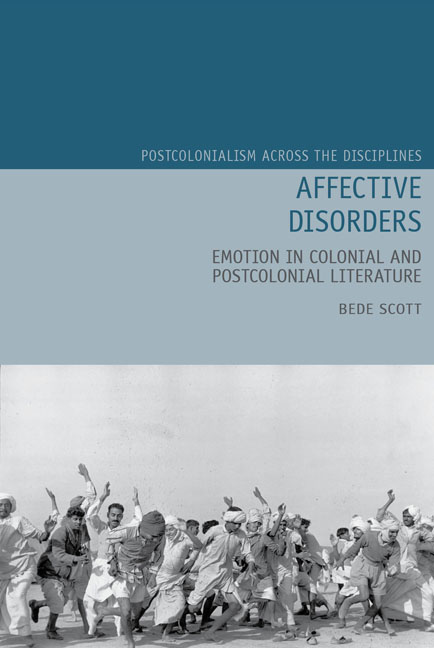
Affective Disorders

-
The digital format of this book is no longer available to purchase from Cambridge Core. Other formats may be available.
-
Select format
-
- Publisher:
- Liverpool University Press
- Publication date:
- 02 July 2020
- 28 September 2019
- ISBN:
- 9781786949639
- 9781786941701
- Dimensions:
- Weight & Pages:
- Dimensions:
- Weight & Pages:
- Subjects:
- Classical Studies, Classical Literature
You may already have access via personal or institutional login- Subjects:
- Classical Studies, Classical Literature
Show more authors 
You may already have access via personal or institutional login
Book description
An Open Access edition of this book is available on the Liverpool University Press website andthrough Knowledge Unlatched.
Situated at the intersection of postcolonial studies, affect studies, and narratology, Affective Disorders explores the significance of emotion in a range of colonial and postcolonial narratives. Through close readings of Naguib Mahfouz, Joaquim Maria Machado de Assis, and Upamanyu Chatterjee, among others, Bede Scott argues that literary representations of emotion need not be interpreted solely at the level of character, individual psychology, or the contingencies of plotting, but could also be related to broader sociopolitical forces. We thus find episodes of anger that serve as a collective response to the 'modernity' of wartime Cairo, feelings of jealousy that are inspired by the slave economy of imperial Brazil, and an overwhelming sense of boredom that emerges, in the late eighties, out of the bureaucratic procedures of the Indian Administrative Service. Affective Disorders also explores in some detail the formal consequences of these feelings – the way in which affective states such as anger or jealousy can often destabilize narratives, provoking crises of representation, generic ambivalence, and discursive rupture. By emphasizing the social origin of these emotions, and by analysing their influence on literary discourse, this study provides a deeper understanding of the relationship between various sociopolitical forces and the affective and aesthetic 'disorders' to which they give rise.
Contents
Contents
Metrics
Altmetric attention score
Full text views
Full text views helpTotal number of HTML views: 0
Total number of PDF views: 0 *
 Loading metrics...
* Views captured on Cambridge Core between #date#. This data will be updated every 24 hours.
Usage data cannot currently be displayed.
Accessibility standard: Unknown
Why this information is here
This section outlines the accessibility features of this content - including support for screen readers, full keyboard navigation and high-contrast display options. This may not be relevant for you.
Accessibility Information
Accessibility compliance for the PDF of this book is currently unknown and may be updated in the future.