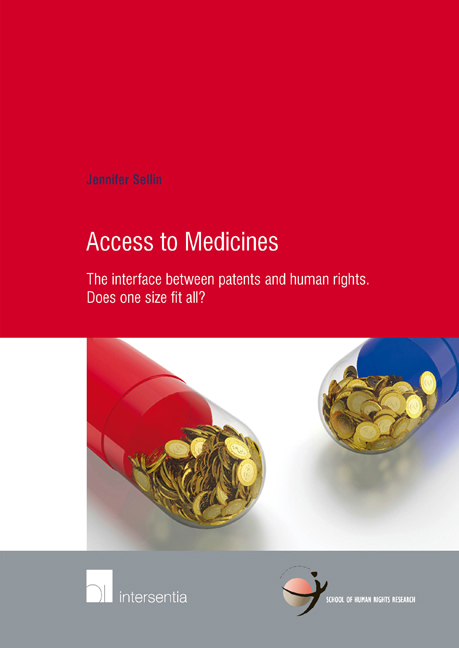
Access to Medicines

-
Select format
-
- Publisher:
- Intersentia
- Publication date:
- 22 November 2017
- 25 June 2014
- ISBN:
- 9781780685083
- 9781780682471
- Dimensions:
- Weight & Pages:
- Dimensions:
- Weight & Pages:
- Subjects:
- Law, Human Rights
- Series:
- School of Human Rights Research
You may already have access via personal or institutional login- Subjects:
- Law, Human Rights
- Series:
- School of Human Rights Research
Show more authors 
You may already have access via personal or institutional login
Book description
Millions of people worldwide lack adequate access to medicines, particularly in developing countries where resources are scarce with devastating human, social and economic consequences. The example of HIV/AIDS, for which treatment has advanced so significantly in the last decade that a diagnosis no longer necessarily brings with it a death sentence, highlights the importance of ensuring that essential medicines are affordable and accessible to all. This book focuses on one aspect of access to medicines: the affordability of essential medicines, and its connection to human rights and patents. The argument often made is that patent protection for medicines results in higher prices which negatively impacts access. Patients having no or inadequate access to affordable medicines endangers the full realisation of human rights, particularly the right to health. This book investigates this issue from a legal perspective, taking both an international and domestic angle. This study examines the interface of access to affordable medicines and patent protection from the perspective of international human rights law and the Agreement on Trade-Related Aspects of Intellectual Property Rights (TRIPS) within the framework of the World Trade Organisation. The essential question posed by this book is whether access to medicines and patent protection conflict or coexist. The discussion is deepened by including a developing country approach. Three country studies have been conducted, on South Africa, India and Uganda. These aim to provide a concrete insight into whether these countries recognise and acknowledge the interplay between patents and human rights with respect to access to medicines. Secondly these studies examine whether TRIPS leaves sufficient freedom for (developing) states to adopt a patent system suited to their domestic needs, enabling them to strike a fair balance between access to medicines and patent protection for medicines. In other words: does one size fit all?This book is targeted at both academics and human rights practitioners, including government officials, human rights advocates and NGOs. It goes further than a mere theoretical discussion on the issue from an international law perspective by providing an in-depth examination of domestic (legal) frameworks relevant for the issue of access to medicines. It illustrates that the normative force of human rights in combination with social movement can provide a powerful tool for prioritising the health needs of the global poor.
Contents
Contents
Metrics
Full text views
Full text views helpTotal number of HTML views: 0
Total number of PDF views: 0 *
 Loading metrics...
* Views captured on Cambridge Core between #date#. This data will be updated every 24 hours.
Usage data cannot currently be displayed.
Accessibility standard: Unknown
Why this information is here
This section outlines the accessibility features of this content - including support for screen readers, full keyboard navigation and high-contrast display options. This may not be relevant for you.
Accessibility Information
Accessibility compliance for the PDF of this book is currently unknown and may be updated in the future.