Editors’ Introduction
Published online by Cambridge University Press: 20 October 2023

Summary
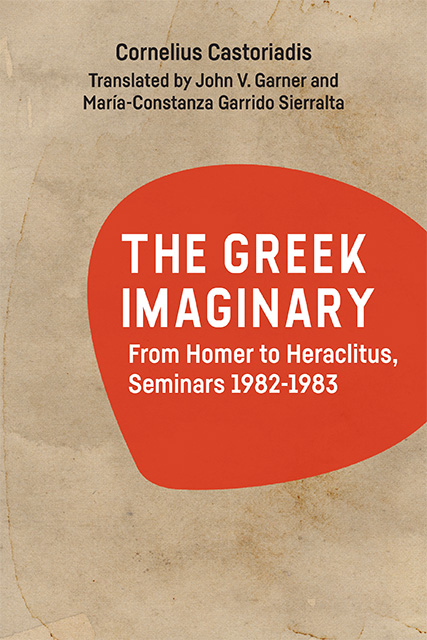
This volume, The Greek Imaginary: From Homer to Heraclitus, Seminars 1982–1983, covers the first five months of Castoriadis’s teaching, in 1982–1983, at the School for Advanced Studies in Social Sciences (EHESS) in Paris. These months’ unity of tone and topic seems to us to justify their separate publication. We will group in a second volume, La Cité et les Lois, the seminars from the remainder of that academic year and those from 1983–1984, which focus on the institutions of the democratic polis and in particular on the selflimitation of democracy as it appears, for example, in the political dimension of tragedy. This volume is first in chronological order among the full publication of Castoriadis’s seminars (1980–1995). There is in fact no transcription for the years 1980–1982, and the few recordings found were unusable. Only the report that Castoriadis himself wrote for the School’s annual publication (which we reproduce in the supplemental material [Appendix A]) makes possible a relatively accurate picture of their content.
See below the overall plan for the publication of the seminars, published under the title of La Création humaine, with the understanding that the order of the publication of the volumes will not necessarily respect the chronology and that the titles are not definitive.
• Ce qui fait la Grèce, 1. D’Homère à Héraclite (1982–1983) [this volume]
• Ce qui fait la Grèce, 2. La Cité et les Lois (1983–1984)
• Thucydide, La force et le droit (1984–1985)
• Imaginaire politique grec et moderne, followed by Sur Le Politique de Platon (1985–1986)
• Sujet et vérité dans le monde social-historique (1986–1987) [published in French in 2002]
• Temps et création (1987–1988)
• Validité de fait et validité de droit (1988–1989)
• Ontologie et modes d’être (1989–1990)
• Sens et significations philosophiques (1990–1991)
• Les Différent modes du faire théorique (1991–1992)
• Psyché et représentation, 1 (1992–1993)
• Psyché et représentation, 2 (1993–1995)
In 1980–1982 Castoriadis deepened the idea, which had been at the center of his work The Imaginary Institution of Society (1964–1975), of the social-historical as a field of creation “that makes itself exist while making exist the institution and the social imaginary significations that incarnate it.”
Information
- Type
- Chapter
- Information
- The Greek ImaginaryFrom Homer to Heraclitus, Seminars 1982-1983, pp. xvii - xxviiiPublisher: Edinburgh University PressPrint publication year: 2023
Accessibility standard: Unknown
Why this information is here
This section outlines the accessibility features of this content - including support for screen readers, full keyboard navigation and high-contrast display options. This may not be relevant for you.Accessibility Information
Accessibility compliance for the PDF of this book is currently unknown
and may be updated in the future.