Book contents
- Frontmatter
- Contents
- List of Illustrations
- Contributors and Editors
- Acknowledgments
- List of Abbreviations
- Simpson: An Interim Report
- PART I THE HERMENEUTICS OF RECOGNITION
- PART II GENRE AND FIGURE
- PART III CULTURE AND INSTITUTIONS
- PART IV REFORMATIONS
- James Simpson’s Publications from 1984 to 2024
- Bibliography
- A Note on the Bloomfield Conferences
- General Index
- Tabula Gratulatoria
2 - “Stuffed with Divine Words”: Undigested Texts in Early Medieval England
Published online by Cambridge University Press: 17 May 2024
By

Book contents
- Frontmatter
- Contents
- List of Illustrations
- Contributors and Editors
- Acknowledgments
- List of Abbreviations
- Simpson: An Interim Report
- PART I THE HERMENEUTICS OF RECOGNITION
- PART II GENRE AND FIGURE
- PART III CULTURE AND INSTITUTIONS
- PART IV REFORMATIONS
- James Simpson’s Publications from 1984 to 2024
- Bibliography
- A Note on the Bloomfield Conferences
- General Index
- Tabula Gratulatoria
Summary
“[T]he students of monuments and records … ought to amass no more than they can digest”
Samuel JohnsonFrom the fifteenth century, when the verb “digest” first entered the English language, the act could refer both to the scholarly work of mulling over food for thought and the bodily one of breaking down organic matter in the stomach. One could hope to digest both “hye witt” and “baskettes of breedes.” I say hope because, of course, digestion sometimes fails. While there is a longstanding understanding of reading as a kind of consuming, there is an equally long tradition of readers who fail to take in their reading matter or who only absorb it incompletely. In more ways than one, then, reading was a matter of taste. As the opening to the Old English poem now known as Solomon and Saturn I hints, however, when we read something carefully, we do not merely taste it; we digest, even as some texts prove frustratingly inedible.
Many early medieval English riddles center on precisely that range of readerly (in)digestibility. While all riddles are designed to provide food for thought and consequently invite close and careful reading, some resist any easy digestion. Several even foreground this kind of unproductive reading directly by presenting tantalizing scenes of empty consumption, from Aldhelm's Enigma 89, in which a bookchest is “stuffed with divine words” (“divinis complentur … verbis”) but fails to profit from the books that fill it, to Exeter Book Riddle 45, whose moth similarly “was not a whit the wiser” (“ne wæs / wihte þy gleawra”) although he “ate words” (“word fræt”). Centering on these two figures, this essay explores the motif of reading as failed digestion, in contrast to the ruminative reading practice advocated by thinkers like Bede. Together, these acts of consumption invite us to reconsider two of the most puzzling digestive remnants in early medieval literature: the Donestre's victims, whose heads they weep over after consuming the rest of their bodies, and the beheaded figure of Æschere, the king's counselor in Beowulf.
Information
- Type
- Chapter
- Information
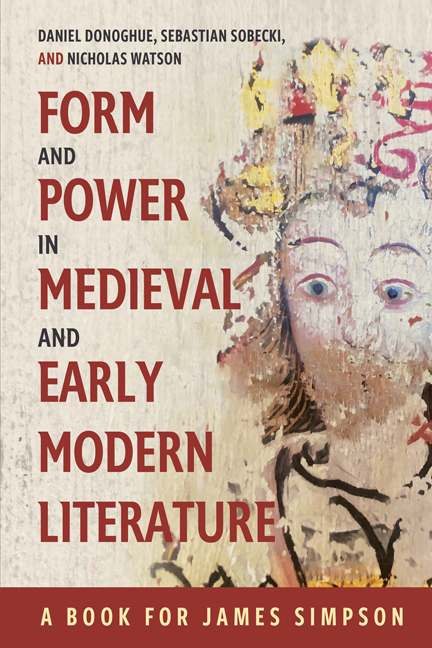
- Form and Power in Medieval and Early Modern LiteratureA Book for James Simpson, pp. 35 - 48Publisher: Boydell & BrewerPrint publication year: 2024
Accessibility standard: Unknown
Why this information is here
This section outlines the accessibility features of this content - including support for screen readers, full keyboard navigation and high-contrast display options. This may not be relevant for you.Accessibility Information
Accessibility compliance for the PDF of this book is currently unknown
and may be updated in the future.