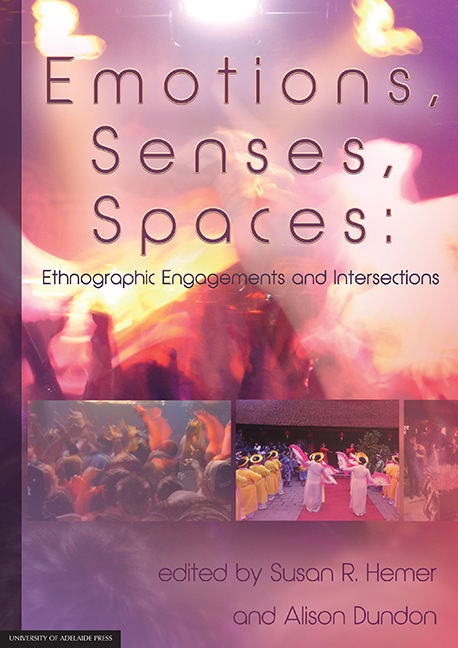
Book contents
- Frontmatter
- Contents
- Biographies
- 1 Ethnographic intersections: Emotions, senses and spaces
- 2 ‘Dancing for joy’: Gender and relational spaces in Papua New Guinea
- 3 Creating the right ‘vibe’: Exploring the utilisation of space at Hip Hop concerts in Adelaide and Melbourne
- 4 Pontic dance: Feeling the absence of homeland
- 5 Emotional actors/Affective agents: Interspecies edgework and sociotechnical networks in the Spanish bullfight from horseback (rejoneo)
- 6 Sensual feasting: Transforming spaces and emotions in Lihir
- 7 Anxious spaces: The intersection of sexuality, the senses and emotion in fieldwork in Nepal
- 8 Interrupted research: Emotions, senses and social space in (and out of) the field
- 9 Voices in the park: The composition of sacred space and public place
- 10 Ngadha being-in-common: Emotional attachment to people and place in Flores, Indonesia
- 11 Trust your senses: Growing wine and making place in McLaren Vale
8 - Interrupted research: Emotions, senses and social space in (and out of) the field
Published online by Cambridge University Press: 25 July 2017

Book contents
- Frontmatter
- Contents
- Biographies
- 1 Ethnographic intersections: Emotions, senses and spaces
- 2 ‘Dancing for joy’: Gender and relational spaces in Papua New Guinea
- 3 Creating the right ‘vibe’: Exploring the utilisation of space at Hip Hop concerts in Adelaide and Melbourne
- 4 Pontic dance: Feeling the absence of homeland
- 5 Emotional actors/Affective agents: Interspecies edgework and sociotechnical networks in the Spanish bullfight from horseback (rejoneo)
- 6 Sensual feasting: Transforming spaces and emotions in Lihir
- 7 Anxious spaces: The intersection of sexuality, the senses and emotion in fieldwork in Nepal
- 8 Interrupted research: Emotions, senses and social space in (and out of) the field
- 9 Voices in the park: The composition of sacred space and public place
- 10 Ngadha being-in-common: Emotional attachment to people and place in Flores, Indonesia
- 11 Trust your senses: Growing wine and making place in McLaren Vale
Summary
Abstract
This chapter reflexively explores the emotions, senses and social spaces that are shared between researcher and informants. I examine the ways in which an interruption to my ethnographic fieldwork on online memorialisation in Vietnam transformed the experience of research, as well as the ways I was positioned in relation to informants. Drawing on reflexive material, I demonstrate how the experience of returning home to my critically ill mother transformed my social space as a researcher when returning to Vietnam. Through the heightened emotional experience of coming home and being with my mother, amplified by the dulling of senses within the hospital walls and the monotony of illness, I underwent experiences which could be usefully applied to my relationship with informants. Consequently, when I returned to Vietnam, an altered social space opened up where I could empathise more readily with the emotions associated with having a family member close to death, and was accepted in a new way by informants.
Introduction
The detachment of the scientific observer … by itself can never be sufficient; there has to be a way of providing for readers imaginative access to the emotional significance of events as felt by the informants … One has to become inward with a culture, and one possible avenue here is by a confrontation of one's own emotional responses with those of the people with whom one lives. (Watson 1999:144)
In 2012 I undertook twelve months of ethnographic research within the three major cities of Vietnam: Hanoi, Da Nang and Ho Chi Minh City. The research was concerned with remembering the dead in Vietnam via new mediated forms of communication such as the internet, and the various connections and tensions this created with the dominant forms of ancestral worship in the country. Such research was largely undertaken in the online memorial website Nghĩa Trang Online [NTO], and also through offline encounters with members of the site. In this I was immersed in the experiences of those who had lost loved ones, sometimes in ‘good deaths’, such as the passing of a grandparent in their home, and often through ‘bad deaths’, such as by abortion, motorcycle accidents and death through warfare.
Information
- Type
- Chapter
- Information
- Emotions, Senses, SpacesEthnographic Engagements and Intersections, pp. 123 - 136Publisher: The University of Adelaide PressPrint publication year: 2016
Accessibility standard: Unknown
Why this information is here
This section outlines the accessibility features of this content - including support for screen readers, full keyboard navigation and high-contrast display options. This may not be relevant for you.Accessibility Information
Accessibility compliance for the PDF of this book is currently unknown
and may be updated in the future.