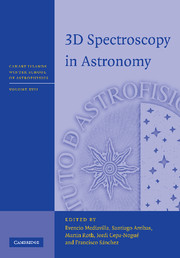
Crossref Citations

This Book has been cited by the following publications. This list is generated based on data provided by Crossref.
2012.
Measuring the Universe.
p.
154.
Schmälzlin, Elmar
Moralejo, Benito
Rutowska, Monika
Monreal-Ibero, Ana
Sandin, Christer
Tarcea, Nicolae
Popp, Jürgen
and
Roth, Martin
2014.
Raman Imaging with a Fiber-Coupled Multichannel Spectrograph.
Sensors,
Vol. 14,
Issue. 11,
p.
21968.
Ranganathan, Mohanakrishna
Sankarasubramanian, K.
Bayanna, A. R.
and
Mathew, S. K.
2018.
Lenslet Array and Fabry–Pérot Based Hyperspectral Imaging.
The Astrophysical Journal,
Vol. 867,
Issue. 1,
p.
77.
Moralejo, Benito
Schmälzlin, Elmar
Bodenmüller, Daniel
Fechner, Thomas
and
Roth, Martin M.
2018.
Improving the frame rates of Raman image sequences recorded with integral field spectroscopy using windowing and binning methods.
Journal of Raman Spectroscopy,
Vol. 49,
Issue. 2,
p.
372.
Matsui, Yoshihiko
Suwa, Akihiro
and
Kato, Kazuya
2019.
Feasibility of Time-Resolved Integral Field Spectroscopy for Vacuum Arc Observation.
p.
122.
Orekhova, Mariia
and
Bakholdin, Alexey
2020.
An Integral Field Unit Based on Parabolic Mirror.
Proceedings of the 30th International Conference on Computer Graphics and Machine Vision (GraphiCon 2020). Part 2,
p.
short48-1.
Matsui, Yoshihiko
Suwa, Akihiro
Kato, Kazuya
and
Niwakawa, Makoto
2021.
Observation of Vacuum Arcs with Time-Resolved Integral Field Spectroscopy.
IEEJ Transactions on Power and Energy,
Vol. 141,
Issue. 11,
p.
695.
Matsui, Yoshihiko
Suwa, Akihiro
Kato, Kazuya
and
Niwakawa, Makoto
2021.
Proposal of Time-Resolved Integral Field Spectroscopy for Vacuum Arc Observation.
p.
253.
Kukushkin, Dmitrii E.
Sazonenko, Dmitrii A.
Valyavin, Gennady G.
and
Bakholdin, Alexey V.
2023.
High-resolution astronomical spectrograph design method with a single echelle grating.
Applied Optics,
Vol. 62,
Issue. 12,
p.
3004.
Liu, Lijie
Li, Beiwen
Qin, Hantang
and
Li, Qing
2024.
Measurement Studies Utilizing Similarity Evaluation between 3D Surface Topography Measurements.
Mathematics,
Vol. 12,
Issue. 5,
p.
669.
Hinderberger, Peter
Grusche, Sascha
Losekamm, Martin J.
Kimura, Toshiyoshi
Babu, Sachidananda R.
and
Hélière, Arnaud
2024.
A double-dispersive setup for spatio-spectral scanning in hyperspectral Earth observation.
p.
43.


