To save content items to your account,
please confirm that you agree to abide by our usage policies.
If this is the first time you use this feature, you will be asked to authorise Cambridge Core to connect with your account.
Find out more about saving content to .
To save content items to your Kindle, first ensure no-reply@cambridge.org
is added to your Approved Personal Document E-mail List under your Personal Document Settings
on the Manage Your Content and Devices page of your Amazon account. Then enter the ‘name’ part
of your Kindle email address below.
Find out more about saving to your Kindle.
Note you can select to save to either the @free.kindle.com or @kindle.com variations.
‘@free.kindle.com’ emails are free but can only be saved to your device when it is connected to wi-fi.
‘@kindle.com’ emails can be delivered even when you are not connected to wi-fi, but note that service fees apply.
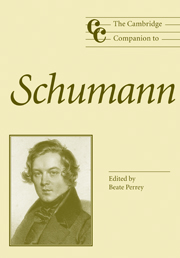
This Companion is an accessible introduction to Schumann: his time, his temperament, his style and his œuvre. An international team of scholars explores the cultural context, musical and poetic fabric, sources of inspiration and interpretative reach of key works from the Schumann repertoire ranging from his famous lieder and piano pieces to chamber, orchestral and dramatic works. Additional chapters address Schumann's presence in nineteenth- and twentieth-century composition and the fascinating reception history of his late works. Tables, illustrations, a detailed chronology and advice on further reading make it an ideally informative handbook for both the Schumann connoisseur and the music lover. An excellent textbook for the university student of courses on key composers of nineteenth-century Western Classical music, it is an invaluable guide for all who are interested in the thought, aesthetics and affective power of one of the most intriguing figures of a culturally rich and formative period.
The basic facts of Schumann's life suggest a life in disarray. Born into the Sehnsucht-driven world of German Romanticism, he is torn between disciplines. He begins the study of law out of a sense of filial duty but then follows his instinct when he turns to music, though never letting go of two other great passions, literature and poetry. Even as a committed musician, however, he veers between the roles of performer, composer and critic. It is to take a self-inflicted hand injury to free him to compose in earnest, and all urgency. Although endowed with an astonishing capacity to produce very great quantities of music in very short spans of time, he suffers periods of total or near-total creative standstill. These extremes of feverish, splendidly productive activity and exhausted, self-doubting arrest testify to a creative modus operandi that is not only intense, impulsive and at times difficult to live with, but which later observers have felt inclined to identify as ‘manic-depressive’. Some critics have also noted that Schumann's works themselves evince these characteristics, and his highly contrastive compositional style still incites puzzlement, if not consternation. Structurally speaking, Schumann cultivated with his seeming free-associated pieces the musically relatively new and disorientating art of brevity, discontinuity and contradiction. They develop from eccentric, spectral and ‘poetic’ early works to more conventional but nonetheless intricate and introvert late works.
Recommend this
Email your librarian or administrator to recommend adding this to your organisation's collection.