Skip to main content Accessibility help
×
Hostname: page-component-857557d7f7-wf4rb Total loading time: 0 Render date: 2025-12-09T09:56:10.101Z Has data issue: false hasContentIssue false

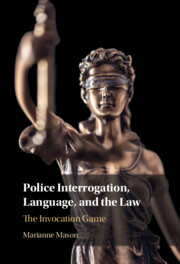
Police Interrogation, Language, and the Law

Published online by Cambridge University Press:  23 December 2023

Marianne Mason
Affiliation:
James Madison University, Virginia

Information

Type
Chapter
Information
Police Interrogation, Language, and the Law
The Invocation Game
, pp. i - ii
Publisher: Cambridge University Press
Print publication year: 2023
Creative Commons
Creative Common License - CCCreative Common License - BYCreative Common License - NCCreative Common License - ND
This content is Open Access and distributed under the terms of the Creative Commons Attribution licence CC-BY-NC-ND 4.0 https://creativecommons.org/cclicenses/

Police Interrogation, Language, and the Law

Recent calls for justice reform have put a spotlight on how the police enforce the law in the United States. How a person’s constitutional rights may be legally thwarted during police interrogation, however, has not been part of any meaningful discussion on police reform. This novel book examines the intersections of the law and policing discourse through the detailed analysis of a large corpus of United States federal court rulings, starting with Miranda v. Arizona (1966). It covers a wide range of topics, including the history of police interrogation in the United States, the role of federal law in handicapping a person’s ability to invoke their right to counsel, and the invocation game of police interrogation that may lead a variety of suspects to change their discursive preferences. It highlights the need for American police interrogation reform, exploring the paths taken by other jurisdictions outside of the United States. This title is part of the Flip it Open programme and may also be available open access. Check our website, Cambridge Core, for details.

Marianne Mason is Associate Professor at James Madison University. Her notable publications include The Discourse of Police Interviews (coedited, 2020) and Courtroom Interpreting (2008). In 2018, she received an American Council of Learned Societies Fellowship.

Accessibility standard: Unknown

Why this information is here

This section outlines the accessibility features of this content - including support for screen readers, full keyboard navigation and high-contrast display options. This may not be relevant for you.

Accessibility Information

Accessibility compliance for the HTML of this book is currently unknown and may be updated in the future.

Save book to Kindle

To save this book to your Kindle, first ensure no-reply@cambridge.org is added to your Approved Personal Document E-mail List under your Personal Document Settings on the Manage Your Content and Devices page of your Amazon account. Then enter the ‘name’ part of your Kindle email address below. Find out more about saving to your Kindle.

Note you can select to save to either the @free.kindle.com or @kindle.com variations. ‘@free.kindle.com’ emails are free but can only be saved to your device when it is connected to wi-fi. ‘@kindle.com’ emails can be delivered even when you are not connected to wi-fi, but note that service fees apply.

Find out more about the Kindle Personal Document Service.

Available formats
×

Save book to Dropbox

To save content items to your account, please confirm that you agree to abide by our usage policies. If this is the first time you use this feature, you will be asked to authorise Cambridge Core to connect with your account. Find out more about saving content to Dropbox.

Available formats
×

Save book to Google Drive

To save content items to your account, please confirm that you agree to abide by our usage policies. If this is the first time you use this feature, you will be asked to authorise Cambridge Core to connect with your account. Find out more about saving content to Google Drive.

Available formats
×