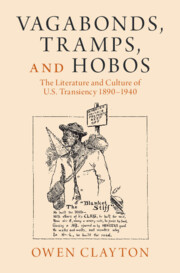

The most enduring version of the hobo that has come down from the so-called 'Golden Age of Tramping' (1890s to 1940s) is an American cultural icon, signifying freedom from restraint and rebellion to the established order while reinforcing conservative messages about American exceptionalism, individualism, race, and gender. Vagabonds, Tramps, and Hobos shows that this 'pioneer hobo' image is a misrepresentation by looking at works created by transient artists and thinkers, including travel literature, fiction, memoir, early feminist writing, poetry, sociology, political journalism, satire, and music. This book explores the diversity of meanings that accrue around 'the hobo' and 'the tramp'. It is the first analysis to frame transiency within a nineteenth-century literary tradition of the vagabond, a figure who attempts to travel without money. This book provide new ways for scholars to think about the activity and representation of US transiency.
Winner, 2024 Book Prize, British Association for American Studies
'An encyclopaedic tour of a now largely forgotten archive of hobo literature in the US … Clayton succeeds in his extraordinary effort to recover the stories of those obscured by popular hobo narratives.'
Amy M. E. Morris Source: Times Literary Supplement
Loading metrics...
* Views captured on Cambridge Core between #date#. This data will be updated every 24 hours.
Usage data cannot currently be displayed.
This section outlines the accessibility features of this content - including support for screen readers, full keyboard navigation and high-contrast display options. This may not be relevant for you.
Accessibility compliance for the PDF of this book is currently unknown and may be updated in the future.
