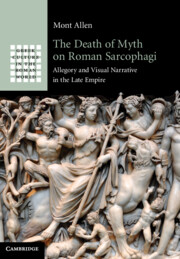

A strange thing happened to Roman sarcophagi in the third century: their Greek mythic imagery vanished. Since the beginning of their production a century earlier, these beautifully carved coffins had featured bold mythological scenes. How do we make sense of this imagery's own death on later sarcophagi, when mythological narratives were truncated, gods and heroes were excised, and genres featuring no mythic content whatsoever came to the fore? What is the significance of such a profound tectonic shift in the Roman funerary imagination for our understanding of Roman history and culture, for the development of its arts, for the passage from the High to the Late Empire and the coming of Christianity, but above all, for the individual Roman women and men who chose this imagery, and who took it with them to the grave? In this book, Mont Allen offers the clues that aid in resolving this mystery.
‘I heartily recommend this book for scholars and students seeking new perspective on style and changing trends in Roman art broadly as well as for those wanting to drive discussion in a special topics class or graduate seminar … a successful, engaging, and compelling contribution to the field of Roman art history, particularly in the immense subfield of sarcophagi.’
J. Cody Houseman Source: Bryn Mawr Classical Review
Loading metrics...
* Views captured on Cambridge Core between #date#. This data will be updated every 24 hours.
Usage data cannot currently be displayed.
This section outlines the accessibility features of this content - including support for screen readers, full keyboard navigation and high-contrast display options. This may not be relevant for you.
Accessibility compliance for the PDF of this book is currently unknown and may be updated in the future.
