
Skip to main content Accessibility help
×
  • Cited by 1
    • Show more authors
    • You may already have access via personal or institutional login
    • Select format
    • Publisher:
      Cambridge University Press
      Publication date:
      May 2018
      June 2018
      ISBN:
      9781108394697
      9781108422987
      Dimensions:
      (228 x 152 mm)
      Weight & Pages:
      0.6kg, 284 Pages
      Dimensions:
      Weight & Pages:
    You may already have access via personal or institutional login
  • Selected: Digital
    Add to cart View cart Buy from Cambridge.org

    Book description

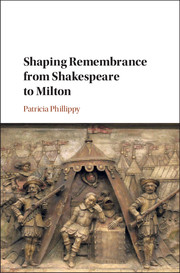
    Whether situated in churches or circulating in more flexible, mobile works - manuscript or printed texts, jewels or rosaries, personal bequests or antique 'rarities' - monuments were ubiquitous in post-Reformation England. In this period of religious change, the unsettled meanings of sacred sites and artifacts encouraged a new conception of remembrance and, with it, changed relationships between devotional and secular writings, arts, and identities. Beginning in the parish church, Shaping Remembrance from Shakespeare to Milton moves beyond that space to see remembrance as shaping dynamic systems within which early modern men and women experienced loss and recollection. Removing monuments from parochial or antiquarian concerns, this study re-imagines them as pervasively involved with other commemorative works, not least the writings of our most canonical authors. These far-reaching, flexible chapters combine three critical strands - religion, materiality, and gender - to describe the arts of remembrance as material and textual remains of living webs of connection in which creators and creations are mutually involved.

    Reviews

    '… the book … offers an impressive if impressionistic account of the unwieldy culture of commemoration in early modern England. In this work, we have a series of leitmotifs - mourning, loss, collection, remembrance, forgetting, curation - that echo one another in frequently surprising ways as they are juxtaposed, ultimately providing an important contribution to the study of a fraught memorial culture in the period.'

    Andrew Griffin Source: Early Modern Literary Studies

    ‘Phillippy’s painstaking research and close readings unlock the play’s cabinet of wonders, 'a woman’s wondrous work of a different order' , for scholars of early modern literature, devotional culture, drama, and, above all, memory.’

    William E. Engel Source: Renaissance Quarterly

    ‘Compellingly written, and bringing together an unusual and rich collection of texts, artefacts, and practices with a methodology that generates fresh insights into post-Reformation literary and memory culture … This is an important addition to what is at the moment one of the most vibrant fields in early modern studies.’

    Isabel Karremann Source: Modern Language Review

    Refine List

    Actions for selected content:

    Select all | Deselect all
    • View selected items
    • Export citations
    • Download PDF (zip)
    • Save to Kindle
    • Save to Dropbox
    • Save to Google Drive

    Save Search

    You can save your searches here and later view and run them again in "My saved searches".

    Please provide a title, maximum of 40 characters.
    ×

    Contents

    Metrics

    Altmetric attention score

    Full text views

    Total number of HTML views: 0
    Total number of PDF views: 0 *
    Loading metrics...

    Book summary page views

    Total views: 0 *
    Loading metrics...

    * Views captured on Cambridge Core between #date#. This data will be updated every 24 hours.

    Usage data cannot currently be displayed.

    Accessibility standard: Unknown

    Why this information is here

    This section outlines the accessibility features of this content - including support for screen readers, full keyboard navigation and high-contrast display options. This may not be relevant for you.

    Accessibility Information

    Accessibility compliance for the PDF of this book is currently unknown and may be updated in the future.
