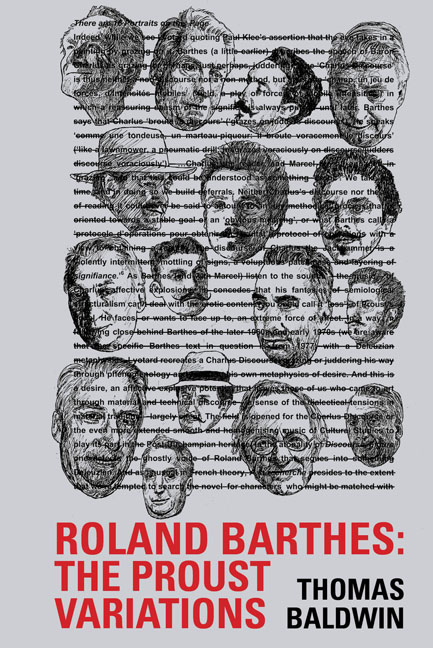
Roland Barthes: The Proust Variations

-
The digital format of this book is no longer available to purchase from Cambridge Core. Other formats may be available.
-
Select format
-
- Publisher:
- Liverpool University Press
- Publication date:
- Invalid date
- September 2019
- ISBN:
- 9781789620016
- Dimensions:
- Weight & Pages:
- Dimensions:
- Weight & Pages:
You may already have access via personal or institutional login
Show more authors 
You may already have access via personal or institutional login
Book description
This book confronts the singularity of the relationship between two exemplary writers of the last century in order to challenge and to reinvigorate our notions of what art and criticism – literary or otherwise – can do. While it takes Roland Barthes's encounters with Marcel Proust's monumental masterpiece À la recherche du temps perdu as its specific focus, the implications of its argument are far-reaching. Indeed, the book argues that Barthes's writing on Proust's work between the early 1950s and 1980 (including a substantial set of unpublished notes for a series of seminars delivered at the University of Rabat in 1969–1970) proposes not only a critical culture of Proust that is productively inconsistent, but also, more generally, a fresh understanding of criticism as a creative activity that embraces insecurity and variation as it refuses to remain fixed upon reassuringly stable themes, meanings and interpretations.
Contents
Contents
Metrics
Full text views
Full text views helpTotal number of HTML views: 0
Total number of PDF views: 0 *
 Loading metrics...
* Views captured on Cambridge Core between #date#. This data will be updated every 24 hours.
Usage data cannot currently be displayed.
Accessibility standard: Unknown
Why this information is here
This section outlines the accessibility features of this content - including support for screen readers, full keyboard navigation and high-contrast display options. This may not be relevant for you.
Accessibility Information
Accessibility compliance for the PDF of this book is currently unknown and may be updated in the future.