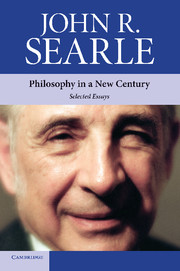
Book contents
- Frontmatter
- Contents
- Original place of publication of the essays
- Introduction
- 1 Philosophy in a new century
- 2 Social ontology: some basic principles (with a new addendum by the author)
- 3 The Turing Test: fifty-five years later
- 4 Twenty-one years in the Chinese Room
- 5 Is the brain a digital computer?
- 6 The phenomenological illusion
- 7 The self as a problem in philosophy and neurobiology
- 8 Why I am not a property dualist
- 9 Fact and value, “is” and “ought,” and reasons for action
- 10 The unity of the proposition
- Name index
- Subject index
- References
9 - Fact and value, “is” and “ought,” and reasons for action
Published online by Cambridge University Press: 05 June 2012

Book contents
- Frontmatter
- Contents
- Original place of publication of the essays
- Introduction
- 1 Philosophy in a new century
- 2 Social ontology: some basic principles (with a new addendum by the author)
- 3 The Turing Test: fifty-five years later
- 4 Twenty-one years in the Chinese Room
- 5 Is the brain a digital computer?
- 6 The phenomenological illusion
- 7 The self as a problem in philosophy and neurobiology
- 8 Why I am not a property dualist
- 9 Fact and value, “is” and “ought,” and reasons for action
- 10 The unity of the proposition
- Name index
- Subject index
- References
Summary
This article deals with an issue that much concerned Hans Kelsen, the “is”–“ought” distinction. It is a fragment of a much larger work I am preparing on the subject of rationality.
A number of binary distinctions are central to our philosophical tradition. One thinks of the distinctions between truth and falsity, good and evil, reality and illusion, freedom and determinism, mind and body, and fact and value. Sometimes the belief in these distinctions creates problems because it seems that the acceptance of a certain standard conception of one of the terms of the distinction rules out the possibility of anything satisfying the other term. I will illustrate this apparent difficulty with three examples: mind and body, freedom and determinism, and fact and value. The corresponding problems can be stated as follows: How can there be irreducible mental phenomena in a universe that consists entirely of non-mental material phenomena? How can there be events that are free human actions, and thus are events not caused by antecedent events, in a universe in which every event is caused by antecedent events? How can there be objective values binding on all rational agents in a world in which all objectivity is factual objectivity and in which values are not factual?
As formulated, none of these questions is answerable. That is, in each case the answer has to be: there can't be anything satisfying the conditions set by the phrasing of the question, because the phrasing of the question would make the hypothesis of the existence of any such phenomenon self-contradictory.
Information
- Type
- Chapter
- Information
- Philosophy in a New CenturySelected Essays, pp. 161 - 180Publisher: Cambridge University PressPrint publication year: 2008
References
, “How to derive ‘ought’ from ‘is,’” Philosophical Review, 73 (January 1964): 43–58CrossRefGoogle Scholar
, “Internal and External Reasons,” in Moral Luck (Cambridge: Cambridge University Press, 1981), pp.101–113CrossRefGoogle Scholar
, Intentionality: An Essay in the Philosophy of Mind (Cambridge: Cambridge University Press, 1983)CrossRefGoogle Scholar
, “General Semantics,” in and (eds.), The Semantics of Natural Language (Dordrecht: Reidel Publishing Co., 1972): 169–218CrossRefGoogle Scholar
, “Logic and Conversation,” in (ed.) The Philosophy of Language (New York and Oxford: Oxford University Press, 1996): 156–167Google Scholar
, “Prima facie obligations,” in (ed.), Practical Reasoning (Oxford: Oxford University Press, 1978): 81–90Google Scholar
Accessibility standard: Unknown
Why this information is here
This section outlines the accessibility features of this content - including support for screen readers, full keyboard navigation and high-contrast display options. This may not be relevant for you.Accessibility Information
Accessibility compliance for the PDF of this book is currently unknown
and may be updated in the future.
- 1
- Cited by