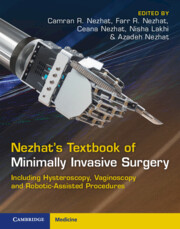
 Nezhat's Textbook of Minimally Invasive Surgery
 Including Hysteroscopy, Vaginoscopy and Robotic-Assisted Procedures
Book contents
- Nezhat’s Textbook of Minimally Invasive Surgery
- Nezhat’s Textbook of Minimally Invasive Surgery
- Copyright page
- Dedication
- Contents
- Online Resources
- Contributors
- Foreword
- Preface
- Chapter 1 A History of Modern-Day Video Surgery with and without Robotic Assistance
- Chapter 2 Equipment for Operative Laparoscopy and Hysteroscopy
- Chapter 3 Anesthesia
- Chapter 4 Patient Positioning and Operating Room Setup
- Chapter 5 Laparoscopic Access
- Chapter 6 Laparoscopic Suturing
- Chapter 7 Pelvic Anatomy
- Chapter 8 Hysteroscopy
- Chapter 9 Fertility
- Chapter 10 Management of Adnexal Masses
- Chapter 11 Endometriosis
- Chapter 12 Video Laparoscopic Adhesiolysis and Adhesion Prevention
- Chapter 13 Video Laparoscopic Sterilization
- Chapter 14 Leiomyomas
- Chapter 15 Hysterectomy
- Chapter 16 Pelvic Floor Procedures
- Chapter 17 Video Laparoscopy
- Chapter 18 Gynecologic Malignancy
- Chapter 19 Video Laparoscopic Surgery during Pregnancy
- Chapter 20 Pediatric Surgery
- Chapter 21 Video Laparoscopic Aortic Surgery
- Chapter 22 Additional Procedures for Pelvic Surgeons
- Chapter 23 Simulation Training in Minimally Invasive Surgery
- Chapter 24 Robotic-Assisted Laparoscopy
- Chapter 25 Vascular Surgery and Management of Pelvic Complications
- Chapter 26 Fetal Surgery
- Chapter 27 Hemostatic Agents in Minimally Invasive Surgery
- Chapter 28 New Techniques in Minimally Invasive Surgery
- Book part
- Index
- References
Chapter 24 - Robotic-Assisted Laparoscopy
Published online by Cambridge University Press: 06 November 2025

Book contents
- Nezhat’s Textbook of Minimally Invasive Surgery
- Nezhat’s Textbook of Minimally Invasive Surgery
- Copyright page
- Dedication
- Contents
- Online Resources
- Contributors
- Foreword
- Preface
- Chapter 1 A History of Modern-Day Video Surgery with and without Robotic Assistance
- Chapter 2 Equipment for Operative Laparoscopy and Hysteroscopy
- Chapter 3 Anesthesia
- Chapter 4 Patient Positioning and Operating Room Setup
- Chapter 5 Laparoscopic Access
- Chapter 6 Laparoscopic Suturing
- Chapter 7 Pelvic Anatomy
- Chapter 8 Hysteroscopy
- Chapter 9 Fertility
- Chapter 10 Management of Adnexal Masses
- Chapter 11 Endometriosis
- Chapter 12 Video Laparoscopic Adhesiolysis and Adhesion Prevention
- Chapter 13 Video Laparoscopic Sterilization
- Chapter 14 Leiomyomas
- Chapter 15 Hysterectomy
- Chapter 16 Pelvic Floor Procedures
- Chapter 17 Video Laparoscopy
- Chapter 18 Gynecologic Malignancy
- Chapter 19 Video Laparoscopic Surgery during Pregnancy
- Chapter 20 Pediatric Surgery
- Chapter 21 Video Laparoscopic Aortic Surgery
- Chapter 22 Additional Procedures for Pelvic Surgeons
- Chapter 23 Simulation Training in Minimally Invasive Surgery
- Chapter 24 Robotic-Assisted Laparoscopy
- Chapter 25 Vascular Surgery and Management of Pelvic Complications
- Chapter 26 Fetal Surgery
- Chapter 27 Hemostatic Agents in Minimally Invasive Surgery
- Chapter 28 New Techniques in Minimally Invasive Surgery
- Book part
- Index
- References
Summary
The following account of telepresence surgery is the collective perspective of a few individuals who witnessed and participated in its development from initial inception at the Stanford Research Institute (SRI) to commercialization at Intuitive Surgical as the da Vinci® system. It should be noted that there are several differing accounts of the history of telepresence surgery, and while there are factual elements in each version, none of the accounts to date has benefited from the perspective of the team that spanned the early days of the development of telepresence surgery at SRI to the early days of development of da Vinci at Intuitive Surgical.
Information
- Type
- Chapter
- Information
- Nezhat's Textbook of Minimally Invasive SurgeryIncluding Hysteroscopy, Vaginoscopy and Robotic-Assisted Procedures, pp. 767 - 781Publisher: Cambridge University PressPrint publication year: 2025
References
References
Dario, P. Robotics for medical applications. IEEE Robot Autom Mag 1996;3:44–56.CrossRefGoogle Scholar
Davies, BL, Hibberd, RD, Coptcoat, MJ, et al. A surgeon robot prostatectomy – a laboratory evaluation. J Med Eng Technol 1989;13:273–277.CrossRefGoogle ScholarPubMed
Davies, BL, Hibberd, RD, Ng, WS, et al. The development of a surgeon robot for prostatectomies. Proc Inst Mech Eng H 1991;205:35–38.CrossRefGoogle ScholarPubMed
Taylor, R. Mittelstadt, BD, Paul, HA, et al. An image-directed robotic system for precise orthopaedic surgery. IEEE Trans Robot Autom 1994;10:261–265.CrossRefGoogle Scholar
Sackier, JM, Wang, Y. Robotically assisted laparoscopic surgery. From concept to development. Surg Endosc 1994;8:63–66.CrossRefGoogle ScholarPubMed
Palep, JH. Robotic assisted minimally invasive surgery. J Minim Access Surg 2009;5:1–7.CrossRefGoogle ScholarPubMed
Glauser, D, Fankhauser, H, Epitaux, M, et al. Neurosurgical robot Minerva: first results and current developments. J Image Guid Surg 1995;1:266–272.3.0.CO;2-8>CrossRefGoogle ScholarPubMed
Masri, BA, McGraw, RW, Beauchamp, CP. Robotrac in total knee arthroplasty. The silent assistant. Am J Knee Surg 1995;8:20–23.Google ScholarPubMed
Alexander, AD. Impacts of telemation on modern society. Proc 1st IFToMM Symp 1978;2:122.Google Scholar
Thring, M. Robotics and Telechirs: Manipulators with Memory, Remote Manipulators, Machine Limbs for the Handicapped. Ultimo: Halstead Press; 1983.Google Scholar
Jensen, JFH. Advanced telepresence surgery system development. In Weghorst, S, Sieburg, H, Morgan, K, eds. Health Care in the Information Age. IOS Press and Ohmsha; 1996: 107–117.Google Scholar
Shah, A, Frazee, J. Interactive surgery and telepresence. In King, WA, Frazee, JG, De Salles, AAF, eds.Endoscopy of the Central and Peripheral Nervous System. New York: Thieme; 1997: 243–262.Google Scholar
Bowersox, JC, Shah, A, Jensen, J, et al. Vascular applications of telepresence surgery: initial feasibility studies in swine. J Vasc Surg 1996;23:281–287.CrossRefGoogle ScholarPubMed
Intuitive Surgical: past, present and future. www.intuitivesurgical.com/company/history/system.html.Google Scholar
Intuitive investor presentation. http://phx.corporate-ir.net/phoenix.zhtml?c=122359&p=irol-IRHome.Google Scholar
References
Woo, R, Le, D, Krummel, TM, et al. Robot-assisted pediatric surgery. Am J Surg 2004;188(4A Suppl):27S–37S.CrossRefGoogle ScholarPubMed
Satava, RM. Emerging technologies for surgery in the 21st century. Arch Surg 1999;134(11):1197–1202.CrossRefGoogle ScholarPubMed
Camarillo, DB, Krummel, TM, Salisbury, JK Jr. Robotic technology in surgery: past, present, and future. Am J Surg 2004;188(4A Suppl):2S–15S.CrossRefGoogle Scholar
Brodie, A, Vasdev, N. The future of robotic surgery: how robotics could help shape the future of surgical care. Ann R Coll Surg Engl 2018;100(Suppl 7):4–13.CrossRefGoogle Scholar
Jakopec, M, Harris, SJ, Rodriguez, y Baena, F, et al. The first clinical application of a “hands-on” robotic knee surgery system. Comput Aided Surg 2001;6(6):329–339.CrossRefGoogle ScholarPubMed
Kwoh, YS, Hou, J, Jonckheere, EA, et al. A robot with improved absolute positioning accuracy for CT guided stereotactic brain surgery. IEEE Trans Biomed Eng 1988;35(2):153–160.CrossRefGoogle ScholarPubMed
Drake, JM, Joy, M, Goldenberg, A, et al. Computer- and robot-assisted resection of thalamic astrocytomas in children. Neurosurgery 1991;29(1):27–33.CrossRefGoogle ScholarPubMed
Benabid, AL, Cinquin, P, Lavalle, S, et al. Computer-driven robot for stereotactic surgery connected to CT scan and magnetic resonance imaging. Technological design and preliminary results. Appl Neurophysiol 1987;50(1–6):153–154.Google Scholar
Varma, TR, Eldridge, PR, Forster, A, et al. Use of the NeuroMate stereotactic robot in a frameless mode for movement disorder surgery. Stereotact Funct Neurosurg 2003;80(1–4):132–135.CrossRefGoogle Scholar
Ahmed, SI, Javed, G, Mubeen, B, et al. Robotics in neurosurgery: a literature review. J Pak Med Assoc 2018;68(2):258–263.Google ScholarPubMed
Minchev, G, Kronreif, G, Martinez-Moreno, M, et al. A novel miniature robotic guidance device for stereotactic neurosurgical interventions: preliminary experience with the iSYS1 robot. J Neurosurg 2017;125:985–996.CrossRefGoogle Scholar
Hollands, CM, Dixey, LN. Applications of robotic surgery in pediatric patients. Surg Laparosc Endosc Percutan Tech 2002;12(1):71–76.CrossRefGoogle ScholarPubMed
Chandra, V, Nehra, D, Parent, R, et al. A comparison of laparoscopic and robotic assisted suturing performance by experts and novices. Surgery 2010;147(6):830–839.CrossRefGoogle ScholarPubMed
Lanfranco, AR, Castellanos, AE, Desai, JP, et al. Robotic surgery: a current perspective. Ann Surg 2004;239(1):14–21.CrossRefGoogle ScholarPubMed
Wren, S, Curet, M. Single-port robotic cholecystectomy: results from a first human use clinical study of the new da Vinci single-site surgical platform. Arch Surg 2011;146:1122–1127.CrossRefGoogle ScholarPubMed
Nezhat, C, Lavie, O, Hsu, S, et al. Robotic-assisted laparoscopic myomectomy compared with standard laparoscopic myomectomy – a retrospective matched control study. Fertil Steril 2009;91(2):556–559.CrossRefGoogle ScholarPubMed
Visco, AG, Advincula, AP. Robotic gynecologic surgery. Obstet Gynecol 2008;112:1369–1384.CrossRefGoogle ScholarPubMed
Gargiulo, AR, Nezhat, C. Robot-assisted laparoscopy, natural orifice transluminal endoscopy, and single-site laparoscopy in reproductive surgery. Sem Reprod Med 2011;29(2):155–168.CrossRefGoogle ScholarPubMed
Lenihan, JP, Kovanda, C, Seshadri- Kreaden, U. What is the learning curve for robotic assisted gynecologic surgery? J Minim Invasive Gynecol 2008;15:589–594.CrossRefGoogle Scholar
Goldberg, JM, Falcone, T. Laparoscopic microsurgical tubal anastomosis with and without robotic assistance. Hum Reprod 2003;18(1):145–147.CrossRefGoogle ScholarPubMed
Sarlos, D, Kots, LA. Robotic versus laparoscopic hysterectomy: a review of recent comparative studies. Curr Opin Obstet Gynecol 2011;23:283–288.CrossRefGoogle ScholarPubMed
Woelk, JL, Borah, BJ, Trabuco, EC, Gebhart, JB. All-cause cost differences between robotic, vaginal, and abdominal hysterectomy. Obstet Gynecol 2015;123(201):255–262.CrossRefGoogle Scholar
Nezhat, C, Lewis, M, Kotikela, S, et al. Robotic versus standard laparoscopy for the treatment of endometriosis. Fertil Steril 2010;94(7):2758–2760.CrossRefGoogle ScholarPubMed
Ramirez, PT, Frumovitz, M, Pareja, R, et al. Minimally invasive versus abdominal radical hysterectomy for cervical cancer. NEJM 2018;379(20):1895–1904.CrossRefGoogle ScholarPubMed
Melamed, A, Margul, DJ, Chen, L, et al. Survival after minimally invasive radical hysterectomy for early-stage cervical cancer. NEJM 2018;379(20):1905–1914.CrossRefGoogle ScholarPubMed
Persky, MJ, Issa, M, Bonfili, JR, et al. Transoral surgery using the Flex Robotic System: initial experience in the United States. Head Neck 2018;40(11):2482–2486.CrossRefGoogle ScholarPubMed
Shademan, A, Decker, RS, Opfermann, JF, et al. Supervised autonomous robotic soft tissue surgery. Sci Transl Med 2016;8(337).CrossRefGoogle ScholarPubMed
Aruni, G, Amit, G, Dasgupta, P. New surgical robotics on the horizon and the potential role of artificial intelligence. Investig and Clin Urol 2018;59(4):221–222.CrossRefGoogle ScholarPubMed
Rafii-Tari, H, Payne, CJ, Yang, GZ. Current and emerging robot-assisted endovascular catheterization technologies: a review. Ann Biomed Eng 2014;42(4):697–715.CrossRefGoogle ScholarPubMed
Salzberg, AD, Bloom, MD, Mourlas, NJ, et al. Microelectrical mechanical systems in surgery and medicine. J Am Coll Surg 2002;194:463–476.CrossRefGoogle Scholar
Choi, PJ, Oskouian, RJ, Tubbs, RS. Telesurgery: past, present, and future. Cureus 2018;10(5):e2716.Google ScholarPubMed
References
Ellis, H. Ephraim McDowell and the first successful elective laparotomy. Br J Hosp Med (Lond) 2009;70(2):107.CrossRefGoogle ScholarPubMed
Pfannestiel, J. Uber die Vorteile des suprasymphysaren Faszienquerschnitt fur die gynaklogischen Koliotomein, zugleich ein Beitrag zu der Indikationsstellung der Operationswege. Samml Klein Vortr Gynakol 1897:68–98.Google Scholar
Pfannestiel, J. Uber die Vorteile des suprasymphysaren Faszienquerschnitt fur die gynaklogischen Koliotomein, zugleich ein Beitrag zu der Indikationsstellung der Operationswege. Klin Vortr NF Gynak 1900;97:268.Google Scholar
Mowat, J, Bonnar, J. Abdominal wound dehiscence after caesarean section. Br Med J 1971;2(5756):256–257.CrossRefGoogle ScholarPubMed
Cottineau, C, Cocaud, J, Jacob, JP. [The beginning of anesthesia]. Allerg Immunol (Paris) 1998;30(5):135–137.Google ScholarPubMed
Kohler, G. [100 years of the Wertheim operation – Ernst Wertheim between myth and reality]. Zentralbl Gynakol 1999;121(3):121–125.Google Scholar
Schollmeyer, T, Soyinka, AS, Schollmeyer, M, et al. Georg Kelling (1866–1945): the root of modern day minimal invasive surgery. A forgotten legend? Arch Gynecol Obstet 2007;276(5):505–509.CrossRefGoogle ScholarPubMed
Baggot, MG. The endotracheal tube in situ as a foreign body: the master key to general anesthesia, its mechanism and inherent (though not peculiar) complications and to effective “life support.” Med Hypoth 2002;59(6):742–750.CrossRefGoogle Scholar
Dukanovic, S, Canic, T. [The value of hysteroscopy in perimenopausal women]. Acta Med Croatica 2007;61(2):185–190.Google ScholarPubMed
Nezhat, C, Crowgey, SR, Garrison, CP. Surgical treatment of endometriosis via laser laparoscopy. Fertil Steril 1986;45(6):778–783.CrossRefGoogle ScholarPubMed
Nezhat, C, Hood, J, Winer, W, et al. Videolaseroscopy and laser laparoscopy in gynaecology. Br J Hosp Med 1987;38(3):219–224.Google ScholarPubMed
Nezhat, C, Crowgey, SR, Garrison, CP. Surgical treatment of endometriosis via laser laparoscopy and videolaseroscopy. Contrib Gynecol Obstet 1987;16:303–312.CrossRefGoogle ScholarPubMed
Nezhat, C. Operative endoscopy will replace almost all open procedures. JSLS 2004;8(2):101–102.Google ScholarPubMed
Mettler, L, Ahmed-Ebbiary, N, Schollmeyer, T. Laparoscopic hysterectomy: challenges and limitations. Minim Invasive Ther Allied Technol 2005;14(3):145–159.Google Scholar
Parkar, RB, Kamau, WJ, Otieno, D, et al. Total laparoscopic hysterectomy at the Aga Khan University Hospital, Nairobi. East Afr Med J 2007;84(11):508–515.Google ScholarPubMed
Ng, SS, Li, JC, Lee, JF, et al. Laparoscopic total colectomy for colorectal cancers: a comparative study. Surg Endosc 2006;20(8):1193–1196.CrossRefGoogle ScholarPubMed
Rashid, P, Goad, J, Aron, M, et al. Laparoscopic partial nephrectomy: integration of an advanced laparoscopic technique. A NZ J Surg 2008;78(6):471–475.CrossRefGoogle ScholarPubMed
Yong, JL, Law, WL, Lo, CY, et al. A comparative study of routine laparoscopic versus open appendectomy. JSLS 2006;10(2):188–192.Google ScholarPubMed
Kalloo, AN, Singh, VK, Jagannath, SB, et al. Flexible transgastric peritoneoscopy: a novel approach to diagnostic and therapeutic interventions in the peritoneal cavity. Gastrointest Endosc 2004;60(1):114–117.CrossRefGoogle ScholarPubMed
Peikert, T, Gillespie, DJ, Cassivi, SD. Catamenial pneumothorax. Mayo Clin Proc 2005;80(5):677–680.CrossRefGoogle ScholarPubMed
Kantsevoy, SV, Hu, B, Jagannath, SB, et al. Transgastric endoscopic splenectomy: is it possible? Surg Endosc 2006;20(3):522–525.CrossRefGoogle ScholarPubMed
Wagh, MS, Merrifield, BF, Thompson, CC. Endoscopic transgastric abdominal exploration and organ resection: initial experience in a porcine model. Clin Gastroenterol Hepatol 2005;3(9):892–896.CrossRefGoogle ScholarPubMed
Wagh, MS, Thompson, CC. Surgery insight: natural orifice transluminal endoscopic surgery – an analysis of work to date. Nat Clin Pract Gastroenterol Hepatol 2007;4(7):386–392.CrossRefGoogle ScholarPubMed
Stark, M, Benhidjeb, T. Natural orifice surgery: transdouglas surgery – a new concept. JSLS 2008;12(3):295–298.Google ScholarPubMed
Nezhat, C, Saberi, NS, Shahmohamady, B, et al. Robotic-assisted laparoscopy in gynecological surgery. JSLS 2006;10(3):317–320.Google ScholarPubMed
Vlcek, P, Capov, I, Jedlicka, V, et al. [Robotic procedures in the colorectal surgery]. Rozhl Chir 2008;87(3):135–137.Google ScholarPubMed
Kwoh, YS, Hou, J, Jonckheere, EA, et al. A robot with improved absolute positioning accuracy for CT guided stereotactic brain surgery. IEEE Trans Biomed Eng 1988;35(2):153–160.CrossRefGoogle ScholarPubMed
Harris, SJ, Arambula-Cosio, F, Mei, Q, et al. The Probot – an active robot for prostate resection. Proc Inst Mech Eng H 1997;211(4):317–325.CrossRefGoogle ScholarPubMed
Hananouchi, T, Nakamura, N, Kakimoto, A, et al. CT-based planning of a single-radius femoral component in total knee arthroplasty using the ROBODOC system. Comput Aided Surg 2008;13(1):23–29.CrossRefGoogle ScholarPubMed
Zhou, HX, Guo, YH, Yu, XF, et al. Zeus robot-assisted laparoscopic cholecystectomy in comparison with conventional laparoscopic cholecystectomy. Hepatobil Pancreat Dis Int 2006;5(1):115–118.Google ScholarPubMed
Kang, CM, Kim, DH, Lee, WJ, et al. Conventional laparoscopic and robot-assisted spleen-preserving pancreatectomy: does da Vinci have clinical advantages? Surg Endosc 2011;25(6):2004–2009.CrossRefGoogle Scholar
Reiley, CE, Akinbiyi, T, Burschka, D, et al. Effects of visual force feedback on robot-assisted surgical task performance. J Thorac Cardiovasc Surg 2008;135(1):196–202.CrossRefGoogle ScholarPubMed
Swan, K, Advincula, AP. Role of robotic surgery in urogynecologic surgery and radical hysterectomy: how far can we go? Curr Opin Urol 2011;21(1):78–83.CrossRefGoogle ScholarPubMed
Gill, RS, Al-Adra, DP, Birch, D, et al. Robotic-assisted bariatric surgery: a systematic review. Int J Med Robot 2011;7(3).CrossRefGoogle ScholarPubMed
Stark, M, Gerli, S, Di Renzo, GC. The importance of analyzing and standardizing surgical methods. J Minim Invasive Gynecol 2009;16(2):122–125.CrossRefGoogle ScholarPubMed
Stark, M. Optimised meta-analysis should be based on standardised methods. Br J Obstet Gynaecol 2011;118(6):765–766; author reply 766.CrossRefGoogle ScholarPubMed
Stephan, D, Salzer, H, Willeke, F. First experiences with the new Senhance telerobotic system in visceral surgery. Visc Med 2018 Feb;34(1):31–36.CrossRefGoogle ScholarPubMed
Fanfani, F, Monterossi, G, Fagotti, A, et al. The new robotic TELELAP ALF-X in gynecological surgery: single-center experience. Surg Endosc 2015;30(1):215–221.CrossRefGoogle ScholarPubMed
Spinelli, A, David, G, Gidaro, S, et al. First experience in colorectal surgery with a new robotic platform with haptic feedback. Colorectal Dis 2017;20(3).Google Scholar
Alletti, SG, Rossitto, C, Fanfani, F, et al. Telelap Alf-X-assisted laparoscopy for ovarian cyst enucleation: report of the first 10 cases. J Minim Invasive Gynecol 2015 Sep-Oct;22(6):1079–1083.CrossRefGoogle Scholar
Alletti, SG, Rossitto, C, Cianci, S, et al. Telelap ALF-X versus standard laparoscopy for the treatment of early-stage endometrial cancer: a single-institution retrospective cohort study. J Minim Invasive Gynecol 2016;23(3):378–383.CrossRefGoogle Scholar
Alletti, SG, Rossitto, C, Cianci, S, Scambia, G. Telelap ALF-X total hysterectomy for early stage endometrial cancer: new frontier of robotic gynecological surgery. Gynecol Oncol 2016;140(3):575–576.CrossRefGoogle Scholar
Fanfani, F, Restaino, S, Rossitto, C, et al. Total laparoscopic (S-LPS) versus TELELAP ALF-X robotic-assisted hysterectomy: a case-control study. J Minim Invasive Gynecol 2016;23(6):933–936.CrossRefGoogle ScholarPubMed
Alletti, SG, Rossitto, C, Cianci, S, et al. The Senhance surgical robotic system (“senhance”) for total hysterectomy in obese patients: a pilot study. J Robot Surg 2017;12:229–234.CrossRefGoogle Scholar
Accessibility standard: WCAG 2.0 A
Why this information is here
This section outlines the accessibility features of this content - including support for screen readers, full keyboard navigation and high-contrast display options. This may not be relevant for you.Accessibility Information
The PDF of this book
conforms to version 2.0 of the
Web Content Accessibility Guidelines
(WCAG), ensuring core accessibility principles are addressed and meets the basic
(A)
level of WCAG compliance, addressing essential accessibility barriers.
Content Navigation
Table of contents navigation
Allows you to navigate directly to chapters, sections, or non‐text items through a linked table of contents, reducing the need for extensive scrolling.
Allows you to navigate directly to chapters, sections, or non‐text items through a linked table of contents, reducing the need for extensive scrolling.
Index navigation
Provides an interactive index, letting you go straight to where a term or subject appears in the text without manual searching.
Provides an interactive index, letting you go straight to where a term or subject appears in the text without manual searching.
Reading Order & Textual Equivalents
Single logical reading order
You will encounter all content (including footnotes, captions, etc.) in a clear, sequential flow, making it easier to follow with assistive tools like screen readers.
You will encounter all content (including footnotes, captions, etc.) in a clear, sequential flow, making it easier to follow with assistive tools like screen readers.
Short alternative textual descriptions
You get concise descriptions (for images, charts, or media clips), ensuring you do not miss crucial information when visual or audio elements are not accessible.
You get concise descriptions (for images, charts, or media clips), ensuring you do not miss crucial information when visual or audio elements are not accessible.
Visual Accessibility
Use of colour is not sole means of conveying information
You will still understand key ideas or prompts without relying solely on colour, which is especially helpful if you have colour vision deficiencies.
You will still understand key ideas or prompts without relying solely on colour, which is especially helpful if you have colour vision deficiencies.
Structural and Technical Features
ARIA roles provided
You gain clarity from ARIA (Accessible Rich Internet Applications) roles and attributes, as they help assistive technologies interpret how each part of the content functions.
You gain clarity from ARIA (Accessible Rich Internet Applications) roles and attributes, as they help assistive technologies interpret how each part of the content functions.