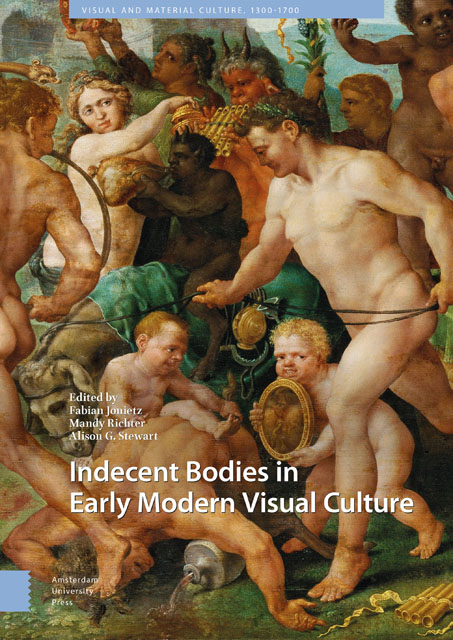
Indecent Bodies in Early Modern Visual Culture

-
The digital format of this book is no longer available to purchase from Cambridge Core. Other formats may be available.
-
Select format
-
- Publisher:
- Amsterdam University Press
- Publication date:
- Invalid date
- December 2022
- ISBN:
- 9789463725835
- Dimensions:
- Weight & Pages:
- Dimensions:
- Weight & Pages:
- Subjects:
- Art: General Interest, Art
You may already have access via personal or institutional login- Subjects:
- Art: General Interest, Art
Show more authors 
You may already have access via personal or institutional login
Book description
The life-like depiction of the body became a central interest and defining characteristic of the European Early Modern period that coincided with the establishment of which images of the body were to be considered 'decent' and representable, and which disapproved, censored, or prohibited. Simultaneously, artists and the public became increasingly interested in the depiction of specific body parts or excretions. This book explores the concept of indecency and its relation to the human body across drawings, prints, paintings, sculptures, and texts. The ten essays investigate questions raised by such objects about practices and social norms regarding the body, and they look at the particular function of those artworks within this discourse. The heterogeneous media, genres, and historical contexts north and south of the Alps studied by the authors demonstrate how the alleged indecency clashed with artistic intentions and challenges traditional paradigms of the historiography of Early Modern visual culture.
Contents
Contents
Metrics
Full text views
Full text views helpTotal number of HTML views: 0
Total number of PDF views: 0 *
 Loading metrics...
* Views captured on Cambridge Core between #date#. This data will be updated every 24 hours.
Usage data cannot currently be displayed.
Accessibility standard: Unknown
Why this information is here
This section outlines the accessibility features of this content - including support for screen readers, full keyboard navigation and high-contrast display options. This may not be relevant for you.
Accessibility Information
Accessibility compliance for the PDF of this book is currently unknown and may be updated in the future.