
Skip to main content Accessibility help
×
  • Cited by 6
    • Show more authors
    • Open Access
      You have digital access to this book
    • Select format
    • Publisher:
      Cambridge University Press
      Publication date:
      April 2022
      May 2022
      ISBN:
      9781108954341
      9781108845038
      Creative Commons:
      Creative Common License - CC Creative Common License - BY Creative Common License - NC Creative Common License - ND
      This content is Open Access and distributed under the terms of the Creative Commons Attribution licence CC-BY-NC-ND 4.0.
      https://creativecommons.org/creativelicenses
      Dimensions:
      (229 x 152 mm)
      Weight & Pages:
      0.56kg, 286 Pages
      Dimensions:
      Weight & Pages:
    Open Access
    You have digital access to this book
    Selected: Digital
    View content
    Add to cart View cart Buy from Cambridge.org

    Book description

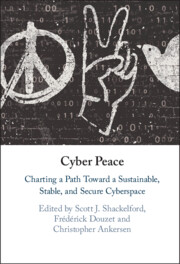
    The international community is too often focused on responding to the latest cyber-attack instead of addressing the reality of pervasive and persistent cyber conflict. From ransomware against the city government of Baltimore to state-sponsored campaigns targeting electrical grids in Ukraine and the U.S., we seem to have relatively little bandwidth left over to ask what we can hope for in terms of 'peace' on the Internet, and how to get there. It's also important to identify the long-term implications for such pervasive cyber insecurity across the public and private sectors, and how they can be curtailed. This edited volume analyzes the history and evolution of cyber peace and reviews recent international efforts aimed at promoting it, providing recommendations for students, practitioners and policymakers seeking an understanding of the complexity of international law and international relations involved in cyber peace. This title is also available as Open Access on Cambridge Core.

    Reviews

    ‘Cyber space and outer space are today's cutting-edge areas of international security concern. One critical difference between them: We have norms in place for the preservation of peace in outer space. While these norms are contested, they provide the starting place for discussion. No comparable principles exist for cyber space – at least before now. Cyber Peace takes up the nascent idea that cyber space should never become battle space. The authors provide critical, normative scholarship necessary for the complex task of building cyber governance in the interest of human flourishing.'

    Mary Ellen O'Connell - Robert and Marion Short Professor of Law and Research Professor of International Dispute Resolution—Kroc Institute for International Peace Studies, University of Notre Dame. Author of Cyber Security without Cyber War, Journal of Conflict and Security Law (2012)

    ‘Convening an expert group of academics and non-governmental organizations, Ankersen, Douzet and Shackelford offer a new framework for assessing international relations in a digital age – positive cyber peace. Expertly edited, their volume situates cyber peace in both international and intra-state contexts amidst the full range of technological developments in surveillance, offensive cyber operations, and machine learning. Along the way, they identify and elaborate practical mechanisms (e.g., information sharing, verification, international criminal law) for ensuring a future very different from the ongoing normalization of cyber insecurity.'

    Duncan B. Hollis - Laura H. Carnell Professor of Law, Temple University

    ‘Is it possible to find peace in a digital world where cyberattacks continue to become more robust, sophisticated and dangerous? And how do we begin to define the term 'cyber peace?' The contributors to this important and timely volume explore an agenda for illuminating a concept that, despite its global impact, eludes easy definition and presents considerable difficulties. They also attempt to sketch a digital ecosystem in which resiliency, safety, and stability are possible despite major challenges. But by wrestling with these complex and intricate problems, they lay the groundwork for how humankind can make fundamental and transformative use of today's extraordinary technological advancements, including artificial intelligence and machine learning, without sacrificing our individual freedoms, our democracy, and our security.'

    Michael A. McRobbie - University Chancellor, President Emeritus, and University Professor Indiana University

    Refine List

    Actions for selected content:

    Select all | Deselect all
    • View selected items
    • Export citations
    • Download PDF (zip)
    • Save to Kindle
    • Save to Dropbox
    • Save to Google Drive

    Save Search

    You can save your searches here and later view and run them again in "My saved searches".

    Please provide a title, maximum of 40 characters.
    ×

    Contents

    Full book PDF
    • Cyber Peace
      pp i-ii
    • Cyber Peace - Title page
      pp iii-iii
    • Charting a Path toward a Sustainable, Stable, and Secure Cyberspace
    • Copyright page
      pp iv-iv
    • Dedication
      pp v-vi
    • Contents
      pp vii-viii
    • Contributors
      pp ix-xvii
    • Acknowledgments
      pp xviii-xviii
    • Introduction
      pp xix-xxxii
    • Part I - Beyond Stability, toward Cyber Peace: Key Concepts, Visions, and Models of Cyber Peace
      pp 1-36
    • 1 - Cyber Peace
      pp 3-21
    • Is That a Thing?
    • 2 - Domestic Digital Repression and Cyber Peace
      pp 22-36
    • 6 - Artificial Intelligence in Cyber Peace
      pp 117-128
    • Part III - Lessons Learned and Looking Ahead
      pp 129-192
    • 8 - Trust but Verify: Diverse Verifiers Are a Prerequisite to Cyber Peace
      pp 154-169
    • Part IV - Reflections and Research Notes
      pp 193-242
    • 11 - Overcoming Barriers to Empirical Cyber Research
      pp 205-211
    • 13 - Cyber Hygiene Can Support Cyber Peace
      pp 223-229
    • 14 - Crowdsourcing Cyber Peace and Cybersecurity
      pp 230-235
    • Index
      pp 243-253

    Metrics

    Altmetric attention score

    Full text views

    Total number of HTML views: 0
    Total number of PDF views: 0 *
    Loading metrics...

    Book summary page views

    Total views: 0 *
    Loading metrics...

    * Views captured on Cambridge Core between #date#. This data will be updated every 24 hours.

    Usage data cannot currently be displayed.

    Accessibility standard: Unknown

    Why this information is here

    This section outlines the accessibility features of this content - including support for screen readers, full keyboard navigation and high-contrast display options. This may not be relevant for you.

    Accessibility Information

    Accessibility compliance for the PDF of this book is currently unknown and may be updated in the future.
