Book contents
- Frontmatter
- Contents
- Figures and Table
- Foreword
- Acknowledgements
- Acronyms and Abbreviations
- Timeline of Historical Events
- Map of Africa, 1994
- Introduction Reconfiguring the Cuba–Africa Encounter
- Part I Politics and Solidarity
- Part II Trajectories
- Part III Voices
- Part IV Reconstructing History, Reconnecting Roots
- Contributors
- Index
Chapter 5 - The Experience of a Multidisciplinary Research into Angola's National Question: Anthropology in a war context
Published online by Cambridge University Press: 15 June 2021

Book contents
- Frontmatter
- Contents
- Figures and Table
- Foreword
- Acknowledgements
- Acronyms and Abbreviations
- Timeline of Historical Events
- Map of Africa, 1994
- Introduction Reconfiguring the Cuba–Africa Encounter
- Part I Politics and Solidarity
- Part II Trajectories
- Part III Voices
- Part IV Reconstructing History, Reconnecting Roots
- Contributors
- Index
Summary
It is astonishing that a small country such as Cuba, located in the middle of the Caribbean Sea, thousands of kilometres from Africa, with an underdeveloped economy and economically and financially hemmed in by the policy of the most powerful country in the world, has achieved such a remarkable influence on the African continent. This has been the result of several factors. First and foremost, it is based on a certain cultural proximity, derived from shared roots, from which spring common identities and interests. Undoubtedly this facilitated dialogue, the exchange of influence and mutual understanding between Cuba and Africa. Furthermore, the representations that result from cultural proximity were heightened by a shared experience of victimhood through the domination of historically configured structures. Cuba and the African continent share the socio-economic location of an underdeveloped South that has been exploited and oppressed. Their collective memory retains the pain of the forced removal of entire populations, snatched from their contexts to be flung, without hope or resources, into a strange and oppressive environment in which they had to re-create their identities. One was a place of departure, the other a place of arrival – but both participated in a single overarching process. Both continue to suffer from the effects and barriers of colonialism, neocolonialism, unfair exchange, dispossession of their natural and human resources, and the consequences of the concentration of wealth, technologies and knowledge in the hands of a few individuals and a few countries. There is, thus, a common stance that makes mutual acquaintance easier.
Furthermore, the Cuban Revolution of the late 1950s coincided with the worldwide struggle for decolonisation and revolution. The popular and nationalist character of the policies of the revolutionary government led to an open confrontation with capitalism and the American companies that owned a substantial part of Cuba's land, industry, services and banks. This confrontation took the form on the part of the US of a state policy towards Cuba, still in place today, that damaged the mainstays of popular support, and led to the country's isolation and international opprobrium. In the shark–sardine situation of confrontation imposed by these circumstances, the Cuban revolutionary process developed and showed great ingenuity in circumventing these structures of domination, which, although global, have concrete local expressions.
Information
- Type
- Chapter
- Information
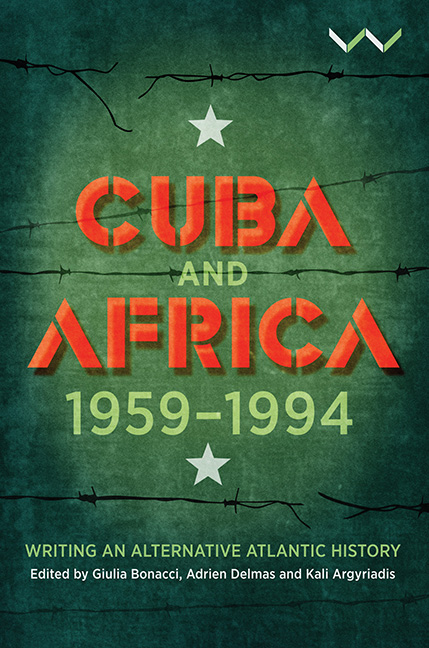
- Cuba and Africa, 1959-1994Writing an Alternative Atlantic History, pp. 109 - 129Publisher: Wits University PressPrint publication year: 2020
Accessibility standard: Unknown
Why this information is here
This section outlines the accessibility features of this content - including support for screen readers, full keyboard navigation and high-contrast display options. This may not be relevant for you.Accessibility Information
Accessibility compliance for the PDF of this book is currently unknown
and may be updated in the future.