To save content items to your account,
please confirm that you agree to abide by our usage policies.
If this is the first time you use this feature, you will be asked to authorise Cambridge Core to connect with your account.
Find out more about saving content to .
To save content items to your Kindle, first ensure no-reply@cambridge.org
is added to your Approved Personal Document E-mail List under your Personal Document Settings
on the Manage Your Content and Devices page of your Amazon account. Then enter the ‘name’ part
of your Kindle email address below.
Find out more about saving to your Kindle.
Note you can select to save to either the @free.kindle.com or @kindle.com variations.
‘@free.kindle.com’ emails are free but can only be saved to your device when it is connected to wi-fi.
‘@kindle.com’ emails can be delivered even when you are not connected to wi-fi, but note that service fees apply.
In this chapter, I show how Plato’s conception of and norms for comedy provide a framework for understanding the Euthydemus as an ideal comedy, and I argue that Plato employs techniques of comedic characterization, in particular borrowing from Aristophanes’ Clouds, in order to portray the enemies of philosophy as ridiculous and self-ignorant. In particular, I argue that he portrays the sophist brothers, Euthydemus and Dionysodorus, as imposters, who wrongly believe that they possess deep and important wisdom because of their skill in eristic argumentation, that is, argument that uses any means necessary to win. Socrates inhabits the role of the ironist, who ironically praises his interlocutors and then ultimately exposes them as ridiculous and self-ignorant. My analysis of the dialogue in terms of the interplay of these comedic character types not only allows us to see the nature, scope and function of Socratic irony in a new light, but it also shows how the dialogue’s overt concern with fallacy and argument ultimately is a question of character and virtue. In the end, I assess the dialogue in light of the constraints on ideal comedy articulated in Chapter 1.
In this chapter, I interpret Plato’s Cratylus as an ideal comedy and argue that Plato employs the comedic technique of parody in order to expose rival methodologies as sources of ridiculous self-ignorance. Socrates’ extended parody of etymology shows that words cannot be a guide to the nature of being, since we have no reason to think that their analysis can teach us anything about reality. Etymology is, in short, a source of laughable self-ignorance because it provides its practitioners with the illusion of wisdom. Parody generally involves the use of an imitation that exaggerates or distorts some feature of the original, often in order to undermine its claim to authority. In the case of etymology, Plato’s parody not only exposes etymology as a false path to wisdom, but it also articulates specific criticisms of etymology regarding its methodology, its scope and its alleged systematicity. The function and purpose of the very long etymological section has proved highly puzzling to interpreters who are generally unsure what to make of it, and my account reveals the etymologies to be playing a central, and previously unnoticed, role in the overall argument of the dialogue. In the end, I assess the dialogue in light of the constraints on ideal comedy articulated in Chapter 1.
In this chapter, I argue, drawing primarily on passages from the Philebus, the Republic and the Laws, that Plato understands comedy to be, in essence, an imitation of laughable people, where the notion of the laughable, or to geloion, is a normative one that picks out what genuinely merits laughter, and not necessarily what people actually laugh at. According to Plato, the only thing that merits laughter is moral vice, in particular the vice of self-ignorance. I formulate four constraints on ideal comedy on Plato’s behalf: the veridical constraint, which holds that only what is genuinely laughable, that is, moral vice, should be imitated as laughable; the educative constraint, which holds that comedic imitation must aim at educating the audience by encouraging them to reject vice in their own lives; the emotional constraint, which holds that the comedic imitation should cause appropriate and appropriately moderate emotional reactions; and the political constraint, which holds that only moral and political enemies should be portrayed as laughable.
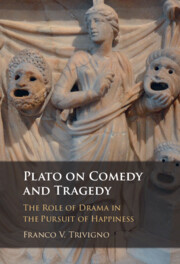
For Plato, tragedy and comedy are meaningful generic forms with proto-philosophical content concerning the moral character of their protagonists. He operates with a distinction between actual drama, the comedy and tragedy of the fourth and fifth centuries BCE, and ideal drama, the norm for what comedy and tragedy ought to be like. In this book Franco Trivigno reconstructs, on Plato's behalf, an original philosophical account of tragedy and comedy and illustrates the interpretive value of reading Plato's dialogues from this perspective. He offers detailed analyses of individual dialogues as instances of ideal comedy and tragedy, with attention to their structure and philosophical content; he also reconstructs Plato's ideals of comedy and tragedy by formulating definitions of each genre, specifying their norms, and showing how the two genres are related to each other. His book will be valuable for a range of readers interested in Plato and in Greek drama.
This chapter excavates a conception of autonomy from Olympiodorus’ (495–570) commentary on Plato’s Gorgias. For Olympiodorus, the subject of the dialogue is the ethical principles that lead to constitutional happiness, i.e., the well-being of one who exhibits a proper interior ‘constitution’, psychic arrangement or order. Such a person knows himself insofar as he identifies himself with the rational soul and rules himself accordingly. The principal interlocutors in the dialogue falter and stumble primarily because they do not know themselves, and this self-ignorance renders them heteronomic. The present essay therefore detects in Olympiodorus’ commentary an insistence on self-knowledge as the archaeological ground upon which an autonomous human life is based. By reading the pages of the Gorgias, Olympiodorus aspires to draw forth for his students a notion of freedom that is truly human. This chapter attends to Olympiodorus’ commentary with the hope of accomplishing a similar outcome.
Recommend this
Email your librarian or administrator to recommend adding this to your organisation's collection.