To save content items to your account,
please confirm that you agree to abide by our usage policies.
If this is the first time you use this feature, you will be asked to authorise Cambridge Core to connect with your account.
Find out more about saving content to .
To save content items to your Kindle, first ensure no-reply@cambridge.org
is added to your Approved Personal Document E-mail List under your Personal Document Settings
on the Manage Your Content and Devices page of your Amazon account. Then enter the ‘name’ part
of your Kindle email address below.
Find out more about saving to your Kindle.
Note you can select to save to either the @free.kindle.com or @kindle.com variations.
‘@free.kindle.com’ emails are free but can only be saved to your device when it is connected to wi-fi.
‘@kindle.com’ emails can be delivered even when you are not connected to wi-fi, but note that service fees apply.
In this chapter we discuss the case of the Russian unicorn Yandex, also known as the ‘Russian Google’. The company has become one of the largest information technology (IT) champions in Russia over the years and seemed to be unaffected by government, political interests and geopolitical tensions. In 2022, after the military conflict with Ukraine triggered severe economic sanctions on Russia, the company experienced political pressures both from the sanctioning countries and its home country government. We analyse the journey of Yandex, which started as a national IT unicorn, and shed light on its transformation into a state-affiliated enterprise in a dynamic situation of geopolitical reshuffling.
In the last century, economic sanctions have been used with increasing frequency as a tool of global governance, as well as in foreign policy. At the same time, they have long been criticized for their lack of success in achieving the stated goals of the sanctioners. However, what has received far less attention is the question of whether, and when, it is legitimate to impose sanctions. It has become increasingly clear that the humanitarian impact of sanctions may be devastating, affecting healthcare and food security, as well as harming vulnerable populations such as migrants. Sanctions may interfere with the work of humanitarian aid organizations, create diplomatic problems, and undermine the autonomy of sovereign states. Further, there can be significant legal questions regarding the use of sanctions, whether they are imposed by states or by institutions of global governance.
This chapter examines the devastating impact of the Gulf War and subsequent economic sanctions of the 1990s on Iraq’s healthcare system, arguing that the sanctions imposed can be understood as a form of silent warfare, causing long-term suffering and systemic collapse. The sanctions, aimed at compelling Iraq’s compliance with international demands, disrupted the country’s vital infrastructure, leading to widespread shortages of medical supplies, a mass exodus of healthcare professionals, and deteriorating public health. As hospitals faced chronic shortages, doctors were forced to adopt unorthodox medical practices, which, though necessary at the time, contributed to the rise of antimicrobial resistance (AMR) and the entrenchment of chronic health issues. The chapter underscores the ecological consequences of sanctions, with a focus on how this induced an ongoing public health crisis, not only within Iraq but across the broader region. It further explores the long-lasting effects of these adaptations on medical practices, such as improvisation in wound care and antibiotic use, which fostered conditions for the spread of resistant infections. By tracing the enduring repercussions of the sanctions, the chapter advocates for a rethinking of sanctions as a form of warfare that has far-reaching, long- lasting consequences for healthcare systems, particularly in conflict zones.
This chapter reviews recent advances in addressing the identification of the effects of sanctions on cross-country and country-level studies. It argues that, given the difficulties in assessing causal relationships in cross-national data, country-level case studies can serve as a useful and informative complement to cross-national regression studies. However, case studies pose a set of additional potential empirical pitfalls that can also obfuscate rather than clarify the identification of causal mechanisms at work, so they should be treated as a complement rather than a substitute to cross-national research. As an example, the chapter discusses the impact of sanctions on Venezuela and shows how they contributed to the country’s economic collapse through their impact on oil production, public sector revenues, and imports of essential goods. These findings are consistent with those of the broader cross-national literature, which identifies constraints on an economy’s trade and financial links as a key channel for the impact of sanctions.
The questions of accountability, legality, and legitimacy in regard to economic sanctions are remarkably convoluted. While they are distinct concepts, in the context of economic sanctions they are closely intertwined. Accountability can be found in many forms, including judicial venues, institutional oversight, political mechanisms, and public protest. In the case of the UNSC sanctions on Iraq in the 1990s, it might be said that the main forms of accountability that came into play were public pressure, as well as political pressure within the UN and outside of it. In the case of “targeted” sanctions, the perception that these measures are genuinely limited in their effects has obscured the fact that they are often indiscriminate and disproportionate, raising questions of legitimacy and legality, while undermining efforts at accountability. With regard to unilateral sanctions imposed by states, there are often significant issues of legality, where these measures do not properly constitute either retorsions or countermeasures. While asset freezes and similar blacklists of individuals (SDNs) appear to address the legal and ethical objections to comprehensive sanctions, there are issues related to the lack of due process, with implications for both the legality and legitimacy of these measures.
Economic sanctions are often deployed as political tools, but their impact extends far beyond their intended political targets. This study examines how intensified sanctions on Iran have affected the human security of Afghan migrants, a population already facing structural vulnerabilities. Drawing on fifty-three semi-structured interviews conducted between 2015 and 2018 with Afghan migrants and experts, the research explores two critical dimensions of human security: economic stability and access to healthcare. The findings reveal that while lower- income Afghan workers in unskilled sectors managed to retain employment due to demand for cheap labor, skilled workers and business owners faced significant economic hardship. At the same time, healthcare access deteriorated as financial constraints reduced government support and international assistance failed to meet growing needs. As the Iranian government adjusted its policies to prioritize its own citizens, Afghan migrants were further marginalized. This study underscores the unintended humanitarian consequences of economic sanctions. It highlights the need for a more nuanced approach to policy design. This applies both in the implementation of sanctions and in the response of host governments. A careful approach is necessary to ensure that vulnerable migrants are not disproportionately affected.
This chapter addresses some of the many ways that unilateral coercive measures run counter to international human rights law. Such measures may directly compromise the human rights to health, education, economic and social rights, and the right to development as well as sustainable development goals. The chapter addresses the expanding practice of the use of unilateral sanctions, provides an assessment of the possibility of imposing unilateral sanctions as countermeasures or retorsions, and provides an overview of the humanitarian impact of different types of sanctions on different categories of human rights. It looks at the recent developments in sanctioning practice. In particular, as targeted sanctions are usually presented as a good alternative to the comprehensive ones, minimizing humanitarian impact of unilateral measures, the chapter addresses the grounds for targeted unilateral sanctions, assesses their impact on the human rights of directly designated individuals, as well as other people and targeted populations in general. It concludes that listings of individuals regularly run counter to the right to due process. Additionally, most recently unilateral sanctions have compromised internet access, which in turn undermines access to many essential services.
What effect do economic sanctions have on civil society participation in target (sanctioned) countries? Do sanctions help or hurt civic activism in target societies? This chapter explores the degree to which economic sanctions affect the extent of civil engagement in target countries. It is argued that sanctions are likely to contribute to the deterioration of civil society participation in target countries through making non-state groups targets of state repression and impairing those groups’ organizational capacity. To substantiate the theoretical claims, cross- national sanctions data for the period 1989–2015 are combined with data on civil society participation. Results offer robust support that sanctions are detrimental to civil society and the suggested impact of sanctions is likely to be higher in the early rather than later years of sanctions imposition.
Do economic sanctions negatively affect democracy and human rights in targeted countries? Although often intended to improve these outcomes, their record of doing so has historically been mixed at best. Most canonical studies cover the 1980s–1990s, but sanctions practice has since undergone major innovations following debates on humanitarian harm. Given this move toward ‘targeted’ sanctions, it stands to reason that sanctions may today be achieving their intended purposes. I take up policy and methodological innovations to re-examine the effects of Western sanctions seeking to improve democracy and human rights from 1990 to 2021. I find that negative effects persist, offering an important update to the empirical literature. Beyond this contribution, I present a template for replicating and extending country-year research in international relations (IR).
This essay argues that the United States’ expansive use of financial sanctions—leveraging dollar-clearing chokepoints and global networks—has paradoxically accelerated pressures toward the erosion of the liberal economic order. As sanctions proliferate, targets move from short-term evasion to building alternative infrastructures, such as China’s RMB settlement system (CIPS), BRICS financial mechanisms, central bank digital currencies (CBDCs), and barter-based trade, thereby fostering governance decoupling from US-led systems. Drawing on structural power and institutionalist insights, I show how sanctions catalyze parallel economic ecosystems that fragment the financial architecture and, over time, erode US leverage and dollar centrality—even as the dollar remains dominant. I emphasize heterogeneous switching costs, with near-term change concentrated in the “plumbing” (messaging, clearing, legal venue) rather than in core reserve functions, and sketch two possible futures-bifurcated rival blocs versus pluralistic coexistence—calling on scholars and policymakers to rethink coercive statecraft in light of sanctions’ long-term institutional legacies.
Pearl Harbor demonstrates that war can occur when coercion (e.g., economic sanctions) works too well. To investigate this dynamic, we also engage another important, but controversial, question in this case – namely, whether the United States (US) president Franklin D. Roosevelt (FDR) deliberately sought war with Japan as a way to enter the war in Europe. Contrary to some scholars, our analysis concludes that FDR was aware of the total oil embargo that Acheson implemented and that FDR wanted war. Indeed, the US made only one serious attempt to avoid war – the modus vivendi proposal. FDR supported the proposal because he thought it would give the US more time to prepare. Tojo may have entertained the proposal, but he never received it because Chiang Kai-shek and Churchill vetoed it. The latter needed the US to intervene in the war to increase their chances of winning. This is yet another example of alliances promoting war – in this instance, by vetoing a peace proposal. Finally, we consider why Japan was willing to attack the US, even though it knew the US was more powerful.
The Russian aggression of Ukraine had dramatic effects on the energy and security policy of the EU. Those effects were mainly managed at the national level. The security and military challenge was left to NATO.
Economic tradecraft is a set of duties, responsibilities and skills required of diplomats working in economic affairs. It is a key instrument in the diplomatic tradecraft toolbox. As is the case with their colleagues in the political career track, economic officers work both at diplomatic missions abroad and at headquarters. On the surface, it may appear that a country’s economic and commercial diplomats do the same type of work abroad, but that is not quite the case. Economic officers inform policymaking at headquarters by monitoring and analyzing economic trends and developments in the receiving state. They also advocate for host-government policies aimed at leveling the playing field for companies from the home country and against regulations that hurt those businesses. Commercial diplomats directly help industries and individual companies in starting or expanding business and investment in the host country. Conversely, they facilitate investment by local firms in the home country.
Diplomacy is a political performing art that informs and determines the decisions of other states and peoples. It shapes their perceptions and calculations, so that they do what we want them to do, because they come to see that doing so is in their own best interests. Sometimes diplomacy rearranges their appraisal of their strategic circumstances–and, when needed, the circumstances themselves. Ultimately, it aims to influence their policies and behavior through measures short of war. Diplomacy succeeds best when it embraces humility, and respects and preserves the dignity of those to whom it is applied. Most of what diplomats do is unseen, and it is relatively inexpensive. Diplomacy’s greatest triumphs tend to be preventing bad things from happening, but gaining credit for something that was avoided is difficult.
The EU Blocking Regulation intends to exclude the effects of extraterritorial legislation by third countries and, in particular, those of US economic sanctions, to protect the interests of economic actors in the EU. The goals of the Regulation—effective enforcement of EU law and the protection of the interests of EU economic actors—give rise to an enforcement paradox: a lack of enforcement by the Commission and the state authorities. The Bank Melli case not only demonstrates a shift in the enforcement of the Blocking Regulation to private parties but also sheds light anew on the doubts about its ability to protect private interests.
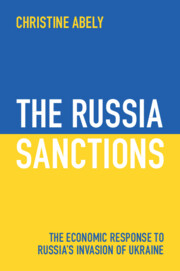
In The Russia Sanctions, Christine Abely examines the international trade measures and sanctions deployed against Russia in response to its 2022 invasion of Ukraine. Abely situates contemporary sanctions within their larger historical and economic backgrounds and provides a uniquely accessible analysis of the historic export controls and import restrictions enacted since 2022. She argues that these sanctions have affected, and will continue to affect, global trading patterns, financial integration, and foreign policy in novel ways. In particular, she examines the effects of sanctions on energy, food, fertilizer, the financial system, and the global use of the US dollar, including trends of de-dollarization. Coverage includes sanctions against oligarchs, the freezing and seizure of assets, and steps taken to make sanctions more effective by promoting financial transparency worldwide.
What strategies work best for enforcing sanctions? Sanctions enforcement agencies like the US Office of Foreign Assets Control (OFAC) face resource limitations and political constraints in punishing domestic firms for violating sanctions. Beyond monetary fines, sanctions enforcement actions also serve a “naming and shaming” function that tarnishes violators’ reputations. Larger, higher-profile companies tend have much more at stake in terms of their reputations than smaller or less well-known firms. At the same time, punishing higher-profile companies for sanctions violations is likely to generate more publicity about the risks and potential consequences of not complying with sanctions. We theorize that OFAC should impose larger fines on high-profile companies to draw attention to those cases, make the enforcement actions more memorable, and enhance the reputational costs that they inflict. We conduct a statistical analysis of OFAC enforcement actions from 2010 to 2021 and find support for our theory.
This article contributes to the understanding of why states resort to targeted, or smart, sanctions to meet the threat of cyber intrusions and whether this type of response is a forced measure or an effective tool to halt, prevent and punish attacking states. The tools of analysis used in the article are legal positivism and political theories, including Mancur Olson's theory of groups and Francesco Giumelli's analytical framework for assessment of sanctions. The authors address the effectiveness of sanctions as a reaction to cyber-enabled activities through the lens of regulation introduced in the United States, the European Union and the United Kingdom, which are the most developed counter-cyber sanction regimes, analysing publicly known cases of cyber-related sanctions.
How can the use of force by states be constrained under international law? Under what circumstances has the use of force by states been deemed "legitimate"? How are rules about the legitimate use of force changing? These questions are examined in depth, along with the relevant instruments of international law. The chapter details the various ways that "force" and "aggression" have been defined and used. It treats all the major forms of force or coercion, including full-scale military operations, economic sanctions and reprisals, proxy and clandestine forces, small-scale conflicts. It then traces growing prohibitions on the use of force from the League, the UN, the ICJ, and other sources. Finally, the Laws of Armed Conflict are highlighted as are the Geneva Conventions and instruments limiting munitions and conflict on the land, air, and sea. The use of drones and autonomous weapons systems, guided by AI, are highlighted as a growing area of concern for international law.
Any government that wants to be taken seriously needs teeth. This chapter sketches a global security system in which national governments will still play a key role, but in which they have also worked together to create stable mechanisms of collective security. Since it is impossible to coerce nuclear-armed Great Powers through direct military action, the new global security system will need an especially robust regime of economic sanctions. If a Great Power transgresses international laws in egregious ways, such sanctions would aim to persuade the leaders of that nation that the costs of continued violations greatly exceed the benefits. In extreme cases, such sanctions could also aim to destabilize a transgressor nation’s economy so severely that its citizens would be impelled to bring about regime change from within. If such a global security system were in place for many decades, successfully keeping the peace, then incremental steps toward reductions in standing armies could be gradually undertaken. The resulting “peace dividend” could be used to further reduce global economic disparities, and to help fund the technologies for mitigating climate change.