Refine search
Actions for selected content:
61 results
Investigation into phenomena surrounding universally Baire sets
- Part of
-
- Journal:
- Bulletin of Symbolic Logic / Volume 31 / Issue 4 / December 2025
- Published online by Cambridge University Press:
- 15 December 2025, pp. 695-696
- Print publication:
- December 2025
-
- Article
-
- You have access
- Export citation
-
This thesis presents my contributions to various aspects of the theory of universally Baire sets. One of these aspects is the smallest inner model containing all reals whose all sets of reals are universally Baire (viz., $L(\mathbb {R})$) and its relation to its inner model $\mathsf {HOD}$. We verify here that $\mathsf {HOD}^{L(\mathbb {R})}$ enjoys a form of local definability inside $L(\mathbb {R})$, further justifying its characterization as a “core model” in $L(\mathbb {R})$. We then study a “bottom-up” construction of more complicated universally Baire sets (more generally, determined sets). This construction allows us to give an “L-like” description of the minimum model of $\mathsf {AD}_{\mathbb {R}} + \mathsf {Cof}(\Theta ) = \Theta $. A consequence of this description is that this minimum model is contained in the Chang-plus model. Our construction, together with Woodin’s work on the Chang-plus model, shows that a proper class of Woodin cardinals which are limits of Woodin cardinals implies the existence of a hod mouse with a measurable limit of Woodin cardinals whose strategy is universally Baire.
Another aspect of the theory of universally Baire sets is the generic absoluteness and maximality associated with them. We include some results concerning generic $\Sigma _1^{H(\omega _2)}$-absoluteness with universally Baire sets as predicates or parameters, as well as generic $\Pi _2^{H(\omega _2)}$-maximality with universally Baire sets as predicates. In the second case, we are led to consider the general question of when a model of an infinitary propositional formula can be added by a stationary-set-preserving poset. We characterize when this happens in terms of a game which is a variant of the Model Existence Game. We then give a sufficient condition for this in terms of generic embeddings.
Abstract taken directly from the thesis
E-mail: obrad@math.ucla.edu


Chapter 7 - An Apparatus for Cognition
- from Part II - A Kantian Account of Thought Experiment
-
- Book:
- Kierkegaard and the Structure of Imagination
- Published online:
- 26 September 2025
- Print publication:
- 16 October 2025, pp 107-118
-
- Chapter
- Export citation
SIZE OF PIECES IN DECOMPOSITIONS INTO THE FIRST UNCOUNTABLE CARDINAL MANY PIECES
- Part of
-
- Journal:
- The Journal of Symbolic Logic , First View
- Published online by Cambridge University Press:
- 09 October 2025, pp. 1-35
-
- Article
-
- You have access
- Open access
- HTML
- Export citation
-
Within the determinacy setting, ${\mathscr {P}({\omega _1})}$ is regular (in the sense of cofinality) with respect to many known cardinalities and thus there is substantial evidence to support the conjecture that ${\mathscr {P}({\omega _1})}$ has globally regular cardinality. However, there is no known information about the regularity of ${\mathscr {P}(\omega _2)}$. It is not known if ${\mathscr {P}(\omega _2)}$ is even $2$-regular under any determinacy assumptions. The article will provide the following evidence that ${\mathscr {P}(\omega _2)}$ may possibly be ${\omega _1}$-regular: Assume $\mathsf {AD}^+$. If $\langle A_\alpha : \alpha < {\omega _1} \rangle $ is such that ${\mathscr {P}(\omega _2)} = \bigcup _{\alpha < {\omega _1}} A_\alpha $, then there is an $\alpha < {\omega _1}$ so that $\neg (|A_\alpha | \leq |[\omega _2]^{<\omega _2}|)$.


ON WINNING STRATEGIES FOR $F_\sigma $ GAMES
- Part of
-
- Journal:
- The Journal of Symbolic Logic , First View
- Published online by Cambridge University Press:
- 26 August 2025, pp. 1-15
-
- Article
- Export citation
-
We prove that every $\Sigma ^0_2$ Gale-Stewart game can be won via a winning strategy $\tau $ which is $\Delta _1$-definable over $L_{\delta }$, the $\delta $th stage of Gödel’s constructible universe, where $\delta = \delta _{\sigma ^1_1}$, strengthening a theorem of Solovay from the 1970s. Moreover, the bound is sharp in the sense that there is a $\Sigma ^0_2$ game with no strategy $\tau $ which is witnessed to be winning by an element of $L_{\delta }$.


CARNAP’S (CATEGORICITY) PROBLEM
- Part of
-
- Journal:
- Bulletin of Symbolic Logic , First View
- Published online by Cambridge University Press:
- 25 July 2025, pp. 1-46
-
- Article
-
- You have access
- Open access
- HTML
- Export citation
4 - Practical Reason in Peril
- from Part II - Key Rhetorical Concepts Animating Contemporary American Law
-
-
- Book:
- Rhetorical Traditions and Contemporary Law
- Published online:
- 02 May 2025
- Print publication:
- 22 May 2025, pp 70-94
-
- Chapter
-
- You have access
- Open access
- HTML
- Export citation
Effect of a cost channel on monetary policy transmission in a behavioral new Keynesian model
-
- Journal:
- Macroeconomic Dynamics / Volume 29 / 2025
- Published online by Cambridge University Press:
- 19 May 2025, e104
-
- Article
- Export citation
Chapter 6 - Cultural Stereotype
-
- Book:
- Cultural Stereotype and Its Hazards
- Published online:
- 21 November 2024
- Print publication:
- 28 November 2024, pp 180-217
-
- Chapter
- Export citation
Chapter 1 - Introduction
-
- Book:
- The Largest Suslin Axiom
- Published online:
- 07 June 2024
- Print publication:
- 27 June 2024, pp 1-8
-
- Chapter
- Export citation
The Largest Suslin Axiom
-
- Published online:
- 07 June 2024
- Print publication:
- 27 June 2024
New evidence on US monetary policy activism and the Taylor rule
-
- Journal:
- Macroeconomic Dynamics / Volume 28 / Issue 8 / December 2024
- Published online by Cambridge University Press:
- 29 February 2024, pp. 1809-1832
-
- Article
-
- You have access
- Open access
- HTML
- Export citation
3 - Answering Kripke’s Skeptic
-
-
- Book:
- Kripke's <i>Wittgenstein on Rules and Private Language</i> at 40
- Published online:
- 22 February 2024
- Print publication:
- 08 February 2024, pp 55-68
-
- Chapter
- Export citation
NOTE ON $\mathsf {TD} + \mathsf {DC}_{\mathbb {R}}$ IMPLYING $\mathsf {AD}^{L(\mathbb {R})}$
- Part of
-
- Journal:
- The Journal of Symbolic Logic / Volume 89 / Issue 1 / March 2024
- Published online by Cambridge University Press:
- 04 January 2024, pp. 211-217
- Print publication:
- March 2024
-
- Article
- Export citation
-
A short core model induction proof of $\mathsf {AD}^{L(\mathbb {R})}$ from $\mathsf {TD} + \mathsf {DC}_{\mathbb {R}}$.


Remarks on labelling and determinacy
-
- Journal:
- Canadian Journal of Linguistics/Revue canadienne de linguistique / Volume 68 / Issue 2 / June 2023
- Published online by Cambridge University Press:
- 18 August 2023, pp. 307-316
-
- Article
-
- You have access
- Open access
- HTML
- Export citation
1 - The Content of Coherence
-
- Book:
- Manifestations of Coherence and Investor-State Arbitration
- Published online:
- 13 December 2022
- Print publication:
- 19 January 2023, pp 11-35
-
- Chapter
- Export citation
COUNTABLE LENGTH EVERYWHERE CLUB UNIFORMIZATION
- Part of
-
- Journal:
- The Journal of Symbolic Logic / Volume 88 / Issue 4 / December 2023
- Published online by Cambridge University Press:
- 21 November 2022, pp. 1556-1572
- Print publication:
- December 2023
-
- Article
- Export citation
-
Assume $\mathsf {ZF} + \mathsf {AD}$ and all sets of reals are Suslin. Let $\Gamma $ be a pointclass closed under $\wedge $, $\vee $, $\forall ^{\mathbb {R}}$, continuous substitution, and has the scale property. Let $\kappa = \delta (\Gamma )$ be the supremum of the length of prewellorderings on $\mathbb {R}$ which belong to $\Delta = \Gamma \cap \check \Gamma $. Let $\mathsf {club}$ denote the collection of club subsets of $\kappa $. Then the countable length everywhere club uniformization holds for $\kappa $: For every relation $R \subseteq {}^{<{\omega _1}}\kappa \times \mathsf {club}$ with the property that for all $\ell \in {}^{<{\omega _1}}\kappa $ and clubs $C \subseteq D \subseteq \kappa $, $R(\ell ,D)$ implies $R(\ell ,C)$, there is a uniformization function $\Lambda : \mathrm {dom}(R) \rightarrow \mathsf {club}$ with the property that for all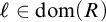 $\ell \in \mathrm {dom}(R)$, $R(\ell ,\Lambda (\ell ))$. In particular, under these assumptions, for all $n \in \omega $, $\boldsymbol {\delta }^1_{2n + 1}$ satisfies the countable length everywhere club uniformization.











DETERMINACY OF SCHMIDT’S GAME AND OTHER INTERSECTION GAMES
- Part of
-
- Journal:
- The Journal of Symbolic Logic / Volume 88 / Issue 1 / March 2023
- Published online by Cambridge University Press:
- 30 May 2022, pp. 1-21
- Print publication:
- March 2023
-
- Article
- Export citation
-
Schmidt’s game and other similar intersection games have played an important role in recent years in applications to number theory, dynamics, and Diophantine approximation theory. These games are real games, that is, games in which the players make moves from a complete separable metric space. The determinacy of these games trivially follows from the axiom of determinacy for real games, $\mathsf {AD}_{\mathbb R}$, which is a much stronger axiom than that asserting all integer games are determined, $\mathsf {AD}$. One of our main results is a general theorem which under the hypothesis $\mathsf {AD}$ implies the determinacy of intersection games which have a property allowing strategies to be simplified. In particular, we show that Schmidt’s $(\alpha ,\beta ,\rho )$ game on $\mathbb R$ is determined from $\mathsf {AD}$ alone, but on $\mathbb R^n$ for $n \geq 3$ we show that $\mathsf {AD}$ does not imply the determinacy of this game. We then give an application of simple strategies and prove that the winning player in Schmidt’s $(\alpha , \beta , \rho )$ game on $\mathbb {R}$ has a winning positional strategy, without appealing to the axiom of choice. We also prove several other results specifically related to the determinacy of Schmidt’s game. These results highlight the obstacles in obtaining the determinacy of Schmidt’s game from $\mathsf {AD}$.


GAMES CHARACTERIZING LIMSUP FUNCTIONS AND BAIRE CLASS 1 FUNCTIONS
- Part of
-
- Journal:
- The Journal of Symbolic Logic / Volume 87 / Issue 4 / December 2022
- Published online by Cambridge University Press:
- 13 April 2022, pp. 1459-1473
- Print publication:
- December 2022
-
- Article
-
- You have access
- Open access
- HTML
- Export citation
-
We consider a real-valued function f defined on the set of infinite branches X of a countably branching pruned tree T. The function f is said to be a limsup function if there is a function $u \colon T \to \mathbb {R}$ such that $f(x) = \limsup _{t \to \infty } u(x_{0},\dots ,x_{t})$ for each $x \in X$. We study a game characterization of limsup functions, as well as a novel game characterization of functions of Baire class 1.



8 - Conclusion: Competing Normative Cultures of War
- from Part III - Managing Uncertainty: Reconciling Legal and Extra-legal Reasoning
-
- Book:
- Law, War and the Penumbra of Uncertainty
- Published online:
- 31 March 2022
- Print publication:
- 07 April 2022, pp 310-330
-
- Chapter
- Export citation
CONSTRUCTING WADGE CLASSES
- Part of
-
- Journal:
- Bulletin of Symbolic Logic / Volume 28 / Issue 2 / June 2022
- Published online by Cambridge University Press:
- 26 January 2022, pp. 207-257
- Print publication:
- June 2022
-
- Article
- Export citation
-
We show that, assuming the Axiom of Determinacy, every non-selfdual Wadge class can be constructed by starting with those of level $\omega _1$ (that is, the ones that are closed under Borel preimages) and iteratively applying the operations of expansion and separated differences. The proof is essentially due to Louveau, and it yields at the same time a new proof of a theorem of Van Wesep (namely, that every non-selfdual Wadge class can be expressed as the result of a Hausdorff operation applied to the open sets). The exposition is self-contained, except for facts from classical descriptive set theory.

