To save content items to your account,
please confirm that you agree to abide by our usage policies.
If this is the first time you use this feature, you will be asked to authorise Cambridge Core to connect with your account.
Find out more about saving content to .
To save content items to your Kindle, first ensure no-reply@cambridge.org
is added to your Approved Personal Document E-mail List under your Personal Document Settings
on the Manage Your Content and Devices page of your Amazon account. Then enter the ‘name’ part
of your Kindle email address below.
Find out more about saving to your Kindle.
Note you can select to save to either the @free.kindle.com or @kindle.com variations.
‘@free.kindle.com’ emails are free but can only be saved to your device when it is connected to wi-fi.
‘@kindle.com’ emails can be delivered even when you are not connected to wi-fi, but note that service fees apply.
Chapter 3 considers T. S. Eliot and Lynette Roberts together as authors who develop major long poems in response to the violence and mechanization of World War II. While Eliot and Roberts carried on significant correspondence during this period, almost nothing has been written about the relationship between their poetry. In the face of wartime desolation, both offer fragmentary images of a submerged national past: the spiritual sanctuary of Little Gidding for Eliot; the buried dragon of the Welsh nation for Roberts. Alongside these images of potential national revival, both consider the possibility of transcendence, while still identifying with the political disarray of their chosen nations.
This chapter begins with reference to the veneration and obscurity that characterises Webb’s reputation. It relates the early Webb’s mentoring by Norman Lindsay and his subsequent rejection of Lindsay’s secular aesthetics and anti-Semitism. Webb’s expatriate years in Canada and then England are discussed as a search for creative independence, although England was the place of his first hospitalisation for mental illness. The chapter observes that some of Webb’s most resonant poems are responses to the East Anglia landscape. It traces Webb’s return to Australia, his continued hospitalisation, and his Catholic devotion. The chapter explores the concept of schizophrenia as a pathology of language to understand Webb’s poetic language, particularly its metaphorical aspects. Lastly, the chapter focuses on Webb’s ‘explorer’ poems, their metaphorics of journeying, and their relationship to Australia’s cultural history, or national mythology, in the late 1950s and 1960s.
From the Frontier Wars to contemporary conflicts, this chapter considers the role of Australian poetry in shaping understandings of war. It includes early critiques of British command during the Boer War and national mythmaking around Breaker Morant. It then considers the patriotism and propaganda of poetry in World War I and the generation of the Anzac or digger myth in national identity. It considers the role of humour and the vernacular in popular poetry, and writing from the homefront. It traces the change in attitudes as World War I continued and resulted in a heavy loss of Australian lives. The chapter also considers poetry written during World War II and the Vietnam War. It considers how writers experimented with form and imagery to create a vehicle of protest, as well as to navigate disillusionment and loss. The chapter considers poetic engagements with a movement into perpetual war and conflict in the late twentieth century, including the role of media. Lastly, it considers the voices of asylum seekers and the role of poetry in protesting and critiquing government policy around border security.
The epilogue explores the enduring legacies of this historical encounter between American soldiers and Chinese civilians. In the People’s Republic of China, the recurring persona of the Chinese victim facing American brutality, further popularized through propaganda during the Korean War, continues to influence popular Chinese anti-American nationalism. In the United States, while the occupation of China remains a largely forgotten history, practices in China created important precedents and patterns for US military involvement with other nations in the following decades. As tensions between the two nations reach new heights today, the legacy of this “lost era” continues to be contested through divergent historical accounts from both countries, shaped by radically changing geopolitical concerns. The shadow of the American occupation remains long and haunting.
1942 represents the apex of the global wave of autocratization associated with the Era of Fascism, and the expansion of Axis Rule during World War were responsible for this impressive growth of authoritarian 'occupation' regimes. Starting in Asia with the Imperialist expansion of Japan, followed by Nazi Germany and Fascist Italy in Europe, the number of dictatorships increased substantially. This Element analyses how the three poles of Axis rule, Italian Fascism, Nazi Germany, and Authoritarian Japan, lead the dynamics of institution-building of political regimes of occupation under their direct or indirect control, respective diffusion models and, in some cases, coercive transfers.
Why did Japan shift from being a status quo power in the 1920s to a revisionist power in the 1930s? This chapter argues that Japan’s rejection of the international order was hastened by changes in strategic thought reaching back to World War I. The rise of total war during World War I led military strategists to view self-sufficiency in resources and production as the prerequisite to success in modern warfare. This understanding of the importance of self-sufficiency did not influence national policy until the liberal order of the 1920s began to break down. Once the old order began to collapse, desires for autarky served as the backdrop behind a series of natural security solutions that gravitated toward war and establishing a new order in the region. The total war of World War II, in turn, shaped the entirety of Japan’s new order, the Greater East Asia Co-Prosperity Sphere.
This chapter situates contemporary Russian war memory in its twentieth-century historical context, exploring how and why the war victory gained such prominence and drawing out certain continuities and discontinuities across the Soviet/post-Soviet divide. Given the immense scale of Soviet wartime losses and the unusually heavy-handed instrumentalization of history under Putin, the Second World War was bound to play a prominent role in Russian memory culture. Yet, as the chapter will show, the precise character of Russian war memory and its utility for the Kremlin derive overwhelmingly from decades of Soviet-era commemorative practices. The chapter does not attempt to rectify distortions of historical truth but rather to elucidate the mechanisms by which states repurpose the past in the service of the present. Soviet war memory, as elsewhere, was the product of internal debate and deliberation as the leadership wrestled with what were often pan-European issues of representation. The chapter therefore approaches the myth and memory of the Great Patriotic War as a particular manifestation of a universal impulse to ‘make sense’ of war in the modern world.
Collective memory of a historical event does not depend on its contemporary and historiographical significance alone. Germany’s selective memory of the Eastern Front is a case in point. It has been influenced by four developments. The problem of the prisoners of war that had remained in the Soviet Union, the ‘returnees’, and the veterans underlined the importance of the Eastern Front among the West German public. The Stalingrad myth, in particular, had a decisive influence on an image of war (in the East), according to which the Germans considered themselves first and foremost victims of that war. The critical discussion of the war and its nexus with the Holocaust after 1970 led to a turning point wherein the victims of the Germans became the focus of remembrance in West Germany. In the socialist satellite state of East Germany, the heroization of the Red Army was a characteristic feature of public war memories. Commemorations of the Eastern Front changed again in unified Germany after the Cold War – from the early years of Russia’s rapprochement to the dramatic deterioration of the German-Russian relationship.
This chapter argues that the division of Korea has been wrongly attributed to Cold War tensions between the United States and the Soviet Union. Instead of being a result of the Cold War, the division itself was a cause of the Cold War. This chapter traces the history of US-Korean relations back to the nineteenth century, highlighting the growing interest of Americans in Korea which placed political pressure on US policymakers to support Korea in 1945. The chapter shows that American interest in Korea predated concerns over Soviet expansionism and was driven by factors such as the spread of Christianity in Korea, the desire to prevent Japanese domination in East Asia, and a sense of obligation stemming from a treaty signed in 1882. By reexamining the historical context of US involvement in Korea, the chapter challenges the prevailing Cold War narrative and offers a fresh perspective on the origins of the Korean conflict.
This chapter analyzes discourses on universal economic and social human rights and social democracy in connection with intellectuals discussing the American and British war aims of World War II. It was an age of major societal transformations: the socialization of work due to industrial capitalism; experiences of authoritarian ideologies emerging out of, inter alia, extreme inequality; and nascent uproars against racism and imperialism. Human rights were part of moral discourses on equality and social justice in the aftermath of the Great Depression and critiques of laissez-faire capitalism. The chapter details how Ralph Bunche and George Herbert Wells championed a vision of social democracy and human rights. Bunche and Wells intervened in wartime when many intellectuals across the political and religious spectrum would write of human rights. Key intellectual actors increasingly referred to a new political “space” of “the world,” and some were redefining “democracy” as a “world” and a “social” democracy. Revisiting their thinking allows for a more detailed reconstruction of their argumentation, including on how, specifically, they defended economic and social human rights.
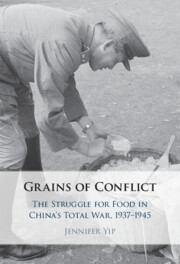
China's war against Japan was, at its heart, a struggle for food. As the Nationalists, Chinese Communist Party, and Japanese vied for a dwindling pool of sustenance, grain emerged as the lynchpin of their strategies for a long-term war effort. In the first in-depth examination of how the Nationalists fed their armies, Jennifer Yip demonstrates how the Chinese government relied on mass civilian mobilization to carry out all stages of provisioning, from procurement to transportation and storage. The intensive use of civilian labor and assets–a distinctly preindustrial resource base– shaped China's own conception of its total war effort, and distinguished China's experience as unique among World War Two combatants. Yip challenges the predominant image of World War II as one of technological prowess, and the tendency to conflate total war with industrialized warfare. Ultimately, China sustained total war against the odds with premodern means: by ruthlessly extracting civilian resources.
The dictatorial regime of Jorge Ubico silenced virtually all internal sociopolitical opposition in Guatemala during the interwar period (1931–44). To circumvent this restrictive political terrain, journalists Luz Valle and Gloria Menéndez Mina created literary journals ostensibly published with advice on home making and personal style which furtively cultivated an intellectual space that reflected transnational antifascist conversations. These journals served as incubators for antifascist, democratic ideals during a period of intense intellectual repression, ideals that revolutionary reformers translated directly into social and political democracy created by the October Revolution in 1944. Within a deeply patriarchal society, the journals’ gender analysis also expanded revolutionary vision of justice to include the political and social inclusion of women. Therefore, the extent to which the Guatemalan Revolution embraced antifascist ideals can be traced in part to the ideas published in Nosotras and Azul.
This chapter reveals how Caribbean Basin democracy and international antifascism came together during the 1944 Masacre Sampedrana. For over a decade, Honduran, Nicaraguan, and Dominican exiles protested against the respective dictatorships of Tiburcio Carías, Anastasio Somoza, and Rafael Trujillo. With World War II, exiles tapped into the international struggle against fascism to invigorate their local anti-dictatorial efforts. They blended the Four Freedoms, the Atlantic Charter, and other antifascist symbols with their longstanding democratic ideals while networking with likeminded allies. Their struggle culminated in July 1944 as teachers, workers, and students utilized antifascist symbols when women spearheaded protests against Carías’ dictatorship. After the regime violently responded, anti-dictatorial individuals and groups throughout the greater Caribbean continued to blend antifascism and Latin American democracy to denounce the horrific Masacre Sampedrana and direct regional and international attention on the Honduran dictatorship.
The book examines Nationalist China’s military provisioning strategies during its war against Japan, from procurement and storage to transportation and seizure from the enemy, to make two broader points. Firstly, the conflict shows that the historical concept of total war should not be confined to modern technology as a means or to rapid victory as an end. Chinese thinkers christened their struggle against Japan a “total war,” but held a different vision of totality to accommodate China’s premodern resource base and commitment to protracted warfare. Secondly, logistics deserves more attention not just among military historians, but among all scholars of war. Its technicalities are a crucial window into the everyday experiences of ordinary actors who have been marginalized in historical scholarship.
Drawing on ethnographic research from Amami Ōshima, southern Japan, this paper documents the ways in which contemporary societies, from the hamlet to the nation state, are wrestling with opposing forces of environmental and economic sustainability and discusses the fractures this creates for people and ecosystems. It uses as a case study the protest to stop the construction of a seawall being built in Katoku, an ocean hamlet in Amami, based within the buffer zone of the island’s United Nations Educational, Scientific and Cultural Organization (UNESCO) World Natural Heritage Site. Rather than being built with the primary aim to protect “people and property,” I suggest this infrastructural intervention is a symbolic declaration of risk management and repository of huge economic value for the island and prefecture. The background to the paper is the return of a cache of color photographs taken by an American anthropologist in the 1950s and the 70th anniversary of the reversion of Amami in 1953 from US military to Japanese control. The paper considers the contemporary ramifications of policy instituted in the post-World War II period, that has sought to maximize the potential of “remote” areas and continues to favor growth and development at the expense of the health of multispecies island communities.
The training of two all-black infantry divisions at Fort Huachuca during World War II is unprecedented in American history. Although it provides an insight into the contradictions of the US Army’s racial policy, this experiment has never been described before. This microhistory explores the agency of soldiers in the face of segregation and of their being treated as if they were inferior by the army.
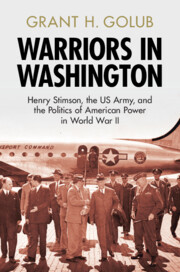
How did the US Army emerge as one of the most powerful political organizations in the United States following World War II? In this book, Grant H. Golub asserts that this remarkable shift was the result of the Army's political masters consciously transforming the organization into an active political player throughout the war. Led by Henry Stimson, the Secretary of War and one of the most experienced American statesmen of the era, the Army energetically worked to shape the contours of American power throughout the war, influencing the scope and direction of US foreign policy as the Allies fought the Axis powers. The result saw the Army, and the military more broadly, gain unprecedented levels of influence over US foreign relations. As World War II gave way to the Cold War, the military helped set the direction of policy toward the Soviet Union and aided the decades of confrontation between the two superpowers.
The chapter illustrates what it meant for Carolyn Beatrice Parker (1917–1966) to be a Black woman physicist in the US during the Jim Crow era. Her father, a physician, and her mother, a teacher, shepherded her into Fisk University, an historically Black college. As a physics major she studied infrared spectroscopy with the Black physicist Elmer Imes, graduating with a BS in 1938. She later attended the University of Michigan, obtaining an MA in physics in 1941. But like many Black women, she spent time before and after graduate school teaching in the K–12 system. In 1943, she became a research physicist at the Aircraft Radio Laboratory in Dayton, Ohio, where she stayed for four years. Although she co-authored a governmental report about her work on signal attenuation in coaxial cables, her name only appeared in the acknowledgments of the ensuing academic publications, thus partly obscuring her contributions. In 1947, Fisk University welcomed Parker on the faculty, but she soon after enrolled in a nuclear physics PhD program at the Massachusetts Institute of Technology. After dropping out, she worked as a laboratory technician until she grew too ill and died a short time later.
From 1941 to 1945, 30,000 African-American infantrymen were stationed at Fort Huachuca near the Mexican border. It was the only 'black post' in the country. Separated from white troops and civilian communities, these infantrymen were forced to accept the rules and discipline that the US Army, convinced of their racial inferiority, wanted to impose on them. Mistrustful of black soldiers, the Army feared mutiny and organized a harsh segregation that included strict confinement, control of the infantrymen during training and leisure, and the physical separation of white and black officers to diffuse any suggestion that equality of rank translated into social equality. In this book, available for the first time in English, Pauline Peretz uncovers America's tortuous relationship with its black soldiers against the backdrop of a war fought in the name of democracy.