To save content items to your account,
please confirm that you agree to abide by our usage policies.
If this is the first time you use this feature, you will be asked to authorise Cambridge Core to connect with your account.
Find out more about saving content to .
To save content items to your Kindle, first ensure no-reply@cambridge.org
is added to your Approved Personal Document E-mail List under your Personal Document Settings
on the Manage Your Content and Devices page of your Amazon account. Then enter the ‘name’ part
of your Kindle email address below.
Find out more about saving to your Kindle.
Note you can select to save to either the @free.kindle.com or @kindle.com variations.
‘@free.kindle.com’ emails are free but can only be saved to your device when it is connected to wi-fi.
‘@kindle.com’ emails can be delivered even when you are not connected to wi-fi, but note that service fees apply.
This chapter examines the period from the Estates General of 1614 to the Fronde (1648–1651), especially the political discourse of the Assemblies of Notables in 1617 and 1626–1627, as well as the dozens of political pamphlets denouncing Anne of Austria, the young Louis XIVs regent, and his first minister, Jules Mazarin. These pamphlets, known as Mazarinades, use the clear vocabulary of absolutism and royal State, as the judges in the Parlement of Paris recognized the authority of the king in return for the judges elevation as first degree nobles.
This book is designed for readers interested in the rise of absolutism in seventeenth-century France, as well as those interested in language and political discourse of this period. It demonstrates how the political discourse in the late Middle Ages, based on ancient Roman ideas that government existed for the common good (le bien public, or la chose publique, a French translation of the Latin res publica), began to evolve in the 1570s. Though references to the common good continued to be used right up to the French Revolution, they began to be overtaken by the language of the State (le bien de l’État). This evolution in language existed at every social level from the peasant village up to the royal court, and they accompanied the rise of absolutism in France, as the book demonstrates by analyzing scores of local, regiona,l and national lists of grievances presented to provincial estates and the Estates-General.
While French political discourse in the late Middle Ages had been based on ancient Roman ideas that government existed for the common good (le bien public, or la chose publique, a French translation of the Latin res publica), these ideas began to evolve in the 1570s. Although references to the common good continued to be used right up to the French Revolution, they were gradually overtaken by a focus on the good of the State (le bien de l'État). James B. Collins demonstrates how this evolution in language existed at every social level from the peasant village up to the royal court. By analysing the language used in scores of local, regional and national lists of grievances presented to provincial estates and the Estates-General, Collins demonstrates how the growth was as much a bottom-up process as a top-down enforcement of royal power.
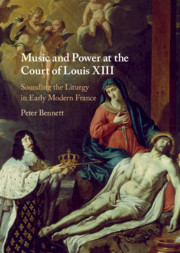
What role did sacred music play in mediating Louis XIII's grip on power in the early seventeenth century? How can a study of music as 'sounding liturgy' contribute to the wider discourse on absolutism and 'the arts' in early modern France? Taking the scholarship of the so-called 'ceremonialists' as a point of departure, Peter Bennett engages with Weber's seminal formulation of power to consider the contexts in which liturgy, music and ceremonial legitimated the power of a king almost continuously engaged in religious conflict. Numerous musical settings show that David, the psalmist, musician, king and agent of the Holy Spirit, provided the most enduring model of kingship; but in the final decade of his life, as Louis dedicated the Kingdom to the Virgin Mary, the model of 'Christ the King' became even more potent – a model reflected in a flowering of musical publication and famous paintings by Vouet and Champaigne.
Recommend this
Email your librarian or administrator to recommend adding this to your organisation's collection.