To save content items to your account,
please confirm that you agree to abide by our usage policies.
If this is the first time you use this feature, you will be asked to authorise Cambridge Core to connect with your account.
Find out more about saving content to .
To save content items to your Kindle, first ensure no-reply@cambridge.org
is added to your Approved Personal Document E-mail List under your Personal Document Settings
on the Manage Your Content and Devices page of your Amazon account. Then enter the ‘name’ part
of your Kindle email address below.
Find out more about saving to your Kindle.
Note you can select to save to either the @free.kindle.com or @kindle.com variations.
‘@free.kindle.com’ emails are free but can only be saved to your device when it is connected to wi-fi.
‘@kindle.com’ emails can be delivered even when you are not connected to wi-fi, but note that service fees apply.
This chapter provides an introduction to Liouville conformal field theory on the sphere, as developed in a series of papers starting with the work of David, Kupiainen, Rhodes and Vargas. We give an informal overview of conformal field theory in general and Polyakov’s action, before starting our rigorous presentation. For this, we first spend some time defining Gaussian free fields on general manifolds, and explaining how to construct their associated Gaussian multiplicative chaos measures via uniformisation. We then show how to construct the correlation functions of the theory under certain constraints known as the Seiberg bounds. One remarkable feature of the theory is its integrability: we demonstrate this phenomenon by expressing the k-point correlation functions as negative fractional moments of Gaussian multiplicative chaos. We conclude with a brief overview of some recent developments, including a short discussion of BPZ equations, conformal bootstrap and the proof by Kupiainen, Rhodes and Vargas of the celebrated DOZZ formula.
This chapter is devoted to the study of so-called quantum surfaces, which are fields defined on a parameterising domain, viewed up to an equivalence relation corresponding to the conformal change of coordinates formula of Chapter 2. We construct various special quantum surfaces enjoying scale-invariance properties, including quantum spheres, discs, wedges and cones. These objects are the conjectured scaling limits of families of random planar maps, as in Chapter 4 for example, depending on the imposed discrete topology. We conclude the chapter by explaining how these quantum surfaces are related in a rigorous way to the Liouville conformal field theory developed in Chapter 5.
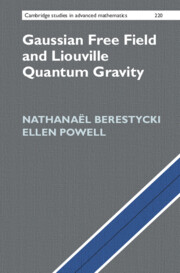
In this comprehensive volume, the authors introduce some of the most important recent developments at the intersection of probability theory and mathematical physics, including the Gaussian free field, Gaussian multiplicative chaos and Liouville quantum gravity. This is the first book to present these topics using a unified approach and language, drawing on a large array of multi-disciplinary techniques. These range from the combinatorial (discrete Gaussian free field, random planar maps) to the geometric (culminating in the path integral formulation of Liouville conformal field theory on the Riemann sphere) via the complex analytic (based on the couplings between Schramm–Loewner evolution and the Gaussian free field). The arguments (currently scattered over a vast literature) have been streamlined and the exposition very carefully thought out to present the theory as much as possible in a reader-friendly, pedagogical yet rigorous way, suitable for graduate students as well as researchers.
Recommend this
Email your librarian or administrator to recommend adding this to your organisation's collection.