To save content items to your account,
please confirm that you agree to abide by our usage policies.
If this is the first time you use this feature, you will be asked to authorise Cambridge Core to connect with your account.
Find out more about saving content to .
To save content items to your Kindle, first ensure no-reply@cambridge.org
is added to your Approved Personal Document E-mail List under your Personal Document Settings
on the Manage Your Content and Devices page of your Amazon account. Then enter the ‘name’ part
of your Kindle email address below.
Find out more about saving to your Kindle.
Note you can select to save to either the @free.kindle.com or @kindle.com variations.
‘@free.kindle.com’ emails are free but can only be saved to your device when it is connected to wi-fi.
‘@kindle.com’ emails can be delivered even when you are not connected to wi-fi, but note that service fees apply.
The Revolution is often remembered in the public consciousness for doing away with censorship, yet the reality was somewhat different, especially when it came to remembering the decade of 1789–99. This chapter analyses how such representations across genres from ballet to fait historique were censored both laterally and bureaucratically from the calling of the Estates General in 1788 through to the coup of 18 Brumaire in November 1799, passing through cities like Nîmes, Brussels, Dijon, Tours, and Bordeaux, alongside Paris. After the initial relaxation of censorship in the early 1790s, it soon returned and there was a stark rise in bureaucratic censorship during the Directory. However, audiences, playwrights, and theatres throughout the Revolution were prepared to use the stage to reject the official view of political progress, at times leading to an overt rejection of the regime in place and bringing major cities to the brink of rebellion.
This chapter explains the origins of the Estates General, in practice from the 1484 meeting, and how deputies were chosen, how the meetings of the Estate General operated, and why kings convoked them in its 1560, 1561, 1576, 1588–1589, and 1614 meetings. It also explains the differences between the Estates General and meetings of provincial estates and bailiwick assemblies.
This chapter examines political discourse at various meetings of the Estates General between 1561 and 1589. it shows the evolution from an emphasis on the common good (bien public) to the good of the state (bien détat). This new language of the royal state was introduced in the 1576 meeting at Blois, but it became even more widely used in the 1588–1589 meeting of the Estates General, also at Blois.
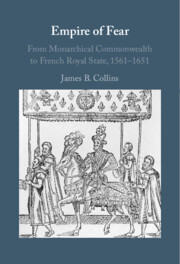
This book is designed for readers interested in the rise of absolutism in seventeenth-century France, as well as those interested in language and political discourse of this period. It demonstrates how the political discourse in the late Middle Ages, based on ancient Roman ideas that government existed for the common good (le bien public, or la chose publique, a French translation of the Latin res publica), began to evolve in the 1570s. Though references to the common good continued to be used right up to the French Revolution, they began to be overtaken by the language of the State (le bien de l’État). This evolution in language existed at every social level from the peasant village up to the royal court, and they accompanied the rise of absolutism in France, as the book demonstrates by analyzing scores of local, regiona,l and national lists of grievances presented to provincial estates and the Estates-General.
While French political discourse in the late Middle Ages had been based on ancient Roman ideas that government existed for the common good (le bien public, or la chose publique, a French translation of the Latin res publica), these ideas began to evolve in the 1570s. Although references to the common good continued to be used right up to the French Revolution, they were gradually overtaken by a focus on the good of the State (le bien de l'État). James B. Collins demonstrates how this evolution in language existed at every social level from the peasant village up to the royal court. By analysing the language used in scores of local, regional and national lists of grievances presented to provincial estates and the Estates-General, Collins demonstrates how the growth was as much a bottom-up process as a top-down enforcement of royal power.
This chapter describes the American Revolution in its general development and underlying logics, with particular attention given to the traditions of political participation and their and transformations, and the ways in which they were fused – or not – with individual equality.
The late medieval French monarchy developed its political vocabulary in the aftermath of the existential crisis of 1356-1360. Charles V patronized intellectuals, above all Nicole Oresme, who created a language for a monarchical commonwealth. French politics took place within the framework of this language for about two centuries, when another existential crisis, tied to the Wars of Religion, generated a new vocabulary, built around a royal State. Chapter 1 focuses on the origin of this vocabulary, tied to the representative assemblies of 1356-1358. The key figures in this process, aside from Charles, then regent for his prisoner father, were Jean Buridan and Nicole Oresme. The “bien de la chose publique” vocabulary came into being around debates on currency at the meetings of the Estates General of Languedoïl in Paris in the late 1350s. Minting brought together the two key elements of the public good – the economy and politics. The connection between currency and the public good would remain strong at later assemblies, in 1484 and 1576.
Chapter Three considers central questions in the French political thought of this era, regarding the status of the ‘ancient’ constitution, the power of election and deposition, and the divisive nature of debates about succession laws. It demonstrates the complex nature and range of responses to Hotman’s Francogallia in these contexts, as well as exploring the role of both the Estates General and the often-overlooked Paris parlement in conserving the constitution. It also considers the problem of ‘popular sovereignty’ and its implications for League political thought, establishing that the Leaguers were only interested in the elective, and deposing, powers of the ‘prudent multitude’ and not the wider populace. The double incorporation of the people, as a whole, into the commonwealth and the church is shown to be centrally important in these debates.
In early May, as the deputies from all three Estates came to Versailles for the scheduled opening of the Estates General they carried with them cahiers enjoining them to reform the constitution in broadly similar ways. One major matter that divided them was the question of how the deputies would meet and vote. Deputies from the Third Estate came determined to pursue common meetings of the three orders with matters decided by a vote by head. Noble and Clerical deputies were split on the issue, but a majority in both orders carried cahiers encouraging or requiring them to seek separate meetings and a vote by order. The electoral regulations sent out by the king in January had not settled which form would prevail. From the very first meeting of the Estates General, the orders entered into a prolonged stalemate as the Third Estate refused to conduct business without first verifying all deputy credentials in common in the main meeting hall and the Nobles insisted that credentials be verified separately by each order.
One of the most remarkable features of the early Revolution was the absence of direct communication between the Third Estate and Louis XVI. The king had given no instructions about how to regulate communication between himself and the orders. The matter devolved to the Keeper of the Seals, Charles Louis François de Paule de Barentin, who took it upon himself to act as the supervisor for everything related to the Estates General. He became the conduit through which communication between the orders and Louis passed. But Barentin was deeply hostile to the pretensions of the Third Estate, going back at least as far as the time of the Result of the King’s Council of State of 1788. Until mid July, Barentin managed communications to the benefit of the Noble order, generally refusing to find times for members of the Third Estate to meet with the king. During the stalemate, the deputies of the Third Estate had only been given one meeting with Louis and it was at the worst time possible, coming two days after the death of the king’s oldest son.
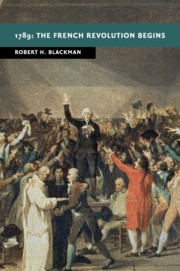
The French Revolution marks the beginning of modern politics. Using a diverse range of sources, Robert H. Blackman reconstructs key constitutional debates, from the initial convocation of the Estates General in Versailles in May 1789, to the National Assembly placing the wealth of the Catholic Church at the disposal of the nation that November, revealing their nuances through close readings of participant and witness accounts. This comprehensive and accessible study analyses the most important debates and events through which the French National Assembly became a sovereign body, and explores the process by which the massive political transformation of the French Revolution took place. Blackman's narrative-driven approach creates a new path through the complex politics of the early French Revolution, mapping the changes that took place and revealing how a new political order was created during the chaotic first months of the Revolution.
Recommend this
Email your librarian or administrator to recommend adding this to your organisation's collection.