

Hostname: page-component-857557d7f7-v2cwp Total loading time: 0 Render date: 2025-12-02T17:41:46.463Z Has data issue: false hasContentIssue false

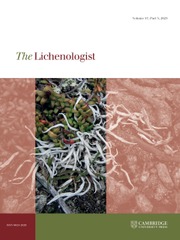
Cladonia rubrotincta, a new species distinct from C. norvegica

Published online by Cambridge University Press:  20 October 2025

Věra Vtípilová
Affiliation:
Department of Botany, Faculty of Science, Charles University, 12801 Prague, Czechia Institute for Environmental Studies, Faculty of Science, Charles University, 12801 Prague, Czechia
Einar Timdal
Affiliation:
Natural History Museum, University of Oslo , Blindern, NO-0318 Oslo, Norway
Eva Stodůlková
Affiliation:
Institute of Microbiology of the Czech Academy of Sciences, 142 20 Prague, Czechia
Jaroslav Semerád
Affiliation:
Institute of Microbiology of the Czech Academy of Sciences, 142 20 Prague, Czechia
Philipp Resl
Affiliation:
Institute of Biology, University of Graz , 8010 Graz, Austria
Jana Steinová*
Affiliation:
Department of Botany, Faculty of Science, Charles University, 12801 Prague, Czechia
*
Corresponding author: Jana Steinová; Email: jana.steinova@natur.cuni.cz

Abstract

Cladonia norvegica was originally described from Norway based on different morphological and chemical characters distinguishing the species from C. coniocraea. Shortly after its description, material containing red spots on the thallus was reported from different parts of the world, but the taxonomic status of this form remained unclear. In this study, we investigated the morphological, chemical and genetic differences between the spotless form of C. norvegica and the red-spotted material. Phylogenetic analyses of mycobiont DNA (ITS rDNA, mtSSU, EF-1α) revealed that red-spotted specimens form a well-supported monophyletic clade, distinct from the spotless form of C. norvegica. We therefore describe red-spotted material as a new species, C. rubrotincta, with the type from Norway and we genetically and morphologically confirm occurrences from Austria, Czechia, Estonia, Great Britain and western Canada. The identity of the red pigment was confirmed to be a rhodocladonic acid by HPLC and LC-HRMS. Specimens with red spots exhibit consistently smaller and more irregularly shaped podetia. Additionally, our analysis of photobionts indicated that both species share a similar pool of Asterochloris symbionts. This study underscores the importance of integrating molecular, chemical, and morphological data in lichen taxonomy and provides insights into the distribution and ecological preferences of C. rubrotincta and C. norvegica.

Information

Type
Standard Paper
Copyright
© The Author(s), 2025. Published by Cambridge University Press on behalf of the British Lichen Society

Access options

Get access to the full version of this content by using one of the access options below. (Log in options will check for institutional or personal access. Content may require purchase if you do not have access.)

Article purchase

Temporarily unavailable

Footnotes

*

Contributed equally

References

Ahti, T (2000) Cladoniaceae . Flora Neotropica 78, 1362.Google Scholar
Ahti, T, Stenroos, S and Moberg, R (2013) Nordic Lichen Flora, Volume 5: Cladoniaceae. Göteborg: Museum of Evolution, Uppsala University.Google Scholar
Baker, PM and Bullock, E (1969) Structure of rhodocladonic acid. Canadian Journal of Chemistry 47, 27332734.10.1139/v69-454CrossRefGoogle Scholar
Brodo, IM and Ahti, T (1996) Lichens and lichenicolous fungi of the Queen Charlotte Islands, British Columbia, Canada. 2. The Cladoniaceae. Canadian Journal of Botany 74, 11471180.10.1139/b96-139CrossRefGoogle Scholar
Burgaz, AR, Ahti, T and Pino-Bodas, R (2020) Mediterranean Cladoniaceae. Madrid: Spanish Lichen Society (SEL).Google Scholar
Castresana, J (2000) Selection of conserved blocks from multiple alignments for their use in phylogenetic analysis. Molecular Biology and Evolution 17, 540552.10.1093/oxfordjournals.molbev.a026334CrossRefGoogle ScholarPubMed
Cocquyt, E, Verbruggen, H, Leliaert, F and Clerck, OD (2010) Evolution and cytological diversification of the green seaweeds (Ulvophyceae). Molecular Biology and Evolution 27, 20522061.10.1093/molbev/msq091CrossRefGoogle ScholarPubMed
Cubero, OF, Crespo, A, Fatehi, J and Bridge, PD (1999) DNA extraction and PCR amplification method suitable for fresh, herbarium-stored, lichenized, and other fungi. Plant Systematics and Evolution 216, 243249.10.1007/BF01084401CrossRefGoogle Scholar
Culberson, CF (1972) Improved conditions and new data for identification of lichen products by standardized thin-layer chromatographic method. Journal of Chromatography A 72, 113125.10.1016/0021-9673(72)80013-XCrossRefGoogle ScholarPubMed
Flieger, J, Tatarczak-Michalewska, M, Blicharska, E, Świeboda, R and Banach, T (2017) HPLC identification of copper (II)-trans-resveratrol complexes in ethanolic aqueous solution. Journal of Chromatographic Science 55, 445450.Google ScholarPubMed
Gardes, M and Bruns, T (1993) ITS primers with enhanced specificity for basidiomycetes – application to the identification of mycorrhizae and rusts. Molecular Ecology 2, 113118.10.1111/j.1365-294X.1993.tb00005.xCrossRefGoogle Scholar
Hepperle, D (2004) SeqAssem©. A sequence analysis tool, contig assembler and trace data visualization tool for molecular sequences. [WWW resource] URL http://www.sequentix.de.Google Scholar
Katoh, K and Standley, DM (2013) MAFFT multiple sequence alignment software version 7: improvements in performance and usability. Molecular Biology and Evolution 30, 772780.10.1093/molbev/mst010CrossRefGoogle ScholarPubMed
Kuusinen, M, Stenroos, S and Ahti, T (1989) Cladonia norvegica and C. incrassata in Finland. Graphis Scripta 2, 128133.Google Scholar
Kuznetsova, ES and Dudov, SV (2017) New records of lichens from the Zeysky Nature Reserve (Amur Region, Russia). Folia Cryptogamica Estonica 54, 5158.10.12697/fce.2017.54.09CrossRefGoogle Scholar
Liška, J, Palice, Z and Bayerová, Š (1999) Cladonia luteoalba a C. norvegica – nové dutohlávky pro ČR. Bryonora 23, 47.Google Scholar
Lõhmus, P and Lõhmus, A (2009) The importance of representative inventories for lichen conservation assessments: the case of Cladonia norvegica and C. parasitica. Lichenologist 41, 6167.10.1017/S002428290900807XCrossRefGoogle Scholar
Malíček, J (2022) Lišejníky přírodní rezervace Getsemanka v Brdech. Bryonora 69, 1929.Google Scholar
Malíček, J, Bouda, F, Palice, Z and Peksa, O (2011) Interesting records of rare and overlooked Cladonia species in the Czech Republic. Bryonora 48, 3450.Google Scholar
Marthinsen, G, Rui, S and Timdal, E (2019) OLICH: a reference library of DNA barcodes for Nordic lichens. Biodiversity Data Journal 7, e36252.10.3897/BDJ.7.e36252CrossRefGoogle ScholarPubMed
Miller, MA, Pfeiffer, W and Schwartz, T (2010) Creating the CIPRES Science Gateway for inference of large phylogenetic trees. In Proceedings of the Gateway Computing Environments Workshop (GCE), 14 November 2010, New Orleans, Louisiana, pp. 18.10.1109/GCE.2010.5676129CrossRefGoogle Scholar
Muhr, LE (1986) Lavfloran i Gravbäcksravinen i Värmland. Svensk Botanisk Tidskrift 81, 1736.Google Scholar
Pfingstl, T, Vtípilová, V, Ghlimová, H, Mourek, J, Steinová, J, Schäffer, S and Resl, P (2025) Oribatid mite fauna of three species of the lichen Cladonia in Europe – observations on species richness, endophagous juveniles and their morphologyAcarologia (in press).Google Scholar
Piercey-Normore, MD and DePriest, PT (2001) Algal switching among lichen symbioses. American Journal of Botany 88, 14901498.10.2307/3558457CrossRefGoogle ScholarPubMed
Pino-Bodas, R and Stenroos, S (2021) Global biodiversity patterns of the photobionts associated with the genus Cladonia (Lecanorales, Ascomycota). Microbial Ecology 82, 173187.10.1007/s00248-020-01633-3CrossRefGoogle ScholarPubMed
Pino-Bodas, R, Sanderson, N, Cannon, P, Aptroot, A, Coppins, B, Orange, A and Simkin, J (2021) Lecanorales: Cladoniaceae, including the genera Cladonia, Pilophorus and Pycnothelia. Revisions of British and Irish Lichens 19, 145.Google Scholar
Quilhot, W, Cuellar, M, Díaz, R, Riquelme, F and Rubio, C (2011) Liqúenes de Aisén, sur de Chile. Gayana Botánica 69, 5787.10.4067/S0717-66432012000100007CrossRefGoogle Scholar
R Core Team (2022) R: a Language and Environment for Statistical Computing, Version 4.1.2. R Foundation for Statistical Computing, Vienna, Austria. [WWW resource] URL https://www.R-project.org.Google Scholar
Rambaut, A (2018) FigTree, a graphical viewer of phylogenetic trees, version 1.4. 4. Institute of Evolutionary Biology, University of Edinburgh. [WWW resource] URL http://tree.bio.ed.ac.uk/software/figtree/.Google Scholar
Randlane, T and Saag, A (1999) Second checklist of lichenized, lichenicolous and allied fungi of Estonia. Folia Cryptogamica Estonica 35, 1132.Google Scholar
Rikkinen, J, Oksanen, I and Lohtander, K (2002) Lichen guilds share related cyanobacterial symbionts. Science 297, 357.10.1126/science.1072961CrossRefGoogle ScholarPubMed
Ronquist, F, Teslenko, M, van der Mark, P, Ayres, DL, Darling, A, Höhna, S, Larget, B, Liu, L, Suchard, MA and Huelsenbeck, JP (2012) MrBayes 3.2: efficient Bayesian phylogenetic inference and model choice across a large model space. Systematic Biology 61, 539542.10.1093/sysbio/sys029CrossRefGoogle ScholarPubMed
Ruoss, VE, Mayrhofer, H and Pongratz, W (1987) Eine Rentier- und eine Becherflechte neu für die Steiermark. Mitteilungen des Naturwissenschaftlicher Verein Steiermark 117, 105110.Google Scholar
Škvorová, Z, Černajová, I, Steinová, J, Peksa, O, Moya, P and Škaloud, P (2022) Promiscuity in lichens follows clear rules: partner switching in Cladonia is regulated by climatic factors and soil chemistry. Frontiers in Microbiology 12, 781585.10.3389/fmicb.2021.781585CrossRefGoogle ScholarPubMed
Stamatakis, A (2014) RAxML version 8: a tool for phylogenetic analysis and post-analysis of large phylogenies. Bioinformatics 30, 13121313.10.1093/bioinformatics/btu033CrossRefGoogle ScholarPubMed
Steinová, J, Škaloud, P, Yahr, R, Bestová, H and Muggia, L (2019) Reproductive and dispersal strategies shape the diversity of mycobiont-photobiont association in Cladonia lichens. Molecular Phylogenetics and Evolution 134, 226237.10.1016/j.ympev.2019.02.014CrossRefGoogle ScholarPubMed
Steinová, J, Holien, H, Košuthová, A and Škaloud, P (2022) An exception to the rule? Could photobiont identity be a better predictor of lichen phenotype than mycobiont identity? Journal of Fungi 8, 275.10.3390/jof8030275CrossRefGoogle Scholar
Stenroos, S (1989 a) Taxonomic revision of the Cladonia miniata group. Annales Botanici Fennici 26, 237261.Google Scholar
Stenroos, S (1989 b) Taxonomy of the Cladonia coccifera group 1. Annales Botanici Fennici 26, 157168.Google Scholar
Stenroos, S and Ahti, T (1990) The lichen family Cladoniaceae in Tierra del Fuego: problematic or otherwise noteworthy taxa. Annales Botanici Fennici 27, 317327.Google Scholar
Stenroos, S and Ahti, T (1994) A synopsis of the Japanese taxa of Cladonia section Cocciferae. Journal of the Hattori Botanical Laboratory 75, 305318.Google Scholar
Stenroos, S, Pino‐Bodas, R, Hyvönen, J, Lumbsch, HT and Ahti, T (2018) Phylogeny of the family Cladoniaceae (Lecanoromycetes, Ascomycota) based on sequences of multiple loci. Cladistics 35, 351384.10.1111/cla.12363CrossRefGoogle ScholarPubMed
Szczepańska, K, Kubiak, D, Ossowska, E, Kukwa, M, Jaskólska, J, Kowalewska, A, Schiefelbein, U, Bohdan, A, Kepel, A, Sęktas, M, et al. (2023) Materiały do rozmieszczenia porostów i grzybów naporostowych Polski, 3. Wiadomości Botaniczne 67, 168486.10.5586/wb/168486CrossRefGoogle Scholar
Tamura, K, Stecher, G and Kumar, S (2021) MEGA11: molecular evolutionary genetics analysis version 11. Molecular Biology and Evolution 38, 30223027.10.1093/molbev/msab120CrossRefGoogle ScholarPubMed
Timdal, E (1989) The production of rhodocladonic acid in Cladonia bacilliformis and C. norvegica triggered by the presence of a lichenicolous mite. Graphis Scripta 2, 125127.Google Scholar
Tønsberg, T and Goward, T (1992) Cladonia norvegica new to North America. Evansia 9, 5658.10.5962/p.345964CrossRefGoogle Scholar
Tønsberg, T and Holien, H (1984) Cladonia (sect. Cocciferae) norvegica, a new lichen species. Nordic Journal of Botany 4, 7982.10.1111/j.1756-1051.1984.tb01978.xCrossRefGoogle Scholar
Urbanavichus, GP and Urbanavichene, IN (2004) Lichens. In Korneeva, TM (ed.), The Present-day State of Biological Diversity within Protected Areas in Russia. Issue 3. Lichens and Bryophytes. Moscow: IUCN – The World Conservation Union, pp. 5235.Google Scholar
Vančurová, L, Malíček, J, Steinová, J and Škaloud, P (2021) Choosing the right life partner: ecological drivers of lichen symbiosis. Frontiers in Microbiology 12, 769304.10.3389/fmicb.2021.769304CrossRefGoogle ScholarPubMed
White, TJ, Bruns, T, Lee, SB and Taylor, JW (1990) Amplification and direct sequencing of fungal ribosomal RNA genes for phylogenetics. In Innis, MA, Gelfand, DH, Sninsky, JJ and White, TJ (eds), PCR Protocols: a Guide to Methods and Applications. New York: Academic Press, pp. 315322.Google Scholar
Wirth, V (1987) Die Flechten Baden-Württembergs: Verbreitungsatlas. Stuttgart: Verlag Eugen Ulmer.Google Scholar
Wirth, V, Hauck, M and Schultz, M (2013) Die Flechten Deutschlands. Volumes 1 and 2. Stuttgart: Eugen Ulmer.Google Scholar
Yahr, R, Vilgalys, R and DePriest, PT (2006) Geographic variation in algal partners of Cladonia subtenuis (Cladoniaceae) highlights the dynamic nature of a lichen symbiosis. New Phytologist 171, 847860.10.1111/j.1469-8137.2006.01792.xCrossRefGoogle ScholarPubMed
Zoller, S, Scheidegger, C and Sperisen, C (1999) PCR primers for the amplification of mitochondrial small subunit ribosomal DNA of lichen-forming ascomycetes. Lichenologist 31, 511516.10.1006/lich.1999.0220CrossRefGoogle Scholar
Supplementary material: File

Vtípilová et al. supplementary material 1

Vtípilová et al. supplementary material
Download Vtípilová et al. supplementary material 1(File)
File 1.9 MB
Supplementary material: File

Vtípilová et al. supplementary material 2

Vtípilová et al. supplementary material
Download Vtípilová et al. supplementary material 2(File)
File 158.8 KB
Supplementary material: File

Vtípilová et al. supplementary material 3

Vtípilová et al. supplementary material
Download Vtípilová et al. supplementary material 3(File)
File 16.3 KB