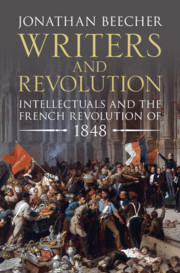

The revolution of 1848 has been described as the revolution of the intellectuals. In France, the revolution galvanised the energies of major romantic writers and intellectuals. This book follows nine writers through the revolution of 1848 and its aftermath: Alphonse de Lamartine, George Sand, Marie d'Agoult, Victor Hugo, Alexis de Tocqueville, Pierre-Joseph Proudhon, Alexander Herzen, Karl Marx, and Gustave Flaubert. Conveying a sense of the experience of 1848 as these writers lived it, this fresh and engaging study captures the sense of possibility at a time when it was not yet clear that the Second French Republic had no future. By looking closely at key texts in which each writer attempted to understand, judge, criticise, or intervene in the revolution, Jonathan Beecher shows how each endeavoured to answer the question posed explicitly by Tocqueville: Why, within the space of two generations, did democratic revolutions twice culminate in the dictatorship of a Napoleon?
'A truly remarkable book which will interest historians of France, of the revolution of 1848, of those who were thrilled by the change it promised, of those who feared it, and of their varying but universal disappointments. An excellent read and an important book.'
Patrice Higonnet - University of Harvard
'In 1848, France had a revolution, declared a republic, elected a dictator. This engaging book vividly evokes the hopes, expectations, and disappointments of a year when anything seemed possible. As we confront the weakness of liberal democracies today, a reminder of the lost radical ideas that preceded them could not be more timely.'
Rebecca Spang - Indiana University
'Jonathan Beecher's book is a brilliant summation of many years' thinking about the meaning of a revolution, which has remained enigmatic both for contemporaries and for us. The experience of 1848 is recounted through the reactions of nine of the most powerful writers of that time, from George Sand to Flaubert.'
Gareth Stedman Jones - University of Cambridge
‘At the heart of (this book) is a simple but powerful idea: to follow nine contemporary intellectuals … into the revolution, link arms with them as they pass through its euphoria, confusion and violence, and track their steps as they re-emerge into the post-revolutionary world.'
Christopher Clark Source: London Review of Books
‘This wonderful book demonstrates once again Jonathan Beecher’s deep knowledge of French political thought along with his considerable talents as an intellectual biographer. … an immensely learned, compelling, and beautifully crafted book.’
Edward Berenson Source: Journal of Modern History
Loading metrics...
* Views captured on Cambridge Core between #date#. This data will be updated every 24 hours.
Usage data cannot currently be displayed.
This section outlines the accessibility features of this content - including support for screen readers, full keyboard navigation and high-contrast display options. This may not be relevant for you.
Accessibility compliance for the PDF of this book is currently unknown and may be updated in the future.
