
Skip to main content Accessibility help
×
  • Cited by 6
    • Show more authors
    • Open Access
      You have access to this book
    • Select format
    • Publisher:
      Cambridge University Press
      Publication date:
      May 2024
      May 2024
      ISBN:
      9781009305815
      9781009305822
      9781009305846
      Creative Commons:
      Creative Common License - CC Creative Common License - BY Creative Common License - NC Creative Common License - ND
      This content is Open Access and distributed under the terms of the Creative Commons Attribution licence CC-BY-NC-ND 4.0.
      https://creativecommons.org/creativelicenses
      Dimensions:
      (229 x 152 mm)
      Weight & Pages:
      0.58kg, 302 Pages
      Dimensions:
      (229 x 152 mm)
      Weight & Pages:
      0.44kg, 304 Pages
    Open Access
    You have access to this book
    Selected: Digital
    View content
    Add to cart View cart Buy from Cambridge.org

    Book description

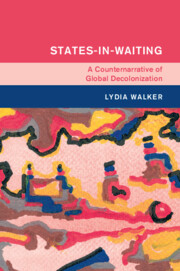
    After the Second World War, national self-determination became a recognized international norm, yet it only extended to former colonies. Groups within postcolonial states that made alternative sovereign claims were disregarded or actively suppressed. Showcasing their contested histories, Lydia Walker offers a powerful counternarrative of global decolonization, highlighting little-known regions, marginalized individuals, and their hidden (or lost) archives. She depicts the personal connections that linked disparate nationalist struggles across the globe through advocacy networks, demonstrating that these advocates had their own agendas and allegiances, which, she argues, could undermine the autonomy of the claimants they supported. By foregrounding particular nationalist movements in South Asia and Southern Africa and their transnational advocacy networks, States-in-Waiting illuminates the un-endings of decolonization—the unfinished and improvised ways that the state-centric international system replaced empire, which left certain claims of sovereignty perpetually awaiting recognition. This title is also available as Open Access on Cambridge Core.

    Awards

    Co-winner, 2025 The James J. Busuttil Medal and Prize for Human Rights, Royal Asiatic Society

    Reviews

    ‘In analyzing the history of ‘decolonization after decolonization,’ States-in-Waiting invites a salutary reconsideration of seemingly self-evident terms like ‘decolonization,’ ‘non-state actors,’ and even ‘states.’ The book's subjects range around the world and include some of the most interesting, if too-often-neglected, causes and characters of the late 20th century.’

    David C. Engerman - Yale University

    ‘Deeply researched and written with clarity, States-in-Waiting reconstructs the transnational advocacy networks and unexpected alliances through which nationalists groups sought to realize their vision of self-determination. Focusing on the delayed and denied projects of national independence, Lydia Walker’s study is a welcome intervention that recasts the constraints, unevenness, and failures of decolonization.’

    Adom Getachew - University of Chicago

    ‘States-in-Waiting is a fascinating account of an overlooked dimension of decolonization after the Second World War. Walker turns the spotlight on nationalist claimants within postcolonial states that sought international recognition for independent statehood and the activities of transnational advocates for their cause. Starting with the nationalist movement in postcolonial India for an independent Nagaland, this twinned history of claims-making and advocacy takes us to Zambia, Congo, Namibia. Along the way we encounter forgotten individuals of the age of decolonization-AJ Muste, Jayaprakash Narayan, Michael Scott-and institutions such as the World Peace Brigade. This brilliantly researched, carefully argued and readable book breaks new ground in the connected history of decolonization in Asia and Africa.’

    Srinath Raghavan - Ashoka University

    ‘Historians of decolonization tend to present the moment of independence as the culmination of nationalist struggles, and the achievement of political sovereignty as a triumph. But for many ethnic, regional, religious, linguistic, and other minority groups, decolonization was a tragedy which foreclosed their political futures, leaving them as perpetual ‘states-in-waiting.’ Lydia Walker’s fine new book seeks to theorize and recover the stories of some of these groups, highlighting ‘little-known regions, marginalized individuals, hidden or lost archives,’ and the loose transnational advocacy networks which connected them.’

    Brad Simpson Source: Diplomatic History

    ‘… will further enrich, and complicate, our assessment of the historical possibilities that decolonization opened and foreclosed. … historically minded international lawyers will find this book greatly enjoyable and will nod at the idea that we cannot sharply distinguish between imperial orderings of the world, and post-colonial orderings. And we certainly benefit from learning that the transition from the world of European empires to a world of largely independent states was midwifed by a universe of transnational actors whose own ideological proclivities, and political priorities, do not easily map onto the lofty rhetoric of liberation that we usually associate with decolonization.’

    Sannoy Das Source: American Journal of International Law

    ‘Walker presents readers with a query: how accurately has the progressive narrative of global decolonization after WW II reflected the reality? … States-in-Waiting reminds readers that the existing international power structures of the Cold War, particularly the UN, opposed nationalist efforts that challenged perceptions of what a new nation-state should look like. Walker makes this clash between Cold War realpolitik and idealistic nation-building clear and compelling … Highly recommended.’

    J. Rogers Source: Choice

    Refine List

    Actions for selected content:

    Select all | Deselect all
    • View selected items
    • Export citations
    • Download PDF (zip)
    • Save to Kindle
    • Save to Dropbox
    • Save to Google Drive

    Save Search

    You can save your searches here and later view and run them again in "My saved searches".

    Please provide a title, maximum of 40 characters.
    ×

    Contents

    Full book PDF
    • States-in-Waiting
      pp i-i
    • Global and International History - Series page
      pp ii-ii
    • States-in-Waiting - Title page
      pp iii-iii
    • A Counternarrative of Global Decolonization
    • Copyright page
      pp iv-iv
    • Contents
      pp v-v
    • Additional material
      pp vi-vi
    • Figures
      pp vii-viii
    • Maps
      pp ix-x
    • Acknowledgments
      pp xi-xiv
    • Naming Conventions
      pp xv-xvi
    • maps
      pp xvii-xviii
    • Introduction
      pp 1-26
    • Nation-Making
    • Part I - Nationalist Claims-Making
      pp 27-82
    • 1 - Sovereignty in the Hills
      pp 29-55
    • 2 - Advocates of Not-Quite Independence
      pp 56-82
    • Part II - International Advocacy
      pp 83-172
    • 3 - The Anti-Algiers
      pp 85-115
    • 4 - The Spectre of Katanga
      pp 116-142
    • 5 - Capital and Claims-Making
      pp 143-172
    • Part III - The Boundaries of Decolonization
      pp 173-229
    • 6 - Marching into the Great Wall of State
      pp 175-202
    • 7 - Postcolonial Imperialism
      pp 203-229
    • Conclusion
      pp 230-240
    • Bibliography
      pp 241-264
    • Index
      pp 265-284

    Metrics

    Altmetric attention score

    Full text views

    Total number of HTML views: 0
    Total number of PDF views: 0 *
    Loading metrics...

    Book summary page views

    Total views: 0 *
    Loading metrics...

    * Views captured on Cambridge Core between #date#. This data will be updated every 24 hours.

    Usage data cannot currently be displayed.

    Accessibility standard: Unknown

    Why this information is here

    This section outlines the accessibility features of this content - including support for screen readers, full keyboard navigation and high-contrast display options. This may not be relevant for you.

    Accessibility Information

    Accessibility compliance for the PDF of this book is currently unknown and may be updated in the future.
